
Penguins in Auckland Islands
Auckland Islands are linked here mainly with Yellow-eyed Penguin. Regional hubs with one species are still useful: they show the place-specific trap that bird is in.
Auckland Islands are part of the penguin world because the surrounding seas, nesting ground, and climate make life possible there. On this page that means one bird first: Yellow-eyed Penguin. Hoiho need quiet nest cover, dependable benthic foraging grounds, and enough adult survival in a very small population already under pressure from disease, predators, and disturbance.
Species in lens
1
Singleton hub — depth over breadth
Profile focus
Yellow-eyed Penguin
Up to 79 cm
Highest risk in view
Yellow-eyed Penguin
Endangered
Species profile entry
Auckland Islands are part of the penguin world because the surrounding seas, nesting ground, and climate make life possible there.
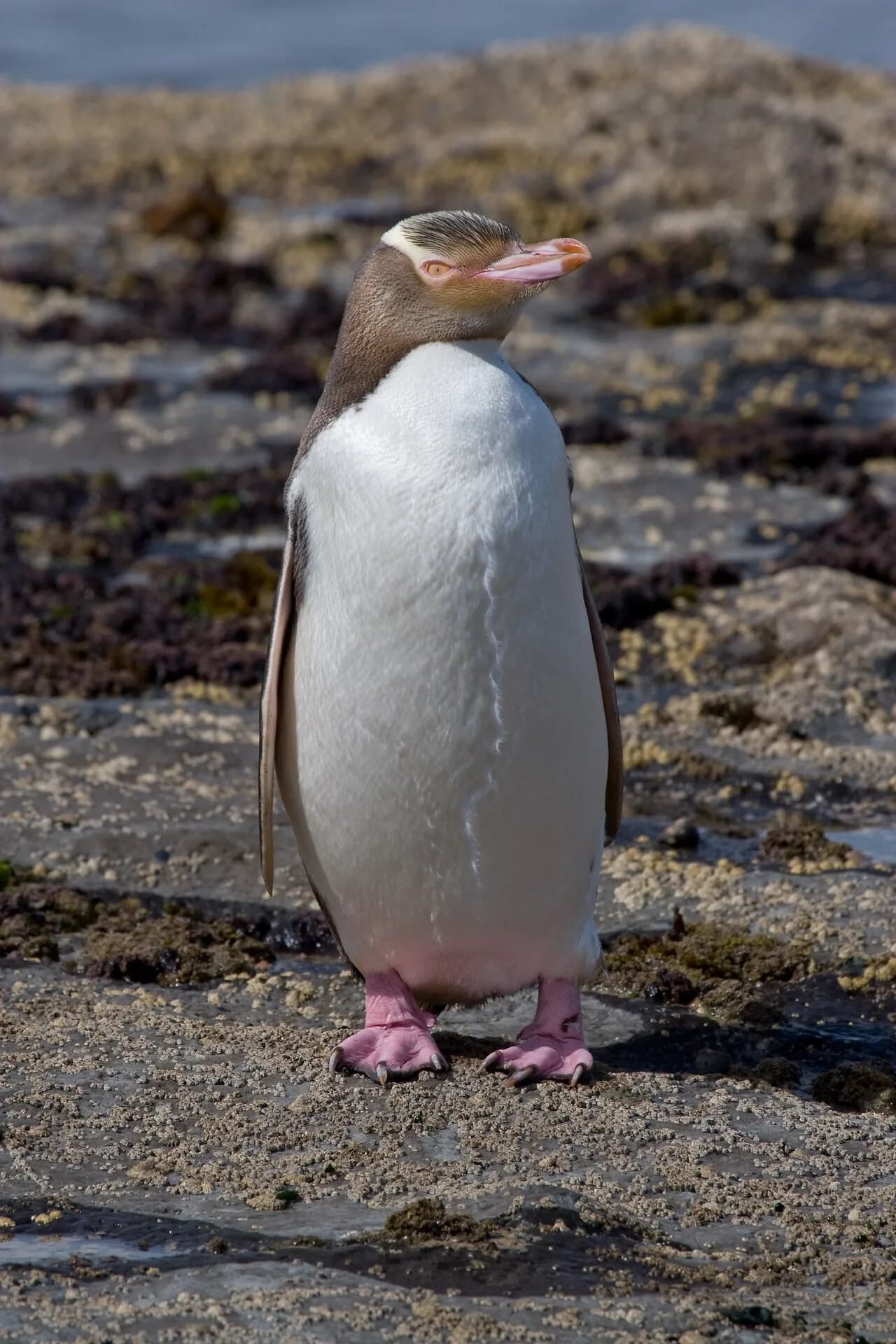
Signature insight
Yellow-eyed Penguins do not behave like tidy colony birds. They breed like private recluses, which makes every breeding pair feel expensive.
Open full Yellow-eyed Penguin profileWhat this view reveals
- Yellow-eyed Penguin is the only species in this region view right now.
- Hoiho need quiet nest cover, dependable benthic foraging grounds, and enough adult survival in a very small population already under pressure from disease, predators, and disturbance.
- Conservation: Endangered · ~3,400 individuals.
Understanding Penguins in Auckland Islands
Auckland Islands currently highlights one species in this catalogue: Yellow-eyed Penguin (Megadyptes antipodes). Yellow-eyed Penguins do not behave like tidy colony birds.
Survival brief: Hoiho need quiet nest cover, dependable benthic foraging grounds, and enough adult survival in a very small population already under pressure from disease, predators, and disturbance. Myth people still carry: Rarity makes Yellow-eyed Penguins delicate versions of ordinary penguins. What the evidence supports instead: Their vulnerability comes from a brutal stack of pressures, not from any lack of toughness. They are strong birds surviving in a very bad equation.
Field numbers: 62–79 cm, 4.5–8.5 kg, lifespan about 8–25 years. Status Endangered; population ~3,400 individuals; trend decreasing.
Where and what: ranges include New Zealand, Auckland Islands, and Campbell Islands; habitats Coastal forests, Scrubland, and Sandy beaches; diet fish, squid, and crustaceans. Classified as Endangered by the IUCN and listed as threatened under U.S. Open the full profile for sources, research gaps, and related species.
Frequently asked questions
Which penguins live in Auckland Islands?
In this catalogue, Yellow-eyed Penguin is the species tied to this region page. Known as Hoiho ('noise shouter') in Māori, this large, pale-faced penguin endemic to New Zealand is one of the world's rarest, unique among penguins for being largely solitary and nesting out of sight of others.
What is the main survival problem for Yellow-eyed Penguin?
Hoiho need quiet nest cover, dependable benthic foraging grounds, and enough adult survival in a very small population already under pressure from disease, predators, and disturbance.
What is the conservation status of Yellow-eyed Penguin?
Yellow-eyed Penguin is listed as Endangered, with an estimated population of ~3,400 individuals. Trend: decreasing. Classified as Endangered by the IUCN and listed as threatened under U.S.