The oldest penguins we have found were already too late to show us the moment flight was lost. By the time their bones entered the fossil record, these birds were swimmers. That was more than 60 million years ago, long before the growth of the great polar ice sheets.1
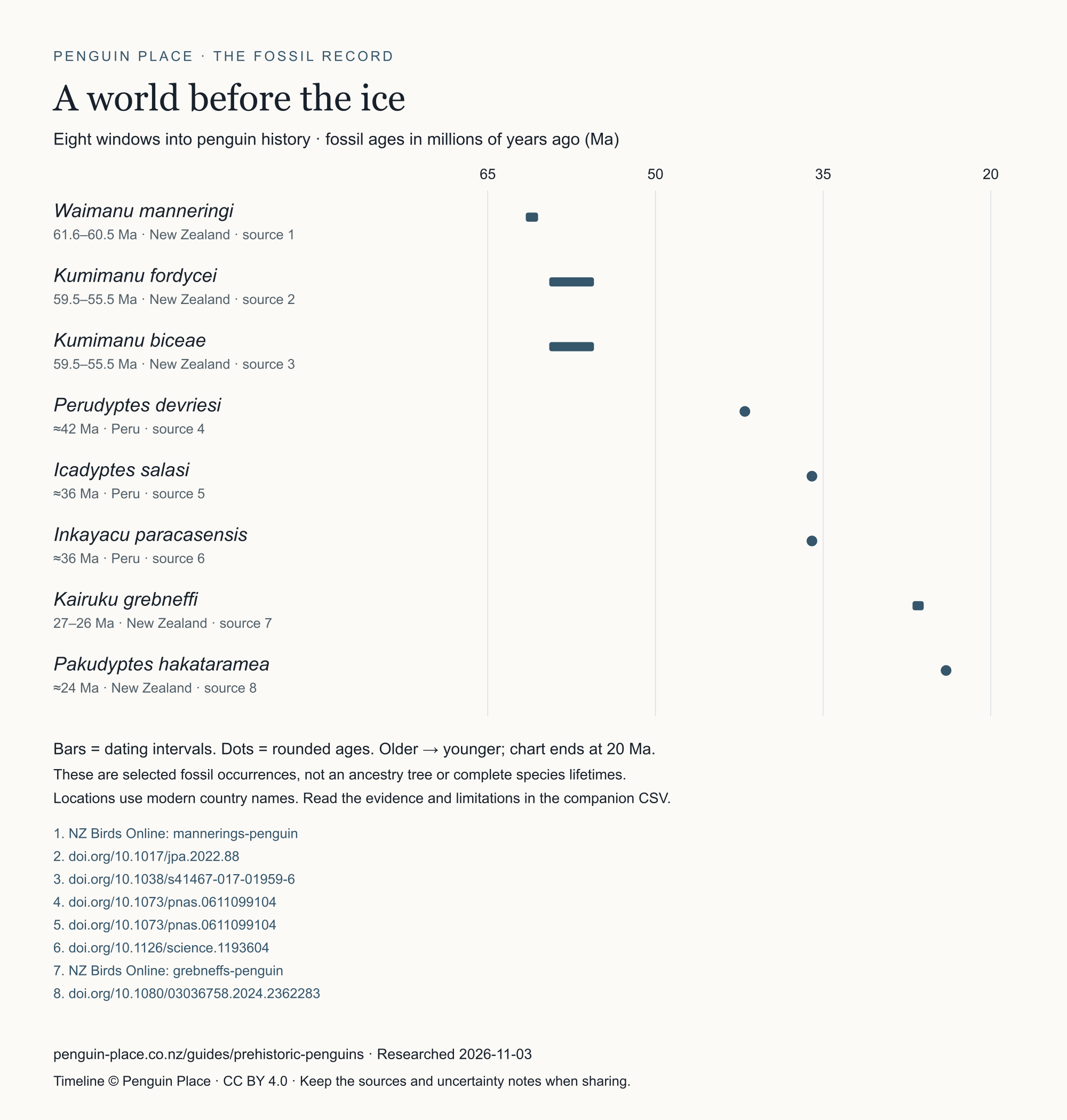
What followed was a much less familiar cast: enormous penguins, long-beaked penguins, and a tiny bird known from just three bones. One fossil even preserves evidence of feather colour. Start with a discovery in the timeline above, or follow the story below.
The first penguins were already divers
Nine bones are enough to open a very old chapter.
An associated partial skeleton from the Waipara River in North Canterbury belongs to Waimanu manneringi. Its pelvis, vertebrae and right-leg bones come from deposits dated to 61.6–60.5 million years ago. This was a flightless penguin, roughly emperor-sized, living in what is now New Zealand.2
Calling it “the first penguin” would go further than the evidence allows. The oldest fossil we happen to find is not necessarily the first member of a lineage. New specimens can push the record back or change how its earliest branches fit together. A 2025 study of other Waipara fossils did exactly the latter, adding several previously unnamed early penguins.3
For now, the firm starting point is simple: penguins had become diving birds very early in their history. The transition itself remains harder to catch in the rocks.1
Giants arrived early
There was no long wait for the heavyweights. Kumimanu fordycei comes from New Zealand deposits 59.5–55.5 million years old. Its partial skeleton includes an enormous humerus—the upper arm bone inside a flipper.4
Researchers used two measurements of that bone to estimate body mass. Length gave 148 kg; width near the shoulder gave about 160 kg. Those are separate model estimates, each with its own uncertainty, rather than the endpoints of a measured weight range.4
The bone supports a bird far heavier than a living emperor. It does not give us an exact standing height. For the size calculations and comparisons with other giants, see the largest penguins.
A fossil is not a finished penguin
A reconstruction makes an extinct animal look complete. The specimen behind it may be anything but.
In the published plate below, the lump of rock at upper left contains parts of Kumimanu biceae, another early giant. The other panels isolate bones, show CT views and compare specimens. Dotted lines supply missing outlines. Those lines are doing something important: marking the boundary between the preserved bone and its reconstruction.5
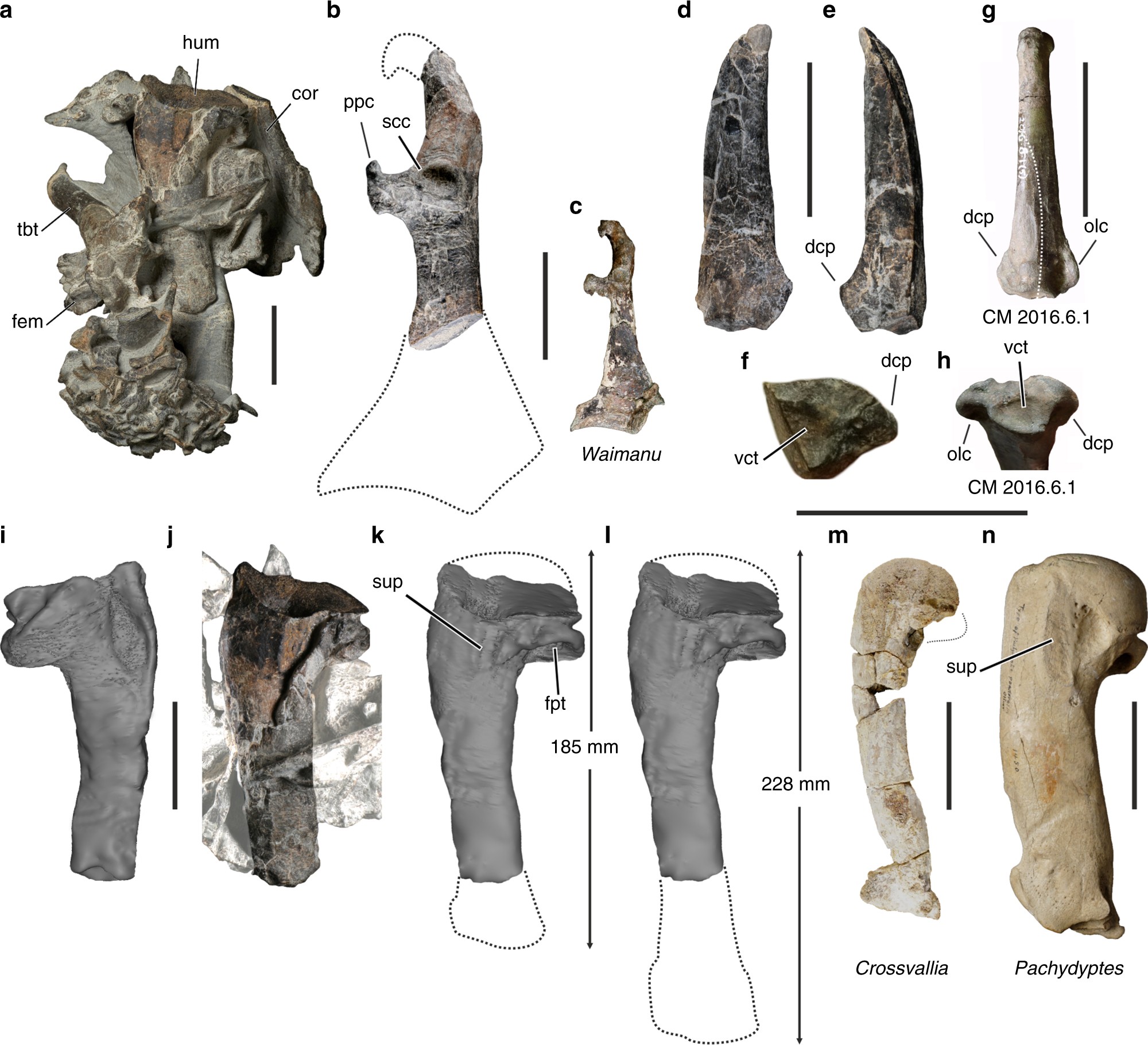 Open full-size fossil plate
Notice how much work sits between that rock and a lifelike penguin. Researchers identify the surviving parts, compare their shapes with other skeletons, and estimate what is missing. Our penguin skeleton guide helps locate the humerus, shoulder and leg bones inside a living bird.
A fossil can strongly support “very large penguin” while leaving its standing posture or feather pattern unresolved. An illustration should make those gaps understandable, rather than quietly turn them into facts.
Penguins in a warmer world
Peru adds a useful correction to the ice-bound penguin stereotype. Perudyptes devriesi, around 42 million years old, and the long-beaked giant Icadyptes salasi, around 36 million years old, lived at low latitudes during greenhouse conditions.6
The sites were roughly 14° south of the equator. These fossils helped overturn the idea that penguins reached such latitudes only much later, after major cooling. A polar climate was not a prerequisite for every ancient penguin—or every giant.6
The locations in our timeline use modern place names. They are discovery sites, not a map of ancient shorelines or the full ranges of the birds.
The feathers that changed the picture
Most reconstructions have to borrow their feather colours. Inkayacu paracasensis gives researchers something rarer to work with.
This roughly 36-million-year-old Peruvian penguin preserved feathers and scales alongside its skeleton. Its feathers already had structural features suited to swimming. Under a microscope, they also contained traces of melanosomes: tiny pigment-bearing structures.7
Comparing their shapes and dimensions with those of living birds pointed to grey and reddish-brown colours in the sampled feathers.7
That last qualification matters. The evidence includes feathers from the underside of a flipper and loose body feathers whose original positions are unknown. It cannot supply a complete colour scheme for Inkayacu, let alone dress every extinct penguin in the same coat. The discovery gives us patches of colour, with the rest still blank.8
The ancient penguin that was small
Even among the large birds, the familiar emperor outline is a poor universal template. Kairuku grebneffi, from 27–26-million-year-old New Zealand deposits, had a long bill and slender proportions. Its skeletons help reveal a body plan that differs from living penguins; the colours in an artist’s reconstruction remain speculative.9
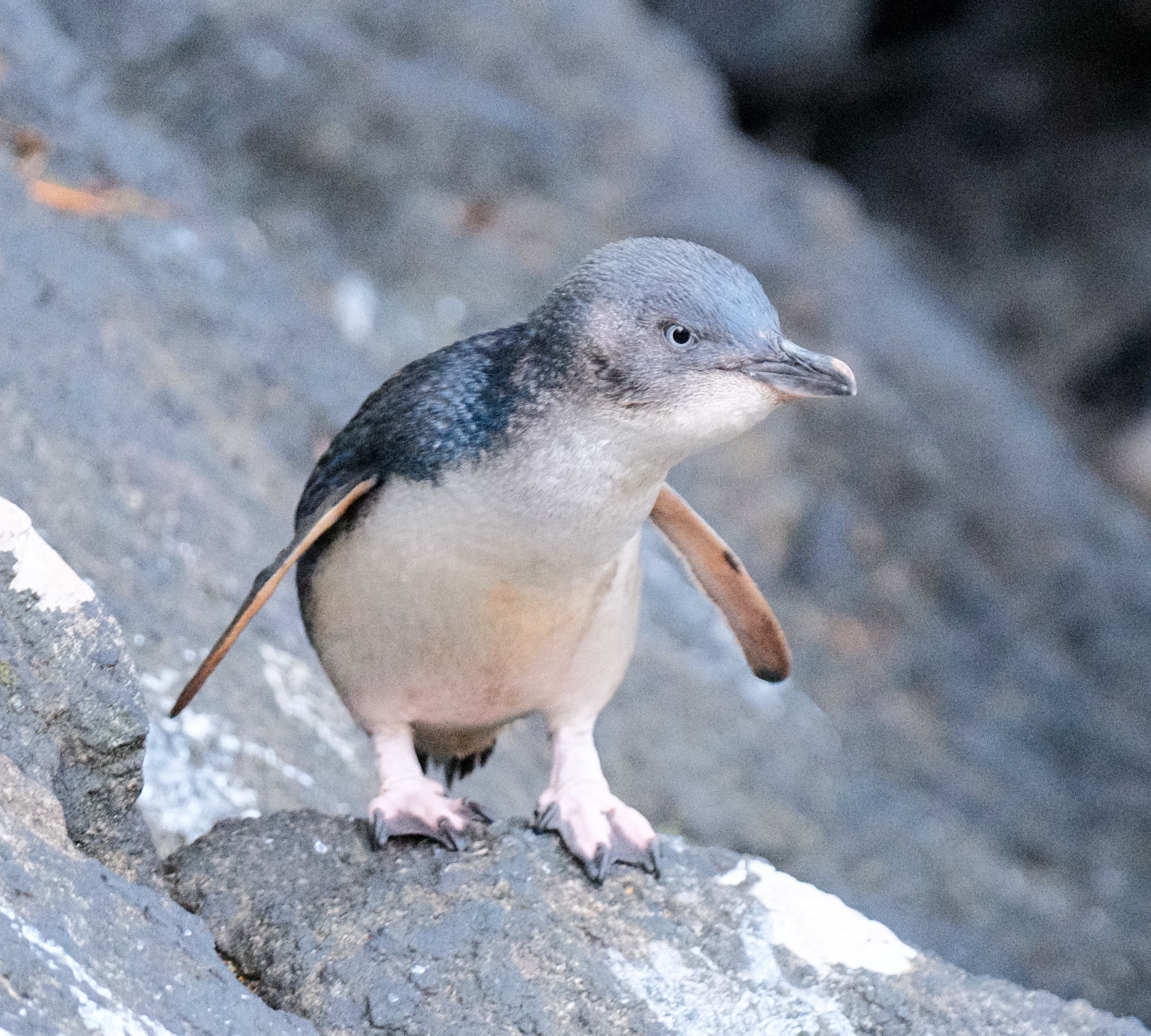
Then there is Pakudyptes hakataramea. About 24 million years ago, a penguin roughly the size of today’s little penguins lived in what is now South Canterbury. Its description rests on three bones: a humerus, an ulna and a femur—two from the wing, one from the thigh.10
Small does not mean uninformative. The shoulder joint resembles those of modern penguins, while the elbow retains features seen in older fossil penguins. That combination helps researchers trace changes in wing structure. It does not prove this bird was the direct ancestor of the Little Blue Penguin.10
Penguin history contains several experiments in size and shape. It cannot be reduced to a row of giants gradually shrinking.
Where did the giants go?
We have evidence that giant penguins existed. Explaining why their lineages disappeared is harder.
Researchers discuss changes in climate and ocean ecosystems, alongside the diversification of marine mammals that might have competed for food or preyed on penguins. But overlap in timing does not establish a cause. “Seals wiped them out” turns a hypothesis into a verdict the fossils cannot yet support.11
Different giant lineages lived in different places and times. There need not have been one universal reason for all of them to vanish. Gaps in the record make those individual histories difficult to reconstruct.11
The family tree is still being redrawn
“Prehistoric penguin” is an informal description, not the name of one branch of the family tree.
Scientists call the last common ancestor of all living penguins, and all its descendants, the crown group. Extinct penguin relatives outside that group belong to the stem. A stem penguin need not be a direct ancestor of any living species, and the species on our timeline are not a chain of parents and descendants.1
A 2022 analysis combining fossils and genomes estimated the crown group’s origin at about 14 million years ago. That is a model-based date for a particular branch, not the age of penguins as a whole. The lineage already had a long fossil history by then.1
New discoveries keep changing that history. In 2025, researchers named four additional early species from the Waipara Greensand, including Daniadyptes primaevus and Waiparadyptes gracilitarsus. Exceptionally preserved bones supplied new evidence about early diversity and the development of diving adaptations.3
The next useful fossil may fill a missing joint, change a name, or move a branch. It does not have to break a size record to change the story.
Keep the fossil timeline
Download the timeline for a lesson, reference sheet or conversation starter. The companion table includes all eight records, the evidence behind each interpretation, uncertainty notes and links to the sources.
Researched 3 November 2026. Ages are in millions of years before present; ranges describe dating uncertainty, not species lifetimes. Place names refer to present-day locations. Penguin Place timeline: CC BY 4.0. Keep the sources and explanatory notes when sharing.
References
-
Cole et al. (2022). Genomic insights into the secondary aquatic transition of penguins. Nature Communications 13: 3912. The crown-group date is an estimate from this analysis. https://doi.org/10.1038/s41467-022-31508-9 ↩ ↩2 ↩3 ↩4
-
NZ Birds Online. Mannering’s penguin — Waimanu manneringi. Specimen and age account. https://www.nzbirdsonline.org.nz/species/mannerings-penguin ↩
-
Mayr et al. (2025). Multiple exceptionally preserved fossils from the Paleocene Waipara Greensand inform the diversity of the oldest stem group Sphenisciformes and the formation of their diving adaptations. Zoological Journal of the Linnean Society 204(4): zlaf080. https://doi.org/10.1093/zoolinnean/zlaf080 ↩ ↩2
-
Ksepka et al. (2023). Largest-known fossil penguin provides insight into the early evolution of sphenisciform body size and flipper anatomy. Journal of Paleontology 97(2): 434–453. https://doi.org/10.1017/jpa.2022.88 ↩ ↩2
-
Mayr et al. (2017). A Paleocene penguin from New Zealand substantiates multiple origins of gigantism in fossil Sphenisciformes. Nature Communications 8: 1927. Figure 1 reproduced under CC BY 4.0. https://doi.org/10.1038/s41467-017-01959-6 ↩
-
Clarke et al. (2007). Paleogene equatorial penguins challenge the proposed relationship between biogeography, diversity, and Cenozoic climate change. PNAS 104(28): 11545–11550. https://doi.org/10.1073/pnas.0611099104 ↩ ↩2
-
Clarke et al. (2010). Fossil evidence for evolution of the shape and color of penguin feathers. Science 330(6006): 954–957. https://doi.org/10.1126/science.1193604 . See also the authors’ university report: https://www.jsg.utexas.edu/news/2010/09/fossilized-giant-penguin-reveals-unusual-colors-sheds-light-on-bird-evolution/ ↩ ↩2
-
Ksepka (2010). Three Discoveries, Part III: Fossil Color. Co-author’s explanation of which feathers were sampled and the limits of a whole-body colour reconstruction. https://fossilpenguins.wordpress.com/2010/10/11/three-discoveries-part-iii-fossil-color/ ↩
-
Ksepka et al. (2012). New fossil penguins (Aves, Sphenisciformes) from the Oligocene of New Zealand reveal the skeletal plan of stem penguins. https://doi.org/10.1080/02724634.2012.652051 . Specimen and age account: https://www.nzbirdsonline.org.nz/species/grebneffs-penguin . Author explanation: https://www.otago.ac.nz/geology/research/paleontology/kairuku-a-new-giant-late-oligocene-penguin-from-new-zealand ↩
-
Ando et al. (2024). A new tiny fossil penguin from the Late Oligocene of New Zealand and the morphofunctional transition of the penguin wing. https://doi.org/10.1080/03036758.2024.2362283 . Author explanation: https://www.otago.ac.nz/news/newsroom/fossil-reveals-how-penguins-wings-evolved ↩ ↩2
-
Pelegrín & Acosta Hospitaleche (2022). Evolutionary and biogeographical history of penguins (Sphenisciformes): review of the dispersal patterns and adaptations in a geologic and paleoecological context. Diversity 14(4): 255. https://doi.org/10.3390/d14040255 ↩ ↩2