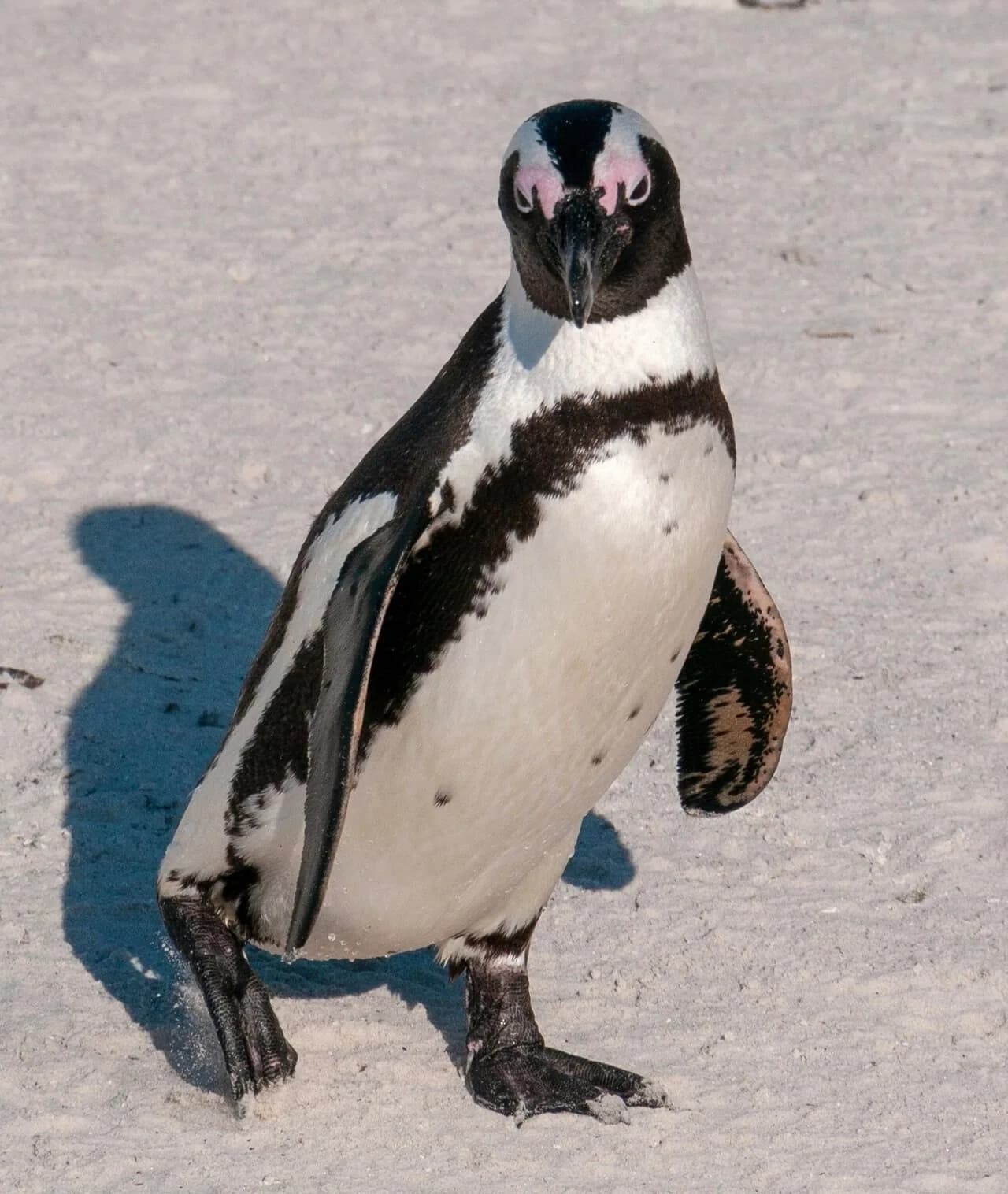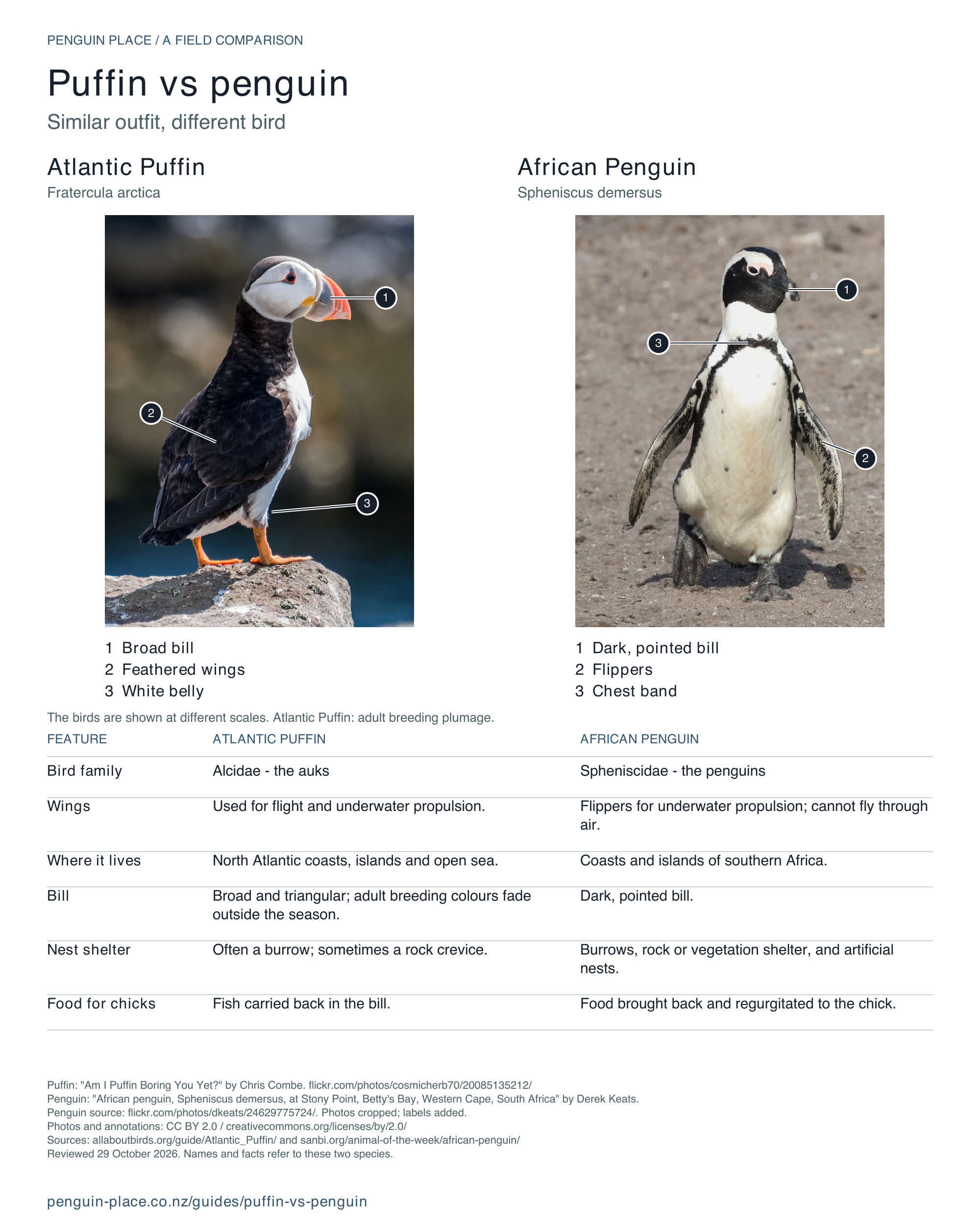
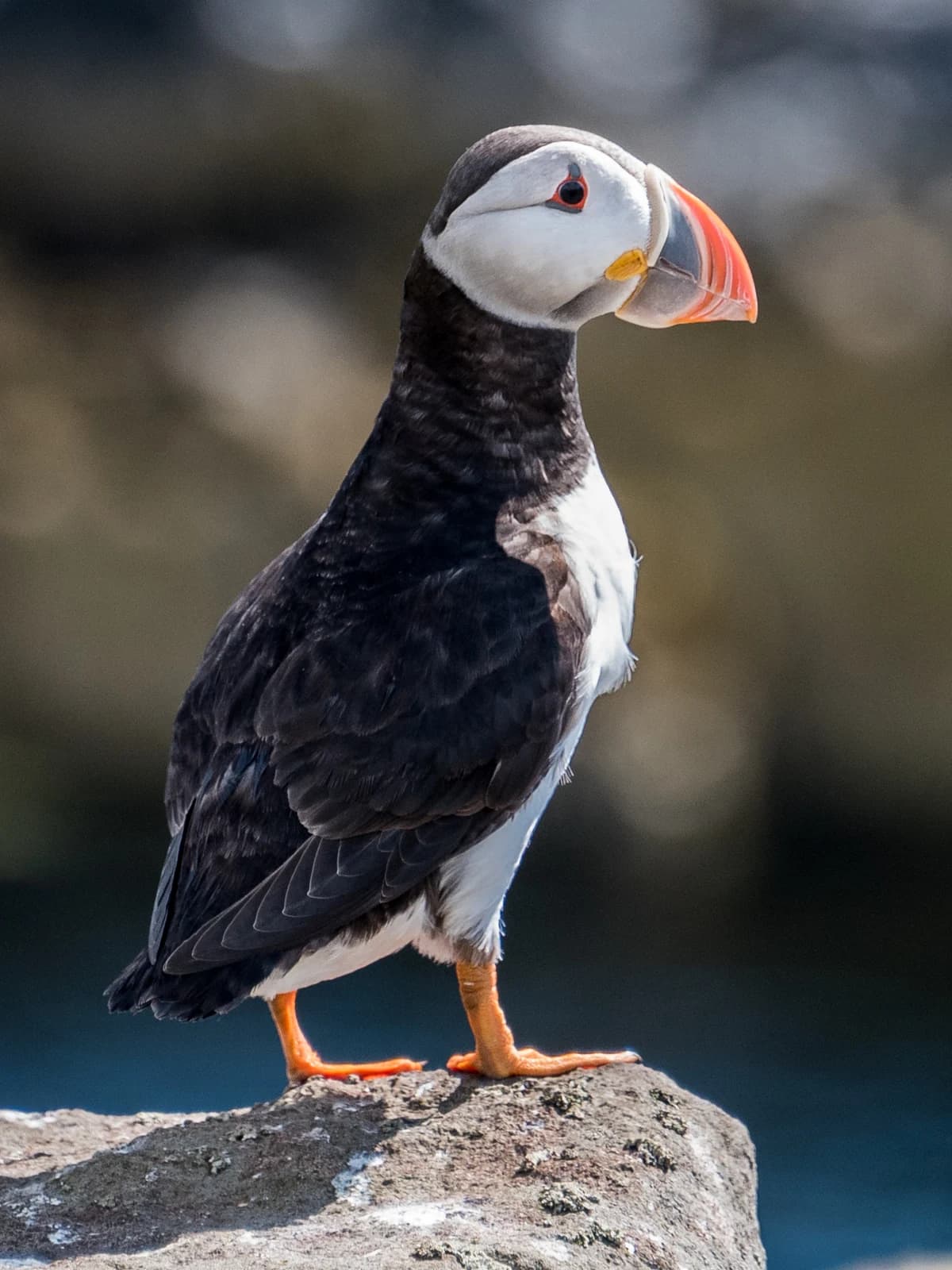
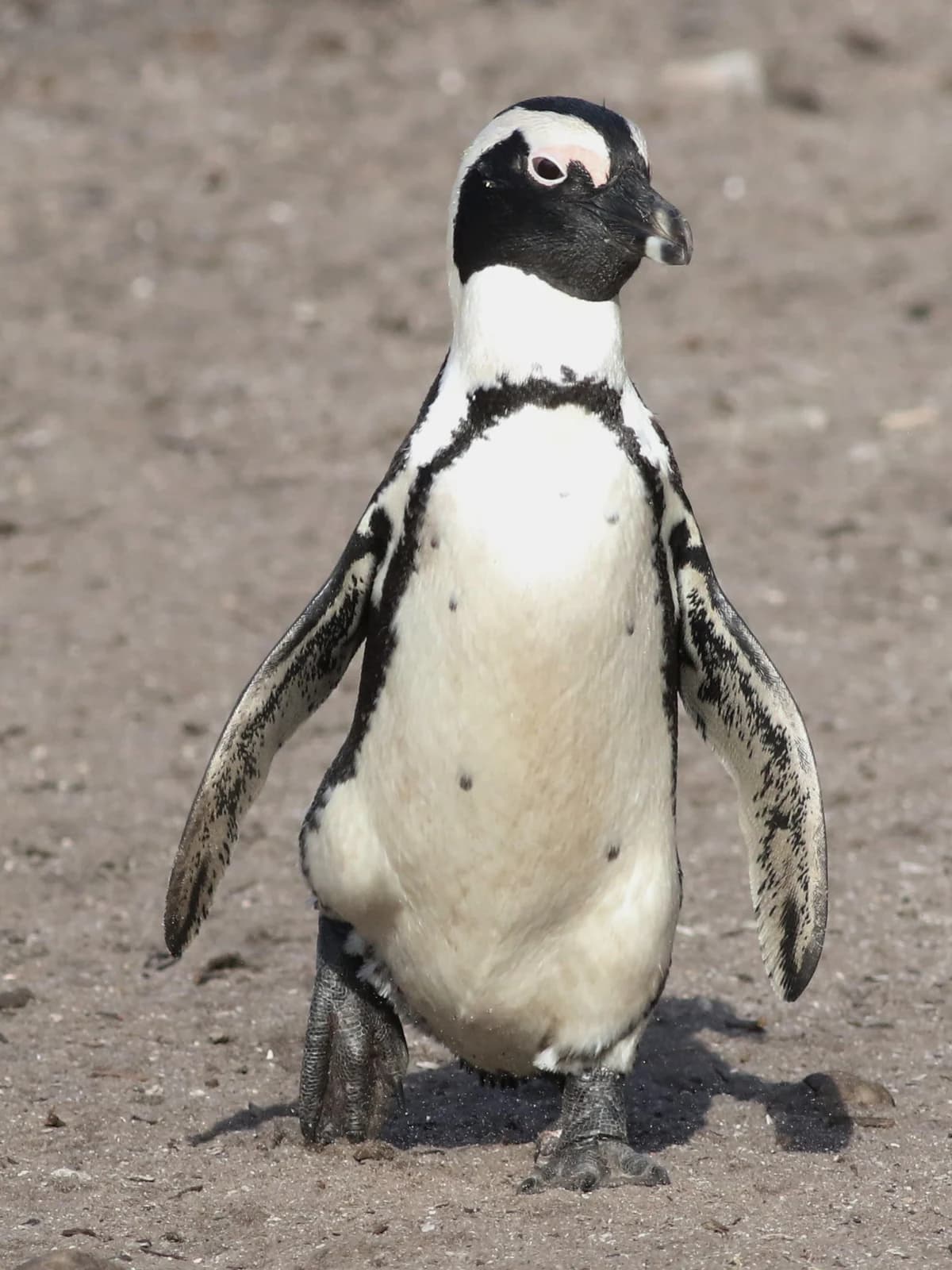
The resemblance is easiest to see when the birds are standing still: dark backs, pale fronts, feet set beneath an upright body. Put an Atlantic Puffin beside an African Penguin and the shared colours catch your eye before the differences do.
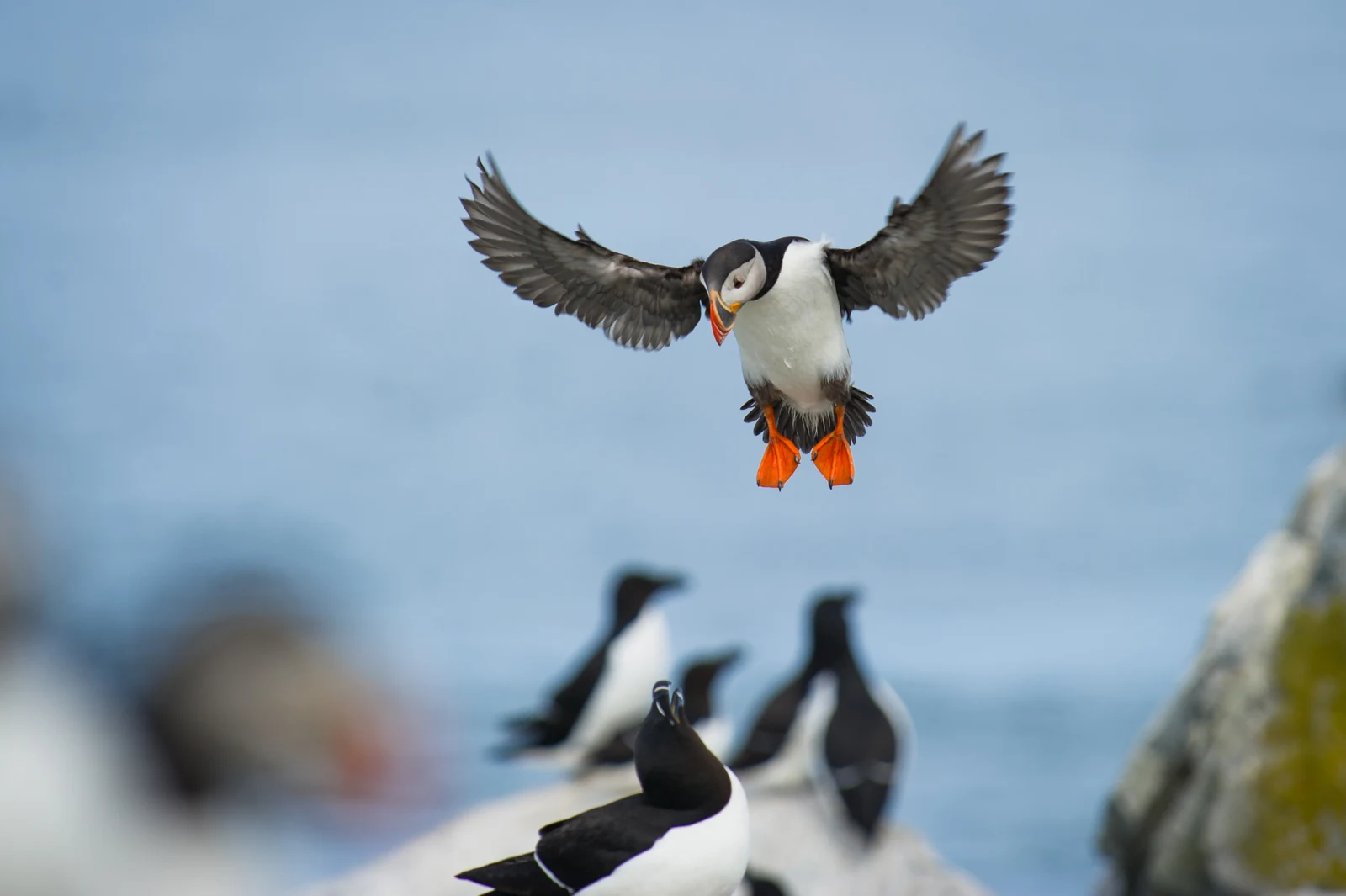
Look at the wings and the difference becomes clearer. The puffin unfolds a spread of flight feathers. The penguin's wing is a narrow, flattened flipper. That contrast is easy to miss when the puffin has its wings folded against its sides.12
How to tell them apart
Start with the bill. An adult Atlantic Puffin in breeding plumage has a deep, triangular bill with bright bands of colour. Its head looks large on a short neck. An adult African Penguin has a dark bill, pink skin above the eyes and a curved black band across its white chest.32
The puffin's appearance changes through the year. Outside the breeding season, the face becomes greyer and the bill loses some of its bright colouring. Young puffins also have smaller, less conspicuous bills. A winter bird may look quite different from the one on a summer postcard.3
Those field marks belong to the Atlantic Puffin and African Penguin pictured above. Other penguins have different head markings and bill colours; other puffins have different plumage. Size is difficult to judge in a photograph with nothing nearby for scale.
| Feature | Atlantic Puffin | African Penguin |
|---|---|---|
| Bird family | Alcidae — the auks | Spheniscidae — the penguins |
| Wings | Used for flight and underwater propulsion. | Flippers for underwater propulsion; cannot fly through air. |
| Where it lives | North Atlantic coasts, islands and open sea. | Coasts and islands of southern Africa. |
| Bill | Broad and triangular; adult breeding colours fade outside the season. | Dark, pointed bill. |
| Nest shelter | Often a burrow; sometimes a rock crevice. | Burrows, rock or vegetation shelter, and artificial nests. |
| Food for chicks | Fish carried back in the bill. | Food brought back and regurgitated to the chick. |
The wings explain the biggest difference
A puffin swimming after fish does not simply paddle with its feet. It beats its wings beneath the surface, with the feet helping it steer. That same bird can rise into the air on short wings, beating them rapidly to stay aloft.43
A penguin takes the swimming specialisation further. Its wing is flattened into a flipper, with restricted joint movement. It is still a wing: the upper-arm, forearm and hand regions remain inside.5 The penguin skeleton guide lets you follow that framework beneath the feathers. A swimming flipper can also bend and twist; calling it stiff does not mean it is completely rigid.6
Air and water ask very different things of a wing. In air, the bird needs enough lift to support its weight. Underwater, it moves through a much denser fluid. The wing shape and body size that work well for one kind of movement can make the other more demanding.
Researchers tested part of this trade-off in a 2013 study of thick-billed murres, another kind of auk, and pelagic cormorants. Flying was extremely costly for the murres, while their wing-propelled dives cost relatively little energy. Even so, the murres' diving costs remained higher than those of penguins in the comparison. The results supported the idea that increasing specialisation for underwater propulsion can make aerial flight prohibitively expensive.7
These measurements support a broader explanation for wing-propelled diving. They do not give an exact flight cost for puffins. For the longer history of penguin flightlessness, see can penguins fly?.
A familiar pattern, a different family
Puffins belong to Alcidae, the auk family, alongside murres and razorbills. Penguins belong to Spheniscidae, a separate seabird family.15
Different bird lineages independently developed wings suited for underwater propulsion, an example of convergent adaptation. They started with the inherited framework of a bird's wing, then modified it for swimming. Similar demands at sea can produce similarities between birds on different branches of the family tree.5
The dark back and pale belly are known as countershading. The usual explanation is camouflage: a dark back blends with the water below, while a pale belly is less conspicuous against the bright surface above.8
Even the matching outfit has exceptions. A Tufted Puffin has a dark belly as well as a dark back. Its breeding plumage includes a white face and long yellow head plumes. “Black-and-white seabird” describes our Atlantic Puffin well, but leaves out much of what puffins can look like.9
Where they live
Atlantic Puffins breed around the North Atlantic. Horned and Tufted Puffins live in the North Pacific, including coasts and islands around Alaska and eastern Asia.10
Penguins are predominantly birds of southern seas, with breeding areas ranging from Antarctica and sub-Antarctic islands to southern Africa, South America, Australia and New Zealand.11 The African Penguin pictured here lives along the coasts and islands of southern Africa. Its home is a reminder that penguins do not require an icy landscape.2
- 1. North Atlantic
Atlantic Puffins breed around the North Atlantic, from eastern North America to Greenland, Iceland and north-western Europe. Source
- 2. North Pacific
Horned and Tufted Puffins occur around the northern Pacific, including parts of eastern Asia and North America. Source
- 3. Galápagos Islands
Galápagos Penguins live around the equator. Some colonies on northern Isabela are in the Northern Hemisphere. Source
- 4. South America
Humboldt Penguins breed along Peru and Chile; Magellanic Penguins breed farther south, around Chile and Argentina. Source
- 5. Southern Africa
African Penguins breed along the coasts of Namibia and South Africa. Source
- 6. Southern Australia
Little penguins breed along southern Australian coasts, including Tasmania. Source
- 7. New Zealand
Little Blue, Yellow-eyed and Fiordland Penguins breed on the mainland; other species breed on offshore islands. Source
- 8. Subantarctic islands
Island groups across the Southern Ocean support species including King and Macaroni Penguins. Source
- 9. Antarctica
Penguins breed along Antarctic coasts and the Peninsula. Emperor Penguins also breed on coastal sea ice. Source
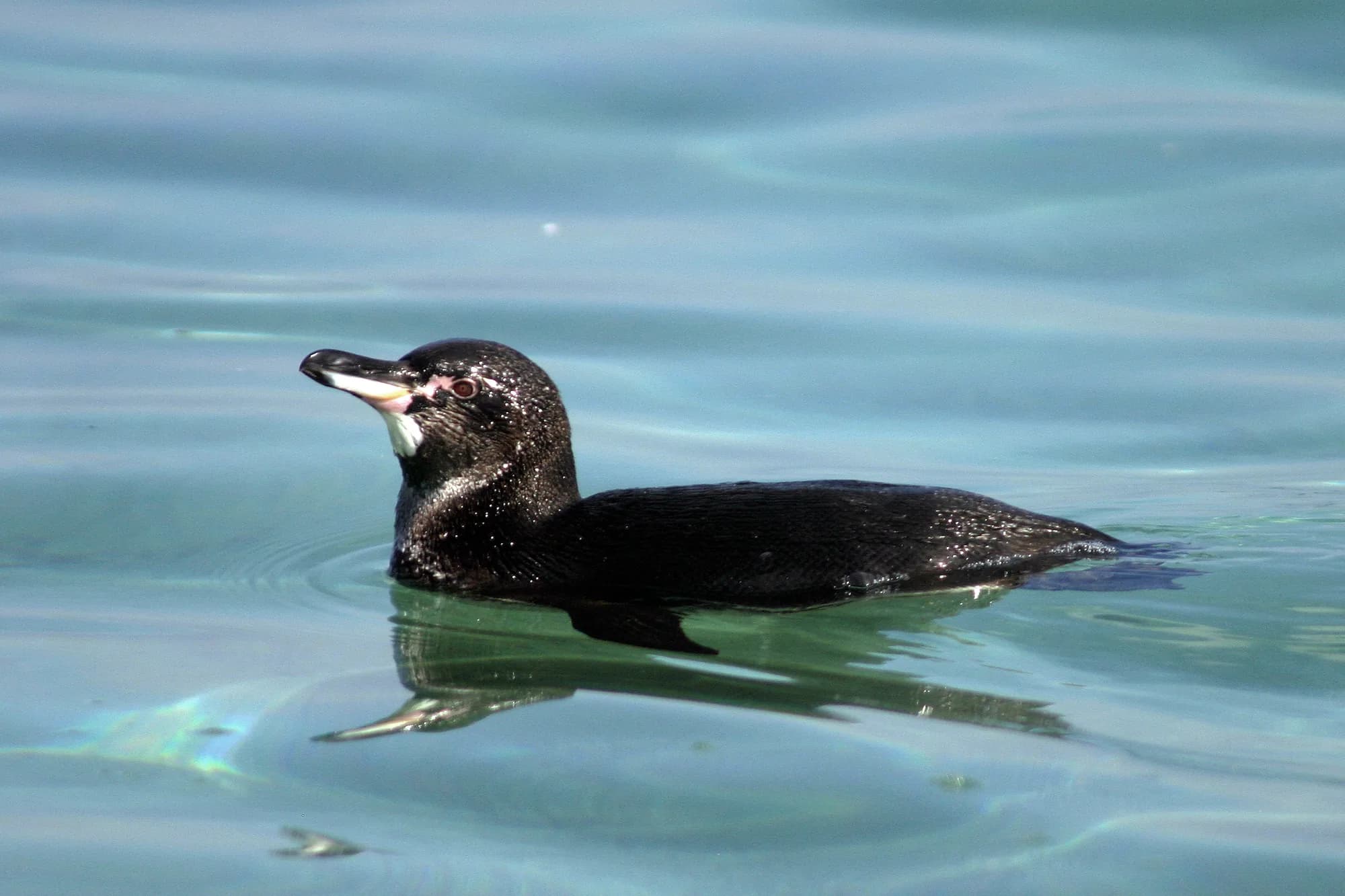
There is also a small but important exception to the north–south shorthand. Galápagos Penguins live around the equator, and colonies on northern Isabela occur in the Northern Hemisphere. Saying that every penguin lives south of the equator would put those birds on the wrong side of an imaginary line.12
The map marks broad regions and selected breeding areas. Our guide to where penguins live follows the penguin regions in more detail, including the feeding waters that make those colonies possible.
Bringing dinner back to the nest
An Atlantic Puffin returning to its chick can carry several small fish crosswise in its bill. The fish may have been caught during the same dive. Structures on the tongue and roof of the mouth help hold them in place while the bird catches more.4
The puffin chick usually waits in a burrow, although some colonies use rock crevices. African Penguins also use burrows, shelter among rocks or vegetation, and artificial nests.42
At an African Penguin nest, the parent regurgitates food directly into the chick's beak. The meal has travelled back inside the adult, ready to be delivered when it reaches the nest.2
Keep the comparison
Download the labelled bird pair and quick comparison as a high-resolution image or printable sheet. Each version includes the species names, photograph credits and a link back to this guide.
The sheet includes species names, sources and photo credits. Photos and Penguin Place annotations are available under CC BY 2.0; keep the credits when sharing and indicate any changes.
References
-
Cornell Lab of Ornithology. Atlantic Puffin: Overview. https://www.allaboutbirds.org/guide/Atlantic_Puffin/overview ↩ ↩2
-
South African National Biodiversity Institute (2018). African penguin. Used for identification, range, nesting and chick feeding, not its dated conservation assessment. https://www.sanbi.org/animal-of-the-week/african-penguin/ ↩ ↩2 ↩3 ↩4 ↩5
-
Cornell Lab of Ornithology. Atlantic Puffin: Identification. https://www.allaboutbirds.org/guide/Atlantic_Puffin/id ↩ ↩2 ↩3
-
Cornell Lab of Ornithology. Atlantic Puffin: Life History. https://www.allaboutbirds.org/guide/Atlantic_Puffin/lifehistory ↩ ↩2 ↩3
-
Watanabe, J., Field, D.J. & Matsuoka, H. (2021; published online 2020). Wing Musculature Reconstruction in Extinct Flightless Auks (Pinguinus and Mancalla) Reveals Incomplete Convergence with Penguins (Spheniscidae) Due to Differing Ancestral States. Integrative Organismal Biology 3: obaa040. https://doi.org/10.1093/iob/obaa040 ↩ ↩2 ↩3
-
Harada, N. et al. (2021). Kinematics and hydrodynamics analyses of swimming penguins: wing bending improves propulsion performance. Journal of Experimental Biology 224: jeb242140. https://doi.org/10.1242/jeb.242140 ↩
-
Elliott, K.H. et al. (2013). High flight costs, but low dive costs, in auks support the biomechanical hypothesis for flightlessness in penguins. PNAS 110: 9380–9384. https://doi.org/10.1073/pnas.1304838110 ↩
-
Smithsonian Ocean (2017). Galapagos Penguin from Above. https://ocean.si.edu/ocean-life/seabirds/galapagos-penguin-above ↩
-
Cornell Lab of Ornithology. Tufted Puffin: Identification. https://www.allaboutbirds.org/guide/Tufted_Puffin/id ↩
-
Trust for Avian Systematics. Alcidae: Auks. H&M4 checklist. https://www.aviansystematics.org/checklist?viewfamilies=63 ↩
-
Smithsonian Ocean. Penguins. Used for broad geographical range, not numerical species counts or conservation estimates. https://ocean.si.edu/ocean-life/seabirds/penguins ↩
-
Galápagos Conservation Trust. Galápagos penguin. https://galapagosconservation.org.uk/species/galapagos-penguin/ ↩