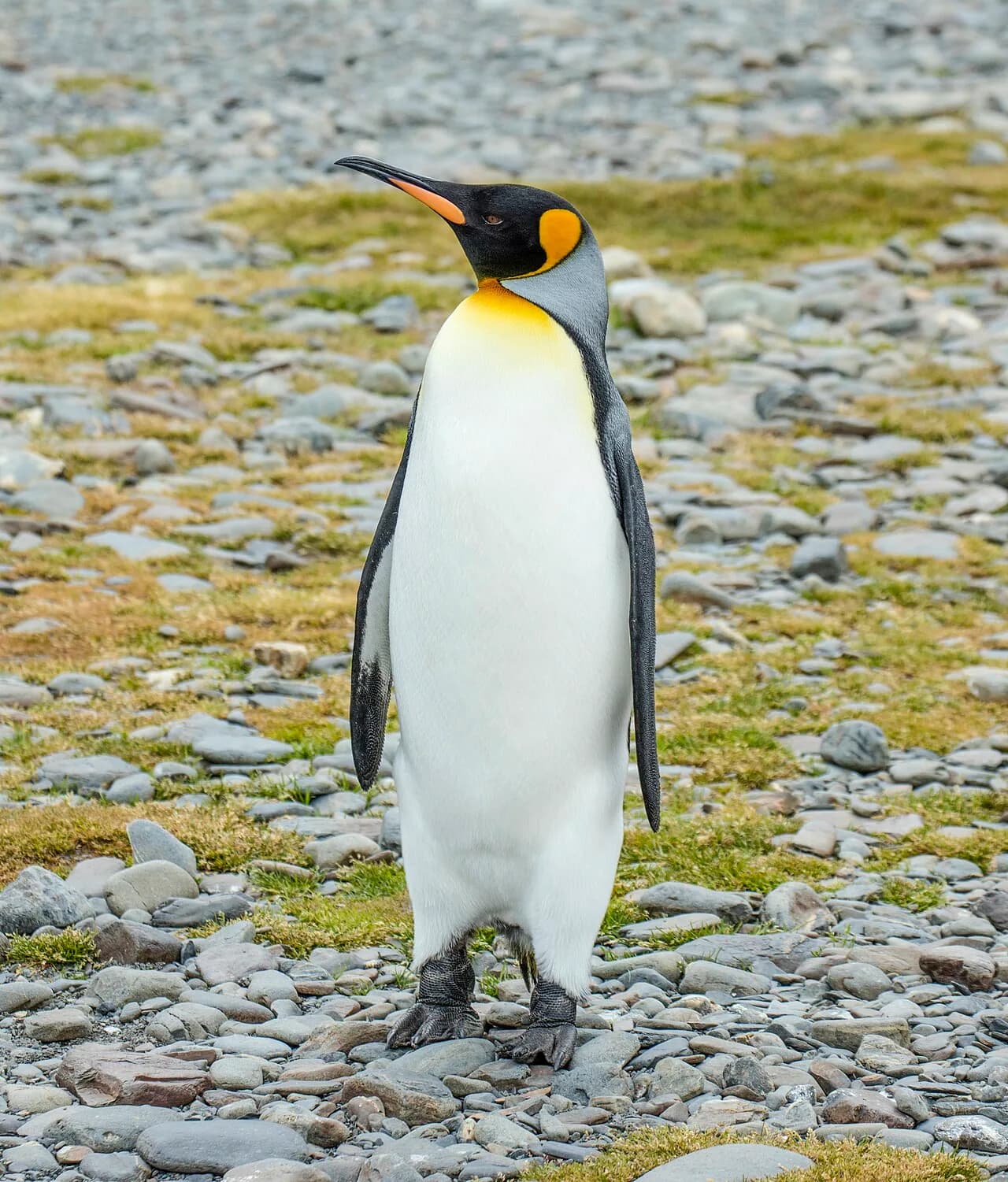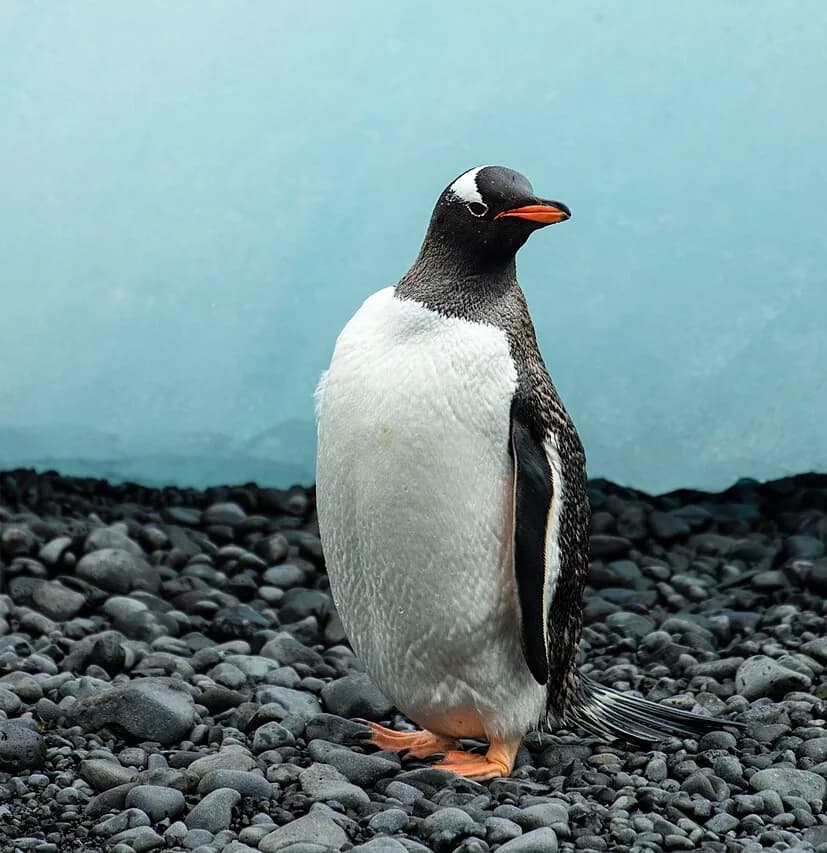
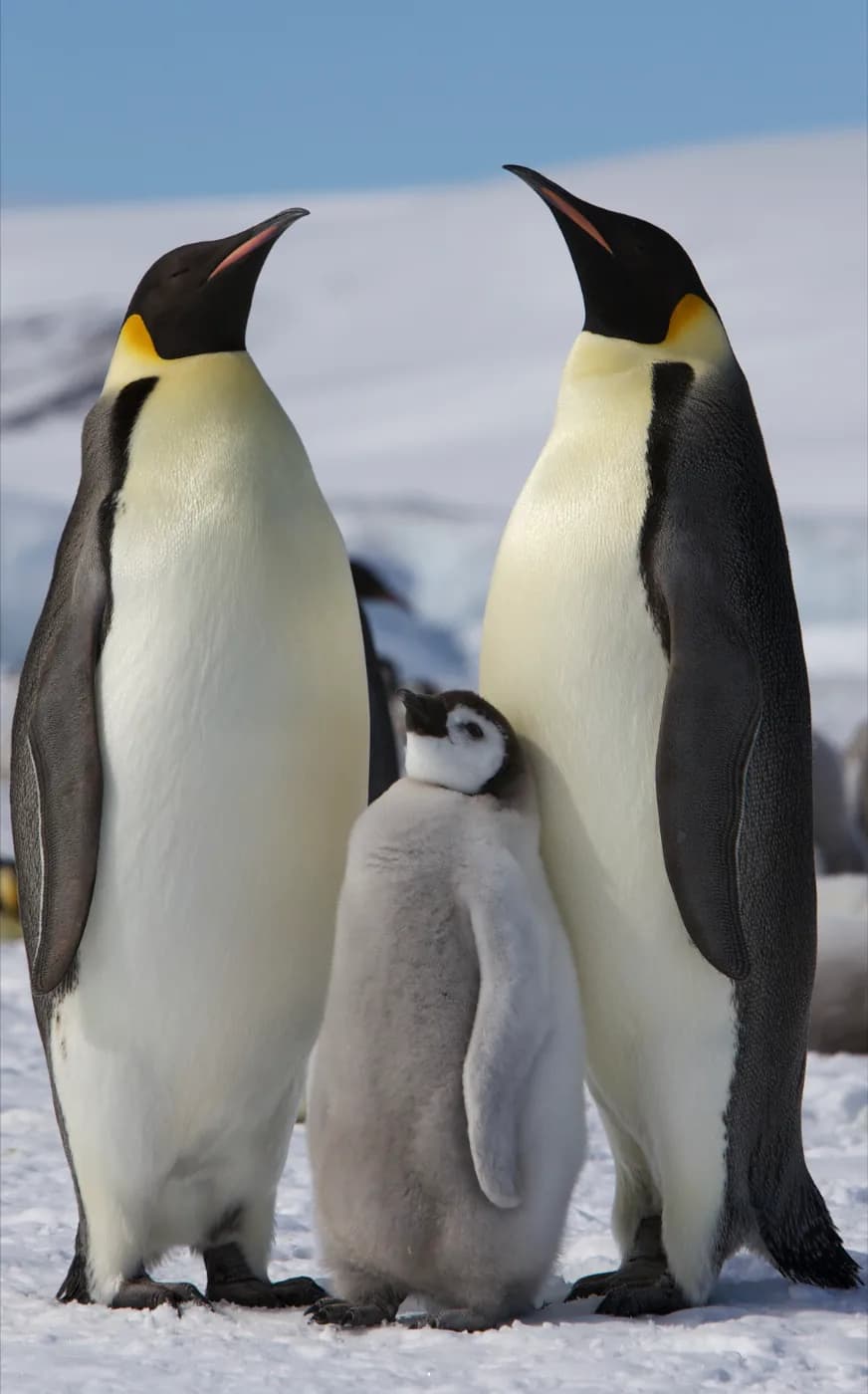
The Emperor Penguin stands 100–130 cm and weighs 22–45 kg, which makes it the largest penguin alive and a moderate one by the standards of the group's own history. Size here is not a trophy. It is a set of purchases — heat retention, oxygen storage, weeks of endurance without food — paid for in prey, in time, and in how often a pair can afford to try.
What Most People Get Wrong
The size ranking is a mass ranking wearing a height costume
Height looks like the natural way to rank penguins, and it is the worst available. The published height ranges overlap so heavily that below the top two species the order depends entirely on which end of each range you quote. Adélie Penguins are listed at 46–71 cm and Chinstrap Penguins at 68–77 cm, so a tall Adélie and a short chinstrap swap places. Gentoo Penguins run 51–90 cm — a range wider than the entire height of a Little Blue Penguin.
Mass behaves completely differently. The lightest emperor on record for the species, 22 kg, is heavier than the heaviest King Penguin at 16 kg. The lightest king, 11 kg, is heavier than the heaviest individual of every other living penguin, all of which top out at 8.5 kg or less. That is not a gradient. It is three tiers with empty space between them.
Below the top two, the height ranking is not a ranking. It is an artefact of measurement.
Today's giants are the small survivors of the lineage
Kumimanu fordycei, described from late Paleocene rocks in North Otago, New Zealand, is estimated at roughly 154 kg — more than three times the heaviest emperor ever weighed.1 Allometric regressions on the humerus gave mean body mass estimates of 148.0 kg (95% CI 132.5–165.3 kg) from humerus length and 159.7 kg (95% CI 142.6–178.8 kg) from proximal width.2 A second species from the same deposits, Petradyptes stonehousei, came in around 50 kg, which already exceeds any living penguin.3
The emperor does not sit at the top of penguin size. It sits at the top of what is left.
Height is the least reliable figure on any penguin page
Much of the "height" quoted for penguins is actually body length, measured bill tip to tail on a bird lying flat, not standing height. For Eudyptula the two conventions differ by around a third: roughly 40–45 cm in length against 30–35 cm standing. The famous 2.01 m estimate for the Antarctic fossil Palaeeudyptes klekowskii is a bill-tip-to-toe length taken from a 9.1 cm tarsometatarsus, not a standing measurement, and the authors were explicit that the standing height would have been considerably less.4
Why This Problem Is Hard
The number moves inside a single bird
A male emperor entering the winter breeding fast weighs about 38 kg. The leanest birds at the point of spontaneous refeeding weigh about 18 kg.5 That is a loss of more than half of body mass inside one season, in one individual, with no change in skeletal size at all. Any single mass figure for the species is a snapshot of an animal that is either loading or unloading.
Fossil size is inferred from one bone at a time
No near-complete skeleton of Kumimanu fordycei exists, so its describers estimated mass but declined to estimate body length. Guinness World Records notes the height remains debated; the related Kumimanu biceae has been put at up to 1.77 m.1 The rival record-holder, P. klekowskii, is known from a different formation, a different bone, and a different estimation method. The two are not measured on the same instrument.
Large bodies need oceans that reliably deliver
Size raises absolute food demand even as it lowers the cost per kilogram. A big penguin can only pay that bill where prey is dense and predictable enough to be found across long foraging commutes. That is why the two heaviest species both work cold, productive water and why the trade collapses when that water changes.
What Scientists Know
The ranking
| Species | Height (cm) | Weight (kg) | Deepest dive (m) | IUCN status |
|---|---|---|---|---|
| Emperor Penguin | 100–130 | 22–45 | 565 | Endangered |
| King Penguin | 85–95 | 11–16 | 343 | Least Concern |
| Gentoo Penguin | 51–90 | 4.5–8.5 | 200 | Least Concern |
| Yellow-eyed Penguin | 62–79 | 4.5–8.5 | 160 | Endangered |
| Royal Penguin | 65–76 | 3–8 | 100 | Near Threatened |
| Macaroni Penguin | 51–77 | 3.3–6.6 | 115 | Vulnerable |
| Magellanic Penguin | 61–76 | 2.7–6.5 | 97 | Least Concern |
| Adélie Penguin | 46–71 | 3.6–6 | 180 | Least Concern |
| Erect-crested Penguin | 50–70 | 2.5–6 | 120 | Endangered |
| Humboldt Penguin | 56–70 | 3.6–5.9 | 150 | Vulnerable |
| Fiordland Penguin | 51–71 | 2.7–5.9 | 60 | Vulnerable |
| Chinstrap Penguin | 68–77 | 3.2–5.3 | 121 | Least Concern |
Ordered by mass, the list separates cleanly. Ordered by height, rows four through twelve reshuffle constantly. Both columns come from the same birds.
What size buys: a favourable geometry
The emperor's cold tolerance is usually explained by insulation. The measurements say otherwise. Minimal thermal conductance in fasting emperors under natural conditions was 1.31 W m⁻² °C⁻¹, which is within the range for other birds. Resting metabolic rate, 49.06 W at 24.8 kg body mass, sat only 7–27% above general avian predictions. What is unusual is the lower critical temperature, about −10 °C, and that was attributed to large body size and body shape giving a smaller surface area relative to volume than other birds.6
The emperor is not better insulated than other birds. It is shaped so that there is less surface per kilogram to lose heat through. Even so, that geometry is not sufficient on its own — huddling was judged essential, without which survival through the winter fast at Antarctic temperatures would be impossible.6 The heat-exchange plumbing that supports this is covered in why penguins don't freeze.
What size buys: time without food
Body mass is a fuel tank with a regulator. Through the long steady phase of the emperor's roughly four-month winter fast, protein supplied a constant 4% of energy and lipid the remaining 96%, and it held that ratio until body mass fell to about 24 kg. Below that threshold, protein use climbed steeply — fourteen times higher at 18 kg than during the steady phase.5 Behaviour switched at the same point: locomotor activity rose up to eightfold and escape attempts up to fifteenfold, consistent with a refeeding drive triggered by the metabolic shift rather than by elapsed time.7
That threshold is what mass is for. A smaller bird reaches it sooner. The full accounting is in how penguins survive long fasts.
What size buys: depth
The two heaviest penguins are also the two deepest divers, at 565 m and 343 m against 200 m for the next species down. Bigger bodies carry proportionally larger oxygen stores and burn them more slowly per kilogram. The mechanism, and the reason it is an oxygen budget rather than a strength contest, is set out in how penguins dive so deep.
What size costs
Both members of Aptenodytes lay a single egg. Every other living penguin genus lays two. Emperor incubation runs 64–67 days and king incubation 52–56 days, the two longest in the family, and the king breeding cycle takes longer than a year, so a successful pair cannot breed in consecutive summers.8 A failed season is therefore not a delay of weeks. It is a delay of a year or more, described further in penguin breeding and chicks.
Gigantism arrived early and more than once
Kumimanu fordycei sits close to the root of the penguin tree while still retaining archaic flipper features, which indicates penguins reached the upper limit of body size very soon after becoming flightless divers rather than building up to it.2 Phylogenetic work on Kumimanu biceae separates the Paleocene giants from later Eocene and Oligocene giants by various smaller taxa, implying gigantism evolved independently several times.9 Nor was it a polar speciality: Icadyptes salasi, a giant exceeding 1.5 m standing height, lived at roughly 14°S in Eocene Peru during one of the warmest intervals of the Cenozoic.10
What Is Still Unclear
Why the giants stopped
The leading explanation is that the Oligo-Miocene radiation of marine mammals — toothed whales and pinnipeds — squeezed giant penguins as competitors and predators. It fits the timing across the fossil record. It has not been demonstrated as a mechanism, and no one has shown which resource was taken or how.11
Which fossil was actually the largest
K. fordycei holds the mass estimate at roughly 154 kg. P. klekowskii holds the length estimate at 2.01 m and about 115 kg.4 Different bones, different regressions, different continents, no complete skeleton on either side. The two records are not directly comparable and should not be reported as if they were.
Whether size still pays
The emperor is now listed as Endangered. Its entire strategy — single egg, four-month fast, deepest dives in the class — is built on fast ice that persists long enough for a chick to fledge. A body plan optimised over millions of years for a stable cold system cannot be repriced on a decadal timescale. Being large was never a guarantee. It was a bet on conditions holding.
Where To Go Next
For the mechanism that makes deep diving possible in a big body, read how penguins dive so deep. For the thermal side of the same trade, read why penguins don't freeze. The two giants are best examined side by side in the emperor and king comparison, and the opposite end of the trade is worked through in smallest penguins.
References
-
Guinness World Records. Heaviest species of penguin ever (Kumimanu fordycei, 154 kg; height debated, K. biceae estimated up to 1.77 m). https://www.guinnessworldrecords.com/world-records/84903-largest-species-of-penguin ↩ ↩2
-
Ksepka, D.T., Field, D.J., Heath, T.A., Pett, W., Thomas, D.B., Giovanardi, S. & Tennyson, A.J.D. (2023). Largest-known fossil penguin provides insight into the early evolution of sphenisciform body size and flipper anatomy. Journal of Paleontology 97(2): 434–453. https://doi.org/10.1017/jpa.2022.88 ↩ ↩2
-
Tennyson, A.J.D. (2024). Stonehouse's penguin, Petradyptes stonehousei. New Zealand Birds Online (Museum of New Zealand Te Papa Tongarewa). https://www.nzbirdsonline.org.nz/species/stonehouses-penguin ↩
-
Acosta Hospitaleche, C. (2014). New giant penguin bones from Antarctica: systematic and paleobiological significance. Comptes Rendus Palevol 13(7): 555–560. https://sciencepress.mnhn.fr/sites/default/files/articles/pdf/comptes-rendus-palevol2014v13f7a03.pdf ↩ ↩2
-
Robin, J.-P., Frain, M., Sardet, C., Groscolas, R. & Le Maho, Y. (1988). Protein and lipid utilization during long-term fasting in emperor penguins. American Journal of Physiology 254(1): R61–R68. https://doi.org/10.1152/ajpregu.1988.254.1.R61 ↩ ↩2
-
Le Maho, Y., Delclitte, P. & Chatonnet, J. (1976). Thermoregulation in fasting emperor penguins under natural conditions. American Journal of Physiology 231(3): 913–922. https://pubmed.ncbi.nlm.nih.gov/970475/ ↩ ↩2
-
Robin, J.-P., Boucontet, L., Chillet, P. & Groscolas, R. (1998). Behavioral changes in fasting emperor penguins: evidence for a "refeeding signal" linked to a metabolic shift. American Journal of Physiology 274(3): R746–R753. https://doi.org/10.1152/ajpregu.1998.274.3.R746 ↩
-
Le Bohec, C., Gauthier-Clerc, M., Grémillet, D., Pradel, R., Béchet, A., Gendner, J.-P. & Le Maho, Y. (2007). Population dynamics in a long-lived seabird: I. Impact of breeding activity on survival and breeding probability in unbanded king penguins. Journal of Animal Ecology 76(6): 1149–1160. https://doi.org/10.1111/j.1365-2656.2007.01268.x ↩
-
Mayr, G., Scofield, R.P., De Pietri, V.L. & Tennyson, A.J.D. (2017). A Paleocene penguin from New Zealand substantiates multiple origins of gigantism in fossil Sphenisciformes. Nature Communications 8: 1927. https://doi.org/10.1038/s41467-017-01959-6 ↩
-
Clarke, J.A., Ksepka, D.T., Stucchi, M., Urbina, M., Giannini, N., Bertelli, S., Narváez, Y. & Boyd, C.A. (2007). Paleogene equatorial penguins challenge the proposed relationship between biogeography, diversity, and Cenozoic climate change. Proceedings of the National Academy of Sciences 104(28): 11545–11550. https://doi.org/10.1073/pnas.0611099104 ↩
-
Pelegrín, J.S. & Acosta Hospitaleche, C. (2022). Evolutionary and biogeographical history of penguins (Sphenisciformes): review of the dispersal patterns and adaptations in a geologic and paleoecological context. Diversity 14(4): 255. https://doi.org/10.3390/d14040255 ↩