1
Body layer
Dense outer feathers
Overlapping feathers block wind, shed water, and protect the insulating layer underneath.
How Emperor Penguins and their relatives stay alive in lethal cold, from feather geometry to blood-flow tricks and huddle physics.
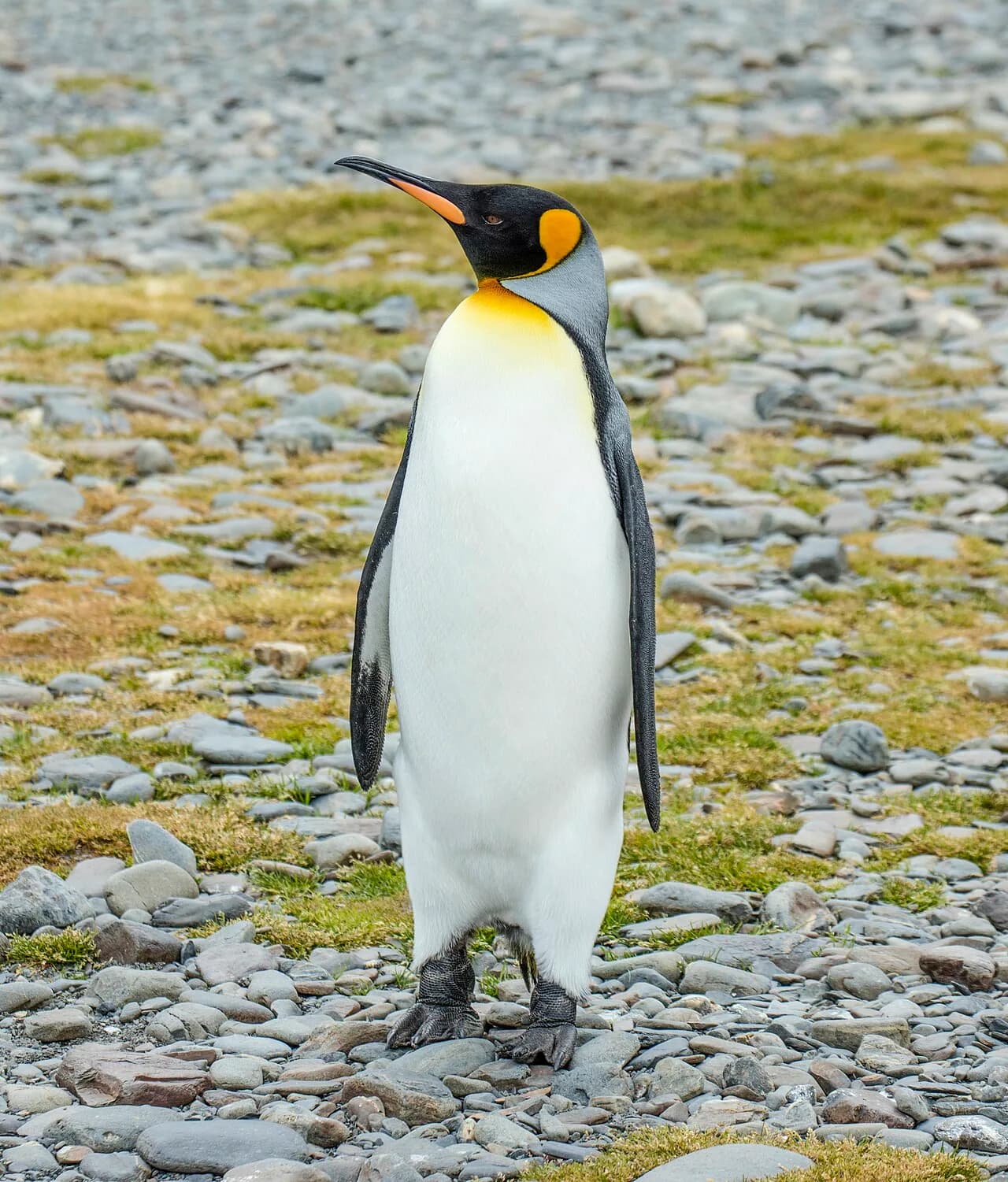
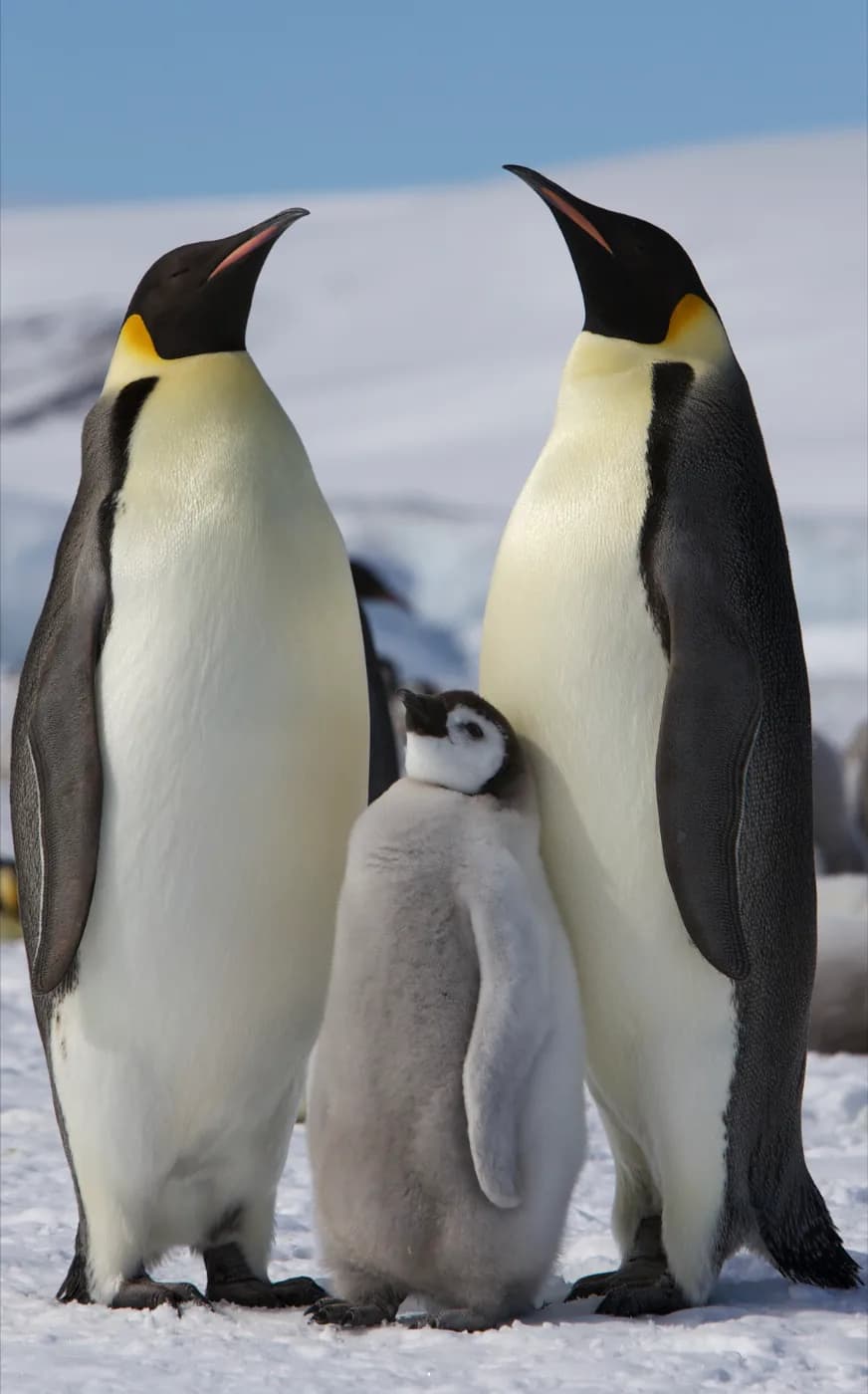
An Emperor Penguin standing on Antarctic ice is not winning because it is numb to cold. It is winning because nearly every exposed surface on the bird has been redesigned to leak less heat than a normal animal should.
Survival Lab
Cold survival is not one trick. It is a stack of defenses, from feather structure to colony behavior, that slows heat loss before the bird runs out of time or energy.
01 The problem
On land
Wind strips exposed heat
Penguins may stand still for long stretches on sea ice while wind keeps drawing heat off exposed tissue and exposed edges.
At sea
Water punishes faster
Cold water pulls heat away much faster than air, so every feeding trip creates a second, harsher heat-loss problem.
A penguin must solve heat loss twice: once in air, once in water.
02 The cold-defense system
Core idea
The useful mental image is not "a bird with blubber."
It is a heat-management system with almost no room for waste.
Visual Key
03 The six defenses
Body layer
Overlapping feathers block wind, shed water, and protect the insulating layer underneath.
Body layer
A thin cushion of air near the body slows heat loss and improves insulation.
Body layer
Fat stores heat and energy, but it works as one layer in a larger system.
Blood-flow control
Blood vessels in the limbs transfer warmth back toward the body core instead of wasting it at the edges.
Behavior
Penguins reduce exposed surface by tucking flippers and keeping the body tight when resting.
Behavior
Colonies behave like moving shelter walls, rotating birds through warmer interior positions.
04 Where the system starts to fail
Works when
Breaks when
The bird is built for cold. The timetable is what becomes fragile.
01 The problem
On land
Wind strips exposed heat
Penguins may stand still for long stretches on sea ice while wind keeps drawing heat off exposed tissue and exposed edges.
At sea
Water punishes faster
Cold water pulls heat away much faster than air, so every feeding trip creates a second, harsher heat-loss problem.
A penguin must solve heat loss twice: once in air, once in water.
02 The cold-defense system
The center of the story is not toughness. It is coordination between body layers, blood-flow control, and colony behavior.
Reading guide
Anatomy markers use the species palette. Structural logic uses the guides palette. Risk language stays in signal only.
Core idea
The useful mental image is not "a bird with blubber."
It is a heat-management system with almost no room for waste.
Visual Key
Body layer
Overlapping feathers block wind, shed water, and protect the insulating layer underneath.
Body layer
A thin cushion of air near the body slows heat loss and improves insulation.
Body layer
Fat stores heat and energy, but it works as one layer in a larger system.
Blood-flow control
Blood vessels in the limbs transfer warmth back toward the body core instead of wasting it at the edges.
Behavior
Penguins reduce exposed surface by tucking flippers and keeping the body tight when resting.
Behavior
Colonies behave like moving shelter walls, rotating birds through warmer interior positions.
04 Where the system starts to fail
Works when
Breaks when
The bird is built for cold. The timetable is what becomes fragile.
01 The problem
On land
Wind strips exposed heat
Penguins may stand still for long stretches on sea ice while wind keeps drawing heat off exposed tissue and exposed edges.
At sea
Water punishes faster
Cold water pulls heat away much faster than air, so every feeding trip creates a second, harsher heat-loss problem.
A penguin must solve heat loss twice: once in air, once in water.
02 The cold-defense system
The center of the story is not toughness. It is coordination between body layers, blood-flow control, and colony behavior.
Reading guide
Anatomy markers use the species palette. Structural logic uses the guides palette. Risk language stays in signal only.
Body layer
Overlapping feathers block wind, shed water, and protect the insulating layer underneath.
Body layer
A thin cushion of air near the body slows heat loss and improves insulation.
Body layer
Fat stores heat and energy, but it works as one layer in a larger system.
Core idea
The useful mental image is not "a bird with blubber."
It is a heat-management system with almost no room for waste.
Visual Key
Blood-flow control
Blood vessels in the limbs transfer warmth back toward the body core instead of wasting it at the edges.
Behavior
Penguins reduce exposed surface by tucking flippers and keeping the body tight when resting.
Behavior
Colonies behave like moving shelter walls, rotating birds through warmer interior positions.
04 Where the system starts to fail
Works when
Breaks when
The bird is built for cold. The timetable is what becomes fragile.
Common myth
Penguins survive freezing conditions because blubber alone does all the work.
What the evidence says
Blubber matters, but feathers, blood-flow control, posture, huddling, and timing are just as important. Cold survival is a full-system trick.
Penguins stay warm through layered insulation, controlled heat loss, and behavior, not one magic adaptation.
The Emperor Penguin is the clearest example because it breeds through the Antarctic winter instead of waiting for kinder conditions.
Cold tolerance does not mean climate safety. A bird can master freezing air and still collapse when sea-ice timing changes.
Lab Note
The useful mental image is not a tough bird with a thick coat. It is a compact heat-management machine that barely tolerates mistakes.
Emperor Penguins are the cleanest place to start because they do not avoid the worst cold. They breed straight through it, standing on sea ice in air that falls below −40 °C and feeding in water held near −1.8 °C.1 That matters because the usual mental picture is wrong: penguins are not just birds with thick fat. They are birds that solved heat loss from the skin outward, and under a clear Antarctic sky the outermost layer of that solution is colder than the air around it.
Most people talk about blubber first, as if penguins were small seals with beaks. Emperors carry a comparatively thin subcutaneous fat layer, and it gets thinner across the winter fast, not thicker. Published estimates put the plumage at roughly 80–90% of the bird's total insulation requirement.2 Fat is a fuel reserve first and a jacket second.
Cold survival is layered instead, and the layers do very different jobs. Each one is dealt with properly further down; laid side by side, they show where the work is actually happening.
| Defence | How it works | What it buys |
|---|---|---|
| Plumage | Contour feathers over dense plumules, trapping still air | 80–90% of total insulation |
| Subcutaneous fat | Thin layer, thinner still by late winter | Fuel reserve first, jacket second |
| Humeral plexus | Flipper arteries each wrapped by returning veins | 2 arteries in little blues, up to 15 in emperors |
| Rete tibiotarsale | The same exchange in the leg | Throttles heat sent to the feet |
| Nasal exchanger | Recovers warmth from exhaled air | Heat and water kept inside the bird |
| Posture | Hides bill, feet and flippers from the wind | Less exposed surface |
| Huddling | Thousands of birds as one wind-shadowed mass | 39% below isolated birds |
The result is not invulnerability. It is efficient damage control.
For decades the standard claim was that emperors have the densest plumage of any bird, usually quoted as about 100 feathers per square inch, or roughly 15 per cm². Scientific papers gave figures anywhere from 11 to 46 feathers per cm². None of them described a counting method or cited a source.1
In 2015 a team at Scripps and UC Irvine plucked and counted feathers from emperor carcasses collected at Cape Washington and Cape Crozier. They found a maximum of nine contour feathers per cm². The white-throated dipper, a small Eurasian stream bird, carries contour feathers more than six times denser.1 Emperors do not hold the record.
The same study found the mechanism everyone had been missing. Beneath the stiff, waterproof contour layer sit plumules — downy feathers attached directly to the skin, four times denser than the afterfeathers that earlier heat-transfer models had treated as the only insulating component. Filoplumes, long reported absent in penguins, were present too.1 The layer being modelled was not the layer doing the work.
Penguins lose heat in two punishing ways at once. On land, wind strips warmth off any exposed tissue, and Antarctic colonies see gusts recorded above 26 m s⁻¹. In water the problem is worse, because water carries heat away from a body far faster than air of the same temperature. A bird that swims to feed and then stands on ice to incubate has to solve both versions, with one coat.
Feet, flippers and bill are thin, poorly insulated and full of moving blood. Left unmodified they would work as radiators, dumping core heat into ice and seawater every hour of every day. Any insulation strategy that ignores the extremities fails at the extremities.
Thermal imaging at the Pointe Géologie colony in June 2008 produced a result the researchers did not expect. Under clear skies, most outer plumage surfaces sat about 4 °C colder than the surrounding sub-zero air.2 The cause is radiative cooling to a clear sky that can be more than 20 °C below air temperature. Only the eyes, flippers and feet were warmer than the air, and only the eyes were above freezing.2
Because the plumage surface is then colder than the air, it gains a trickle of heat back by convection. That gain is not what keeps the bird warm — the plumage conducts so poorly that almost none of it reaches the skin. What the measurement really shows is how completely the coat is decoupled from the body inside it.
Warm blood heading out to a flipper runs alongside cold blood returning to the core, and hands off most of its heat before it ever reaches the tip. In penguins the flipper version is the humeral arterial plexus: a bundle of parallel arteries, each wrapped by veins, replacing the single brachial artery other birds have.
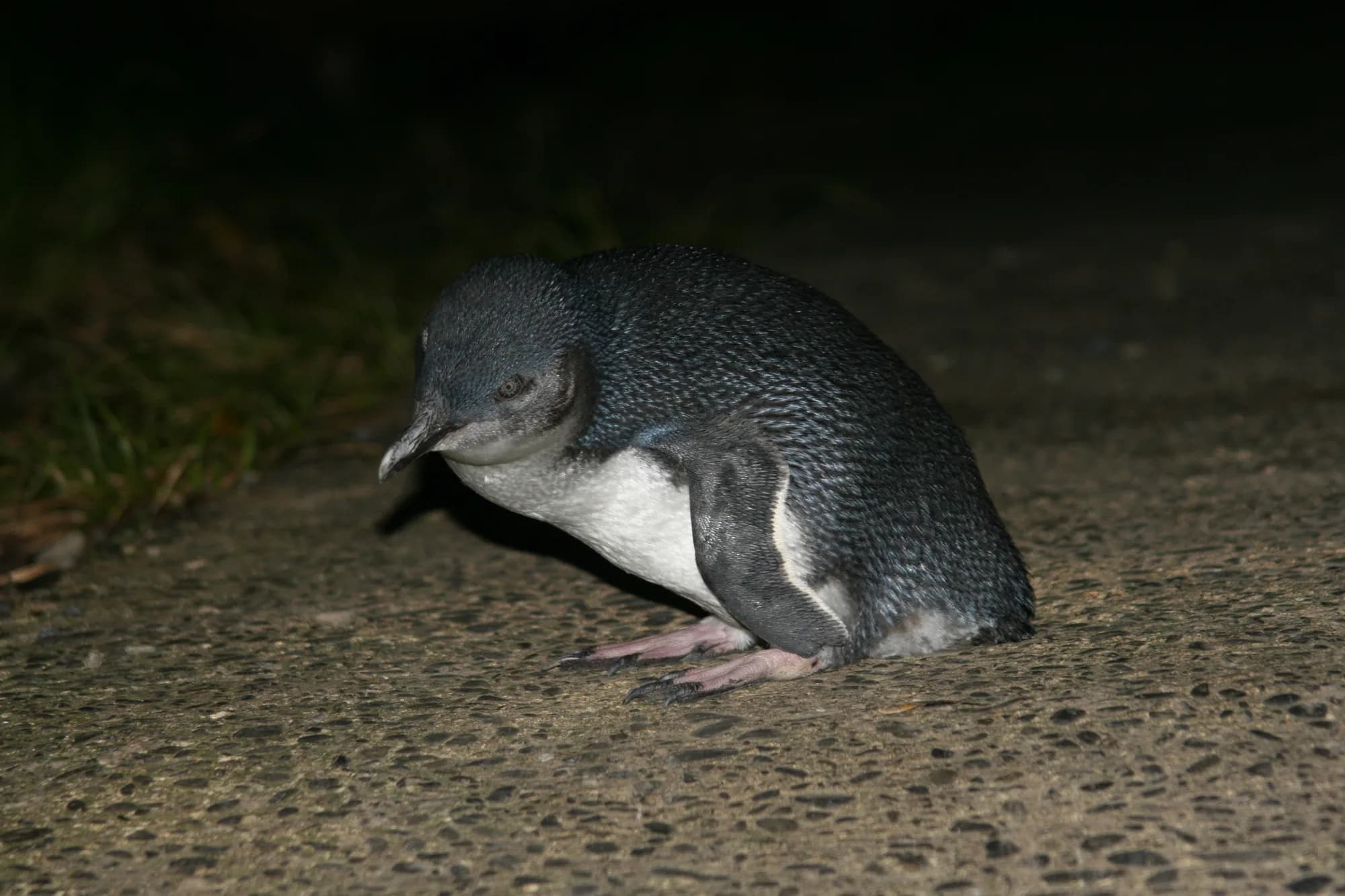
The number of arteries scales with how much surface there is to protect. Little Blue Penguins have two humeral arteries and a wing surface area of about 75 cm². Emperor Penguins have up to 15, across roughly 203 cm². Across species the artery count tracks wing area more closely than it tracks sea temperature.3 The legs carry their own exchanger, the rete tibiotarsale, and a nasal counter-current exchanger recovers heat and water from exhaled air before it leaves the bird.
One detail undercuts the tidy story. Fossil evidence puts the humeral plexus in penguins at least 49 million years ago, during a greenhouse interval with no polar ice at all. It evolved for foraging in cool subsurface water at temperate latitudes.4 The ice arrived later and the birds already had the hardware — which is also why the same plumbing shows up in warm-water species and in the deep divers covered in how penguins dive so deep.
Huddling is usually described as birds keeping each other warm. The energetics are more specific. Emperors held in loose groups of five to ten, unable to huddle properly, ran metabolic rates 39% below isolated birds, and about 32% of that saving came from wind protection alone. Free-ranging birds that could huddle properly ran a further 21% below the loosely grouped birds.5
Inside a tight huddle, ambient temperature has been recorded above 35 °C, reaching up to 37.5 °C.6 Implanted loggers showed that males incubating successfully held core temperature steady at 36.9 ± 0.2 °C even while huddling, while males that had lost their egg let core temperature drift down to about 35.5 °C.7 Incubation sets a floor that energy saving is not allowed to cross.
The huddle also moves. Every 30–60 seconds, small forward steps travel through the packed birds as a wave, reorganising a structure otherwise close to a jammed lattice.8 Modelling suggests any bird inside the huddle can trigger one.9 There is no leader and no rotation schedule, only a rule set that gives every bird roughly equal access to the middle.
An emperor's lower critical temperature — the point below which it must burn extra fuel to stay warm — sits around −10 °C. Feather rigidity means winds up to about 5 m s⁻¹ barely change heat loss at all.10 Much of what looks like heroic endurance is a bird sitting inside its thermoneutral zone in weather that would kill an unprotected mammal, and the whole arrangement exists to protect the fasting budget described in how penguins survive long fasts.
The measured drop in core temperature during huddling is small — around 0.5 °C in pairing birds, roughly 1 °C at most. That is far too little to account for the energy savings observed. Researchers attribute the remainder to metabolic depression driven by the reduction in cold-exposed body surface.7 That is a reasonable inference from the surface-area maths. It has not been measured directly in free-ranging birds, and it is fair to call the mechanism incompletely resolved.
Penguins are generally smaller than the predicted minimum body size for a marine endotherm, and little penguins sit well below it. The working explanation is regional heterothermy: let the extremities run cold, defend only the core.11 How much thermal flexibility small species actually have, and what it costs them, is much less studied than the emperor case. King Penguins sit at the other end of the same trade-off, which is part of what makes the emperor and king comparison informative rather than decorative.
Nothing in the current evidence suggests penguins are running out of cold tolerance. The exposure is to the surface they stand on. Emperors breed on fast ice that has to form early enough and hold long enough for a chick to fledge, and that timetable is not something feathers can fix.
The IUCN uplisted the Emperor Penguin to Endangered on 9 April 2026,12 against a population of roughly 595,000 individuals.13 The species did not become worse at surviving cold. Its breeding platform became less reliable.
To follow the same body into the water, read how penguins dive so deep, where the counter-current plumbing turns into an oxygen-budgeting problem. For the energy side of the winter, read how penguins survive long fasts. For the birds themselves, start with the Emperor Penguin profile and the wider Antarctic species, or look at what the ice trend means in conservation.
Williams, C. L., Hagelin, J. C. & Kooyman, G. L. (2015). Hidden keys to survival: the type, density, pattern and functional role of emperor penguin body feathers. Proceedings of the Royal Society B 282: 20152033. https://doi.org/10.1098/rspb.2015.2033 ↩ ↩2 ↩3 ↩4
McCafferty, D. J., Gilbert, C., Thierry, A.-M., Currie, J., Le Maho, Y. & Ancel, A. (2013). Emperor penguin body surfaces cool below air temperature. Biology Letters 9: 20121192. https://doi.org/10.1098/rsbl.2012.1192 ↩ ↩2 ↩3
Thomas, D. B. & Fordyce, R. E. (2012). Biological plasticity in penguin heat-retention structures. The Anatomical Record 295: 249–256. https://doi.org/10.1002/ar.21538 ↩
Thomas, D. B., Ksepka, D. T. & Fordyce, R. E. (2011). Penguin heat-retention structures evolved in a greenhouse Earth. Biology Letters 7: 461–464. https://doi.org/10.1098/rsbl.2010.0993 ↩
Gilbert, C., Blanc, S., Le Maho, Y. & Ancel, A. (2008). Energy saving processes in huddling emperor penguins: from experiments to theory. Journal of Experimental Biology 211: 1–8. https://doi.org/10.1242/jeb.005785 ↩
Gilbert, C., Robertson, G., Le Maho, Y., Naito, Y. & Ancel, A. (2006). Huddling behavior in emperor penguins: dynamics of huddling. Physiology & Behavior 88: 479–488. https://doi.org/10.1016/j.physbeh.2006.04.024 ↩
Gilbert, C., Robertson, G., Le Maho, Y., Naito, Y. & Ancel, A. (2006). Body temperature changes induced by huddling in breeding male emperor penguins. American Journal of Physiology 291: R1373–R1381. https://doi.org/10.1152/ajpregu.00912.2005 ↩ ↩2
Zitterbart, D. P., Wienecke, B., Butler, J. P. & Fabry, B. (2011). Coordinated movements prevent jamming in an emperor penguin huddle. PLoS ONE 6: e20260. https://doi.org/10.1371/journal.pone.0020260 ↩
Gerum, R. C., Fabry, B., Metzner, C., Beaulieu, M., Ancel, A. & Zitterbart, D. P. (2013). The origin of traveling waves in an emperor penguin huddle. New Journal of Physics 15: 125022. https://doi.org/10.1088/1367-2630/15/12/125022 ↩
Le Maho, Y., Delclitte, P. & Chatonnet, J. (1976). Thermoregulation in fasting emperor penguins under natural conditions. American Journal of Physiology 231: 913–922. https://doi.org/10.1152/ajplegacy.1976.231.3.913 ↩
Thomas, D. B. & Fordyce, R. E. (2007). The heterothermic loophole exploited by penguins. Australian Journal of Zoology 55: 317–321. https://doi.org/10.1071/ZO07053 ↩
IUCN (9 April 2026). Emperor penguin and Antarctic fur seal now Endangered due to climate change — IUCN Red List. https://iucn.org/press-release/202604/emperor-penguin-and-antarctic-fur-seal-now-endangered-due-climate-change-iucn ↩
Fretwell, P. T., LaRue, M. A., Morin, P., Kooyman, G. L., Wienecke, B., Ratcliffe, N., Fox, A. J., Fleming, A. H., Porter, C. & Trathan, P. N. (2012). An emperor penguin population estimate: the first global, synoptic survey of a species from space. PLoS ONE 7: e33751. https://doi.org/10.1371/journal.pone.0033751 ↩
Yes. Penguins are constantly managing cold stress, especially on land and in wind. Their success comes from reducing heat loss faster than the environment can strip it away.
Blubber helps, but it works alongside dense feathers, compact bodies, heat exchangers in the limbs, and huddling behavior.
Because the real issue is not temperature alone. Breeding depends on stable sea ice lasting long enough for chicks to hatch and fledge.
More short answers live in the site FAQ; definitions in the glossary.
The uncertainty is not whether penguins can handle cold. It is how far the system bends when weather stays extreme but sea ice stops behaving in the old way.
We start with conservation assessments, research institutions, and field guides that have to survive real scrutiny. Then we write only what still sounds true after the comparison.
These are the main references behind the guide and the linked species pages.
How Penguins Survive Long Fasts
Why fasting is normal penguin biology, from Emperor males on winter sea ice to chicks and moulting birds trapped on land.
Open guidePenguin Breeding and Chicks
How penguins turn sea ice, burrows, bare rock, and dense vegetation into nurseries, and why breeding style is really a survival strategy.
Open guideHow Penguins Dive So Deep
Why some penguins dive like compressed springs, and how Emperor and King Penguins turn oxygen, pressure, and timing into depth.
Open guideKeep following the problem through the linked species, hubs, and adjacent guides.