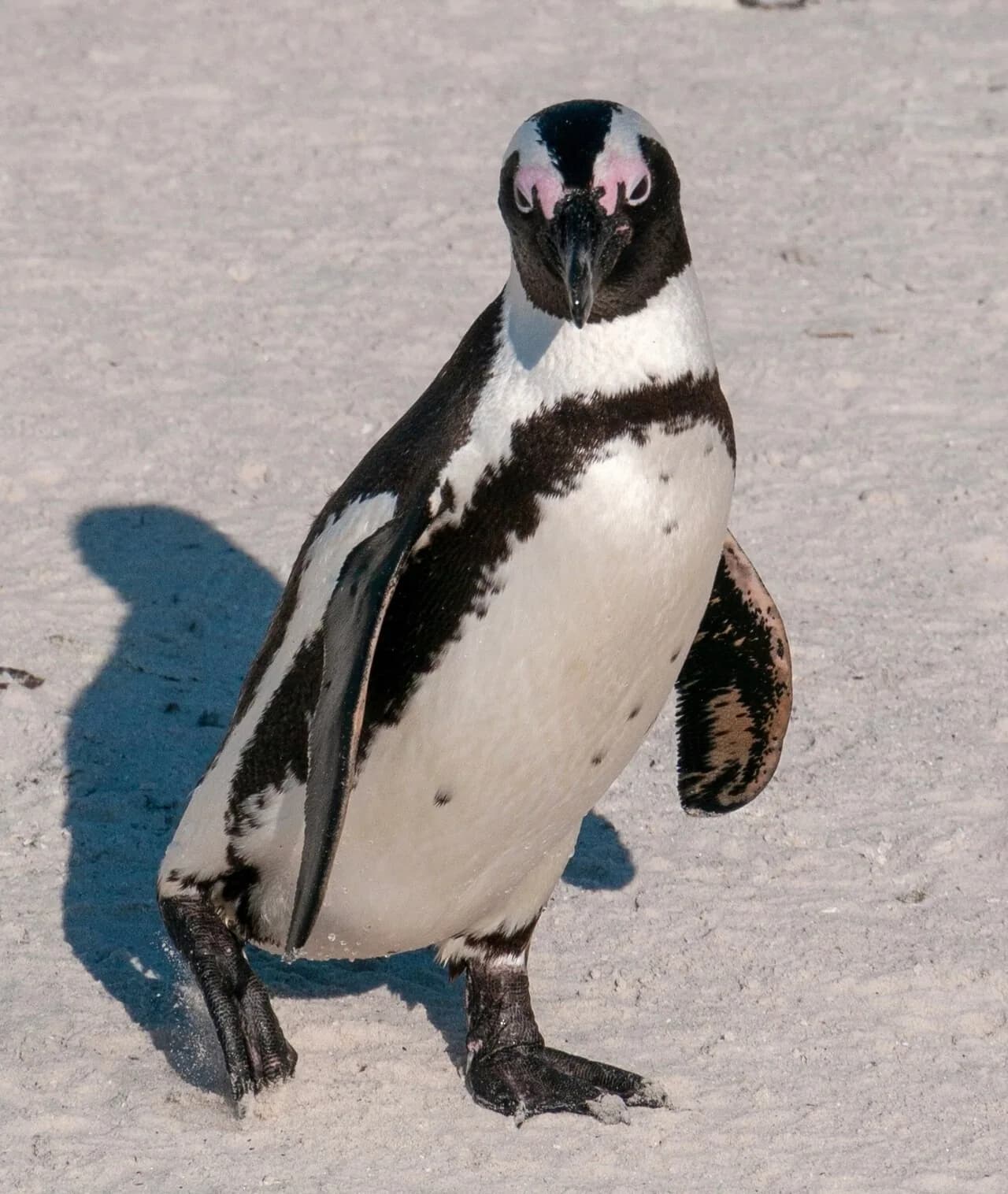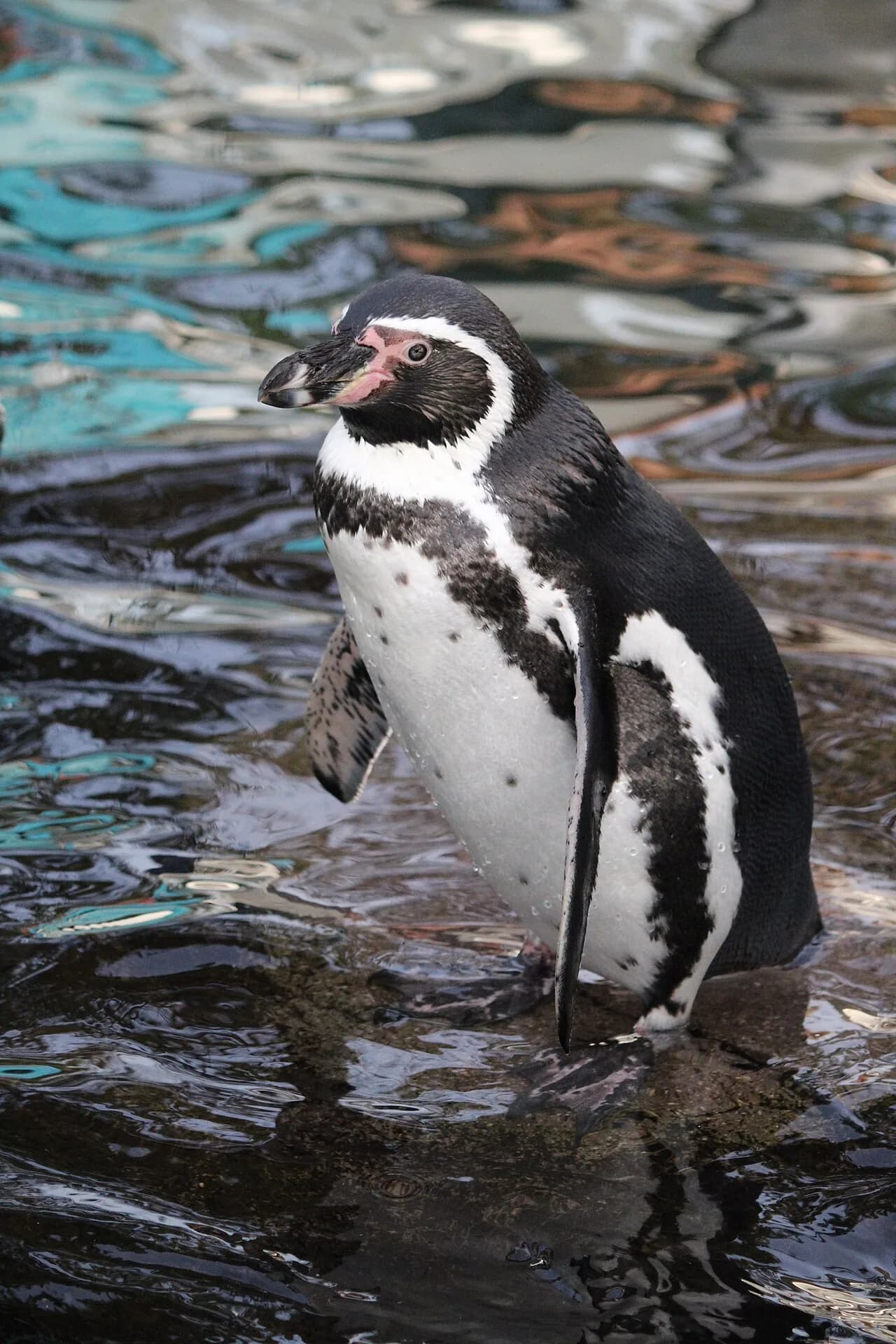
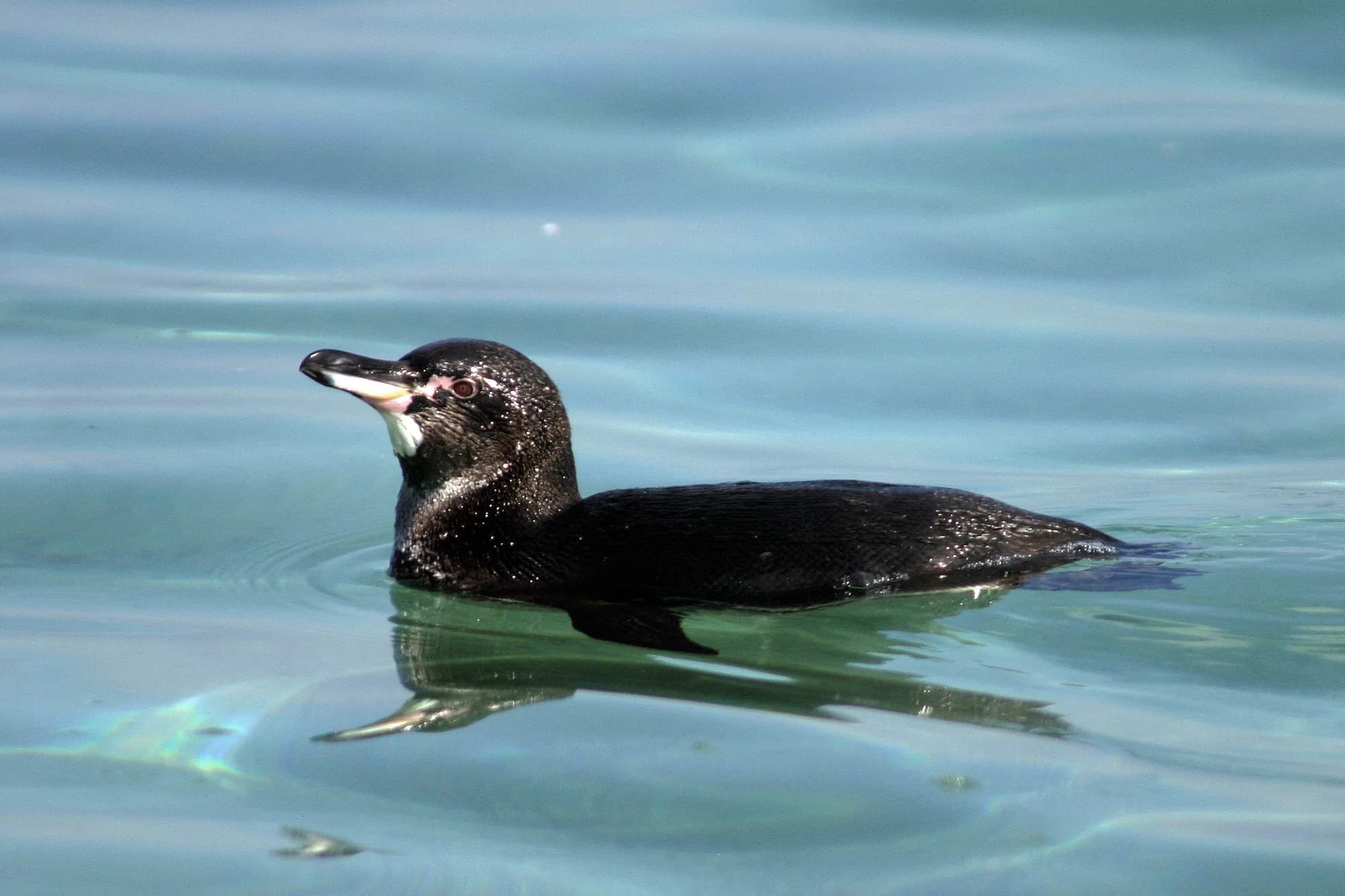
The Galapagos Penguin breeds on the equator, on black lava, under a tropical sun, and it is still a cold-water bird. That is not a contradiction. It is the whole explanation. Roughly 95 per cent of the world's 1,200 or so Galapagos Penguins sit on Fernandina and western Isabela, and those are precisely the two coastlines where cold water is forced to the surface.1
What Most People Get Wrong
The penguin did not become tropical. The water stayed cold
The usual assumption is that some penguin lineage shed its cold-water biology and adapted to heat. The evidence points the other way. Warm-latitude penguins are still built like cold-water penguins, and they persist where cold, nutrient-rich water reaches them despite the latitude.
In the Galapagos the source is the Cromwell Current, better known as the Equatorial Undercurrent. It runs eastward as a subsurface ribbon roughly 200 m thick and 400 km wide, sitting somewhere between 20 and 250 m below the surface within about 50 km of the equator, and measuring around 15.5°C at 100 m depth. When it slams into the western flank of the archipelago it is deflected upward. Surface temperatures on that side can fall to about 16°C.
They did not adapt to the tropics. They found a cold pool with a tropical postcode.
The same logic explains the Humboldt Penguin on the Atacama coast and the African Penguin in the Benguela system. Look at the currents, not the map.
Why This Problem Is Hard
A cold-water body still has to sit on a hot beach
Everything about penguin anatomy is designed to keep heat in: dense plumage, subcutaneous fat, compact shape, and elaborate counter-current heat exchangers. Dissection work on African Penguins found arterio-venous heat-exchange systems in the head, the armpits and both segments of the leg, including a post-orbital rete supplying the eye and nasal passages, and a humeral plexus in which the brachial artery splits into parallel vessels each paired with up to three veins.2
That plumbing is a problem on land. It is also, usefully, reversible: the same study identified a shunt that bypasses the veins of the humeral plexus, allowing a heat-stressed bird to dump heat through the flipper instead of conserving it.2
This is not a bird that overcame its cold-water design. It is a bird that learned to run the design backwards for a few hours a day.
Penguins cannot sweat, and evaporation costs water they may not have
The available cooling routes are panting, postural exposure of bare or thinly feathered surfaces, and getting wet. All three are constrained. Panting costs water. Many of these colonies sit on arid coastline — Atacama desert margin, semi-arid Namibian and South African coast, bare lava with no fresh water at all — so a bird that pants heavily on a hot afternoon has bought cooling with a resource it cannot easily replace.
What Scientists Know
Where heat stress actually starts
Controlled work on African Penguins gives real thresholds rather than impressions. The species forages in water of 10–20°C but breeds and moults on land where temperatures routinely exceed 30°C.3 In an experiment ramping ambient temperature from 20°C to 35°C:
- Heat storage began at an ambient temperature of about 29°C.
- Above that, body temperature climbed roughly 0.2°C for every 1°C rise in ambient temperature.
- Panting began at 31.4°C ambient, with a body temperature of 37.8°C.
- Birds also stood up, raised their heads and extended their flippers away from the body.3
In the field it starts far earlier. Camera-trap observations on Bird Island recorded penguins panting at 25°C inside artificial nest boxes and at 22°C in exposed surface nests — solar load and confinement matter more than air temperature alone.4
For comparison, the Humboldt Penguin has an unusually wide thermoneutral zone, measured at roughly 2–30°C, with a core temperature near 39°C.5 Wide is not unlimited. The ceiling still sits around 30°C.
The nest does most of the thermoregulation
African Penguins historically dug burrows into deep guano deposits, which gave them a cool, humid, buffered chamber. Commercial guano scraping removed that habitat, which is why so many pairs now breed on open surfaces. Microclimate measurements on Bird Island compared four options over an austral summer, and three of the four crossed 40°C.4
| Nest type | Peak temperature | Midday humidity | Standing |
|---|---|---|---|
| Natural guano burrow | Over 40°C on several occasions | Not reported | Best of the traditional options |
| Exposed surface | Repeatedly over 40°C | Around 60 per cent | No buffer at all |
| Cement pipe | Also over 40°C | Below 50 per cent | Driest of the four |
| Double-layered ceramic | Never above 36.7°C | Above 70 per cent throughout | Beats even natural burrows |
Earlier work found fibreglass nests held temperatures above 30°C for the longest stretches and had consistently poorer hatching success, probably through excess water loss from the eggs.6 Nest design decides whether an egg stays viable or dries out, which is a large part of why the African Penguin's slide to Critically Endangered is so hard to arrest even at protected sites.
At Boulders Beach near Simon's Town — one of only a handful of mainland colonies — the birds use coastal strandveld thicket for shade while breeding and moulting.7 Vegetation is doing the job the guano used to do.
Heat kills quickly, not gradually
The Magellanic Penguin is Least Concern with a large range, and it still demonstrates the point. On 19 January 2019 the temperature at Punta Tombo, Argentina hit 44°C in the shade — the highest recorded there since monitoring began in 1982. At least 354 penguins died. Around three-quarters were adults, and post-mortem analysis pointed to dehydration; over a quarter of the bodies were found between the colony and the sea, meaning the birds died trying to reach water.8
Long-term data from the same colony shows heat killing chicks up to 70 days old, and burrow nests measurably reducing weather-driven mortality.9
Heat does not have to be chronic to be lethal. One afternoon is enough.
The ocean still outranks the thermometer
For every warm-latitude penguin, the larger threat is the food supply, not the sunshine. The two strong El Niño events of 1982–83 and 1997–98 were each followed by Galapagos Penguin population crashes of 77 per cent and 65 per cent respectively, and by 2004 the population stood at less than half its pre-1982 level.10 Long-term census work found body condition improving under La Niña conditions and deteriorating under El Niño, with outright starvation in the worst years.11
The mechanism is simple. Warm surface water suppresses the upwelling, the upwelling stops feeding the fish shoals, and the colony fails regardless of how cool its lava crevices are.
What Is Still Unclear
Whether the Galapagos cold pool holds
This is the genuinely surprising part, and it cuts against the intuitive story. High-resolution sea-surface temperature records show the Galapagos cold pool has been intensifying and expanding northward since 1982, with a linear cooling trend of about 0.8°C over 33 years.12 The proposed cause is a slackening of the cross-equatorial trade winds shifting the mean position of the Equatorial Undercurrent equatorward — stronger, better-placed upwelling in the middle of a warming ocean.
Nobody knows how long that persists, or whether it survives stronger forcing. It may buy the species decades. It may reverse.
How much of the extinction risk is real and how much is modelled
Population viability modelling using observed El Niño frequencies put the Galapagos Penguin's extinction probability at roughly 30 per cent over 100 years, rising above 80 per cent if the frequency of strong events merely doubled from 5 to 10 per cent.13 Those are model outputs, and they are highly sensitive to two assumptions the field cannot pin down: survival rates during El Niño years, and sex ratio. Treat the direction as robust and the exact figures as provisional.
Where the physiological ceiling actually sits
The threshold numbers above come from a small number of studies, several on handled or captive birds, and field onset of panting is much lower than laboratory onset. There is no good published figure for how long a bird can tolerate a given temperature before it dies, which is precisely the number needed to forecast mortality in the next heatwave. And while engineered nests clearly outperform surface sites, no design has been shown to hold up under a permanently hotter mean climate rather than an occasional bad day.
Where To Go Next
For the mirror image of this problem — the same anatomy solving the opposite task — read why penguins don't freeze. For the geographic pattern behind all of it, see where penguins live. For current population figures and Red List movements on the species named here, the conservation tracker is the live record, and the Endangered species hub is where the Galapagos Penguin now sits.
References
-
Galapagos Conservation Trust. The Galapagos Penguin. Species factsheet — source for the ~95 per cent of the population living on Fernandina and the western part of Isabela. https://galapagosconservation.org.uk/wp-content/uploads/2025/03/The-Galapagos-Penguin-and-threats.pdf ↩
-
Frost, P.G.H., Siegfried, W.R. & Greenwood, P.J. (1975). Arterio-venous heat exchange systems in the Jackass penguin Spheniscus demersus. Journal of Zoology 175: 231–241. https://doi.org/10.1111/j.1469-7998.1975.tb01398.x ↩ ↩2
-
Welman, S., Green, J.A., Ryan, P.G., Parsons, N.J. & Pichegru, L. (2024). Body temperature and thermoregulatory behaviour in the Endangered African Penguin Spheniscus demersus. Bird Conservation International 34: e29. https://doi.org/10.1017/S095927092400025X ↩ ↩2
-
Welman, S. & Pichegru, L. (2023). Nest microclimate and heat stress in African Penguins Spheniscus demersus breeding on Bird Island, South Africa. Bird Conservation International 33: e34. https://doi.org/10.1017/S0959270922000351 ↩ ↩2
-
Drent, R.H. & Stonehouse, B. (1971). Thermoregulatory responses of the Peruvian penguin, Spheniscus humboldti. Comparative Biochemistry and Physiology A 40: 689–710. https://doi.org/10.1016/0300-9629(71)90254-4 ↩
-
Lei, B.R., Green, J.A. & Pichegru, L. (2014). Extreme microclimate conditions in artificial nests for Endangered African Penguins. Bird Conservation International 24: 201–213. https://doi.org/10.1017/S0959270913000671 ↩
-
BirdLife South Africa. Boulders Beach — Important Bird and Biodiversity Area directory entry. https://www.birdlife.org.za/iba-directory/boulders-beach/ ↩
-
Holt, K.A. & Boersma, P.D. (2022). Unprecedented heat mortality of Magellanic Penguins. Ornithological Applications 124: duab052. https://doi.org/10.1093/ornithapp/duab052 ↩
-
Boersma, P.D. & Rebstock, G.A. (2014). Climate change increases reproductive failure in Magellanic penguins. PLoS ONE 9(1): e85602. https://doi.org/10.1371/journal.pone.0085602 ↩
-
Vargas, F.H., Harrison, S., Rea, S. & Macdonald, D.W. (2006). Biological effects of El Niño on the Galápagos penguin. Biological Conservation 127: 107–114. https://doi.org/10.1016/j.biocon.2005.08.001 ↩
-
Boersma, P.D. (1998). Population trends of the Galapagos Penguin: impacts of El Niño and La Niña. The Condor 100: 245–253. https://digitalcommons.usf.edu/condor/vol100/iss2/4 ↩
-
Karnauskas, K.B., Jenouvrier, S., Brown, C.W. & Murtugudde, R. (2015). Strong sea surface cooling in the eastern equatorial Pacific and implications for Galápagos Penguin conservation. Geophysical Research Letters 42: 6432–6437. https://www2.whoi.edu/site/jenouvrier/wp-content/uploads/sites/118/2021/02/Karnauskas_et_al-2015-Geophysical_Research_Letters.pdf ↩
-
Vargas, F.H., Lacy, R.C., Johnson, P.J., Steinfurth, A., Crawford, R.J.M., Boersma, P.D. & Macdonald, D.W. (2007). Modelling the effect of El Niño on the persistence of small populations: the Galápagos penguin as a case study. Biological Conservation 137: 138–148. https://doi.org/10.1016/j.biocon.2007.02.005 ↩