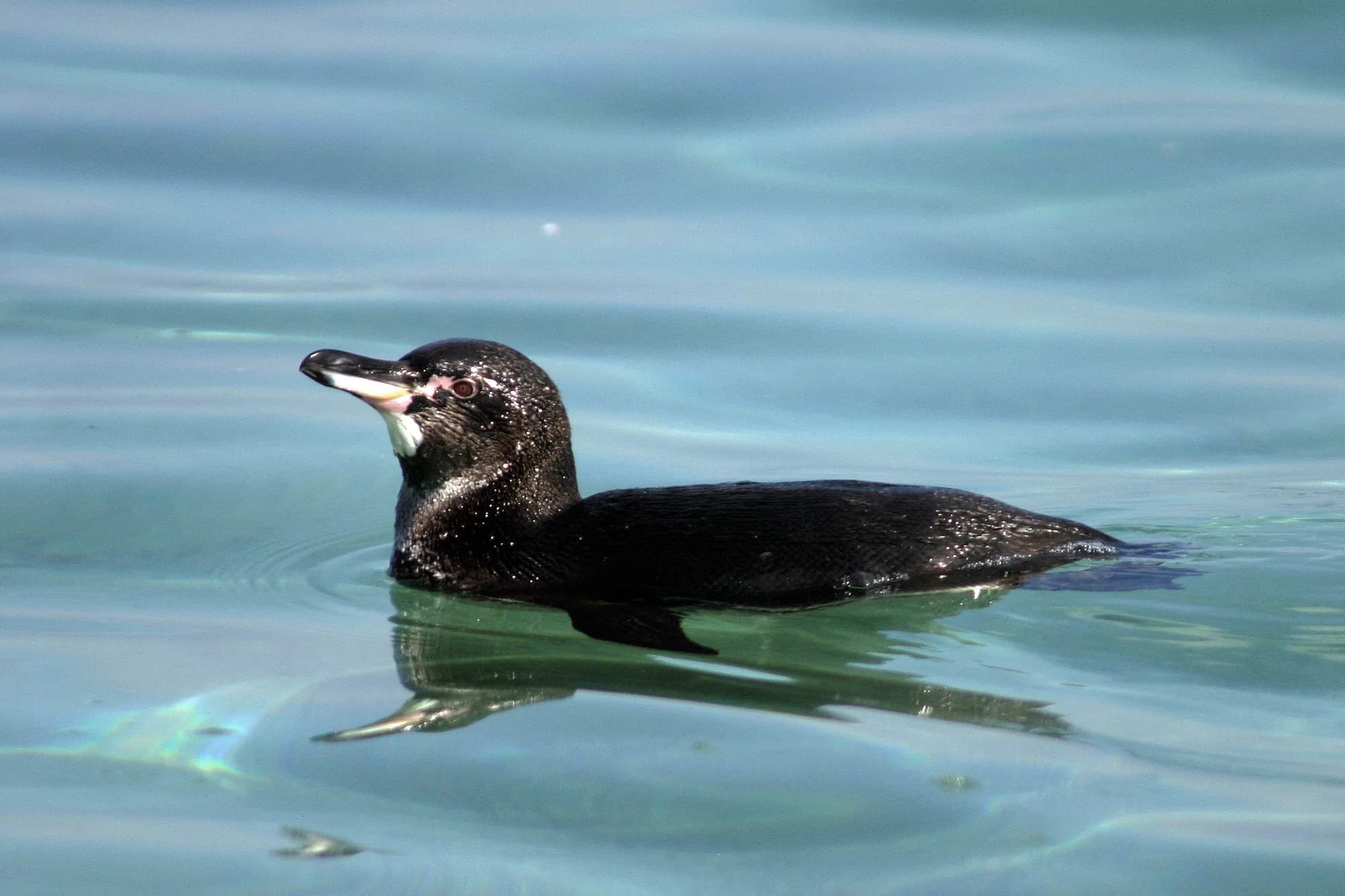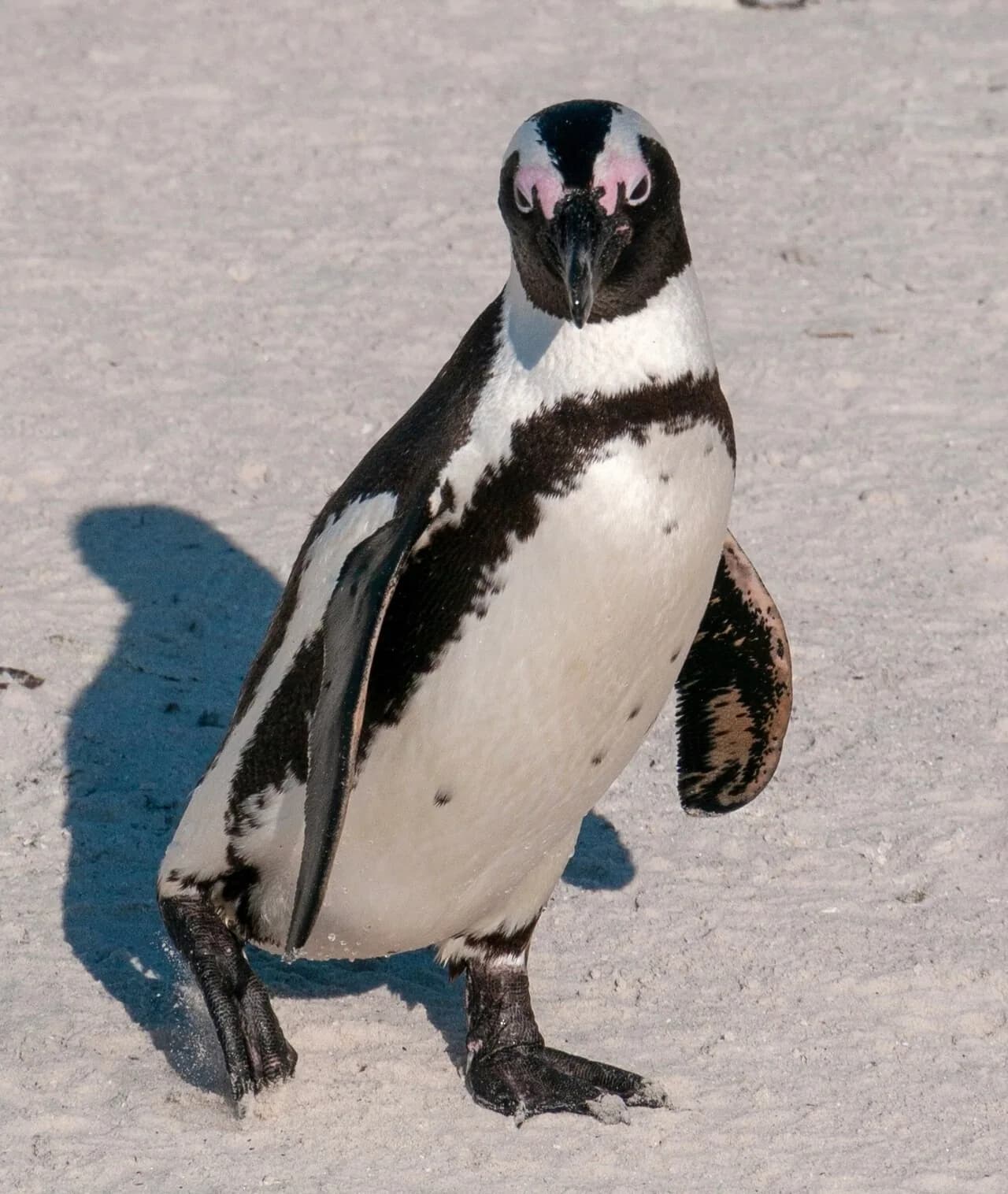
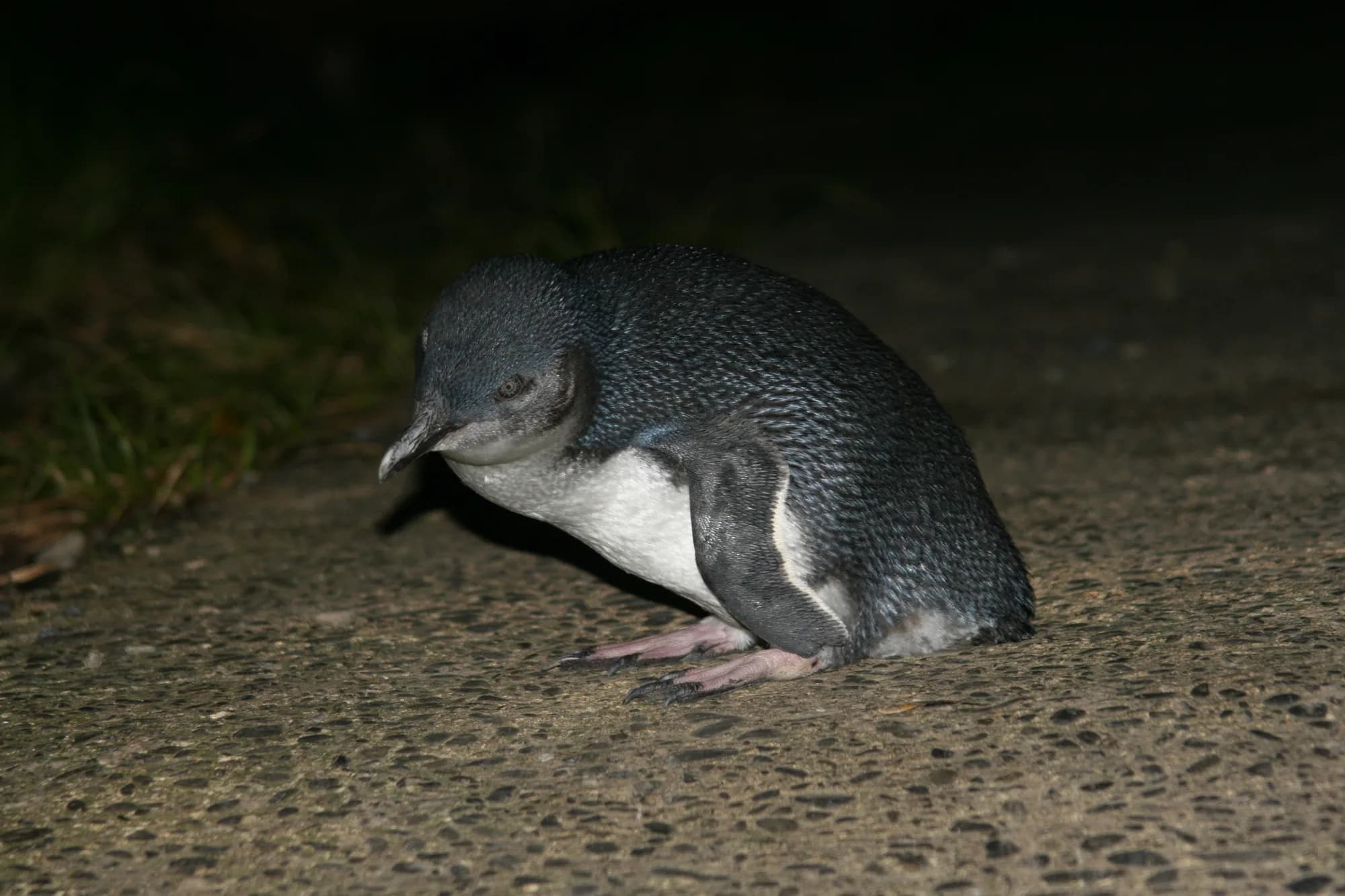
The Little Blue Penguin is 30–33 cm tall and weighs 1–1.5 kg, and it is not a scaled-down version of anything. Small size in a marine endotherm is a set of hard constraints — heat leaks faster, oxygen stores are smaller, reserves run out sooner — and the species that live at the bottom of the ranking have had to solve each of those problems with something other than body mass.
What Most People Get Wrong
The gap at the bottom is larger than the rest of the ranking
People treat "smallest penguin" as a close-run contest. It is not close. The little blue is the only living penguin under 45 cm and the only one under 1.7 kg. The next smallest by height are the western and eastern rockhoppers at 45–55 cm, a 12 cm step up from the little blue's shortest measurement. By mass the separation is absolute: the little blue tops out at 1.5 kg and the next lightest species, the Galápagos Penguin, starts at 1.7 kg. The ranges do not touch.
Meanwhile the six species immediately above the little blue are separated from each other by a few hundred grams each. One species is genuinely small. The rest are small-ish, in a crowd.
The rockhoppers are not a size story
The western and eastern rockhoppers are both 45–55 cm and both around 2–3.5 kg. They were split on genetic and behavioural grounds, not morphometric ones, and any account that contrasts their sizes is describing something that is not there. The same applies more broadly: Eudyptes is the largest genus in the family and its members cluster tightly, from 45 cm at the small end to 77 cm at the large end, with almost every species overlapping every other.
Small does not mean tropical
The little blue works temperate New Zealand and southern Australian coasts. The Galápagos Penguin sits on the equator. The African Penguin at 2.2–3.5 kg works the Benguela upwelling. The rockhoppers at similar mass work sub-Antarctic islands. Small body size is not a warm-water adaptation. It is a coastal, short-commute adaptation that happens to be compatible with warm water when shelter is available.
Why This Problem Is Hard
Surface area and volume scale against each other
Heat is produced in proportion to volume and lost in proportion to surface area, and surface area falls away more slowly than volume as a body shrinks. The consequence is visible at the other end of the ranking: the Emperor Penguin has a lower critical temperature of about −10 °C, and that figure was attributed to large body size and body shape giving a smaller relative surface area, not to unusual insulation — its minimal thermal conductance, 1.31 W m⁻² °C⁻¹, is within the ordinary avian range.1
A 1 kg penguin has the same feathers and the same blood available, and a far worse ratio. It cannot solve the cold with geometry, because it does not have any.
The problem runs in both directions
Little penguins are also poorly equipped to shed heat. Measured evaporative water loss accounted for a maximum of about 40% of total heat production, and cooling of expired respiratory gas recovers a further share of heat and water rather than dumping it.2 Moulting raises metabolic rate about 1.5-fold while thermal conductance rises across the skin, which stacks the two hardest thermal problems of the year on top of each other.2
The small penguin's thermal window is narrow at both ends. That is the constraint the rest of its behaviour is built around.
A small oxygen store caps the dive
Diving depth in penguins tracks body oxygen stores, and those stores scale with mass. The little blue's deepest recorded dive is 72 m, against 565 m for the emperor. Ordinary foraging is far shallower still, in the top 10–30 m, with several hundred to more than a thousand dives recorded in a single day.3 A small penguin cannot buy access to depth. It buys repetition instead, and repetition only works when prey is close to shore.
What Scientists Know
The ranking
| Species | Height (cm) | Weight (kg) | Deepest dive (m) | IUCN status |
|---|---|---|---|---|
| Little Blue Penguin | 30–33 | 1–1.5 | 72 | Least Concern |
| Galápagos Penguin | 49–53 | 1.7–2.6 | 52 | Endangered |
| Western Rockhopper Penguin | 45–55 | 2–3.4 | 113 | Vulnerable |
| Eastern Rockhopper Penguin | 45–55 | 2.1–3.5 | 113 | Vulnerable |
| African Penguin | 60–70 | 2.2–3.5 | 130 | Critically Endangered |
| Snares Penguin | 51–61 | 2.5–4 | 120 | Vulnerable |
| Northern Rockhopper Penguin | 52–62 | 2.5–4.3 | 168 | Endangered |
| Fiordland Penguin | 51–71 | 2.7–5.9 | 60 | Vulnerable |
| Magellanic Penguin | 61–76 | 2.7–6.5 | 97 | Least Concern |
| Erect-crested Penguin | 50–70 | 2.5–6 | 120 | Endangered |
| Chinstrap Penguin | 68–77 | 3.2–5.3 | 121 | Least Concern |
Sorted by weight rather than height, because height ranges in the middle of this table overlap almost completely. The Galápagos Penguin is second lightest and eighth shortest at the same time.
The burrow does the work the body cannot
A little blue that cannot regulate temperature with body mass regulates it with real estate. The species breeds in burrows, rock crevices, dense vegetation and, increasingly, human structures — the sheltered microclimate is not a preference but part of the physiology.3
The measurements bear this out. A three-year study at the north-western range edge of the species compared natural burrows with artificial nest boxes installed between 1986 and 2006. The boxes ran about 2 °C hotter at daily maximum than natural nests and spent longer above the birds' upper thermoneutral limits. Under a simulated 2 °C warming, the number of days exceeding thermally stressful conditions of 35 °C or above rose by up to 49%, with the worst exposure falling during late breeding and moult.4
A nest box is not a neutral substitute for a burrow. For a bird this size it is a thermal decision.
Darkness is the second half of the strategy
Little blues come ashore after dusk, gathering offshore in groups called rafts and crossing the beach together.3 The timing avoids diurnal aerial predators such as Pacific gulls and sea eagles, which a 1 kg bird cannot out-fight or out-run on land. Foraging is correspondingly compressed: adults can take around 25% of body mass in food per day, roughly 250 g, and during breeding must return to a fixed burrow each time.5 Being small forces short loops, and short loops force the colony to sit next to its food.
Tiny penguins are not a recent development
The small end of the family is old. Pakudyptes hakataramea, described from the Late Oligocene of New Zealand, is the earliest known tiny penguin and overlaps in body size with Eudyptula minor. Its bone microanatomy is comparable in structure to Eudyptula.6 A Pliocene relative, Eudyptula wilsonae, extends the small-bodied lineage further.7 Small penguins existed while giant ones were still around; the two solutions ran in parallel for tens of millions of years.
What Is Still Unclear
Whether the smallest penguin is one species or two
Genetic work has repeatedly recovered two divergent clades within Eudyptula — an "Australian" group that includes birds in Otago, and a "New Zealand" group covering the remaining populations. Coalescent modelling indicates the Australian lineage expanded into southern New Zealand only recently, with low levels of hybridisation where the two now co-occur, consistent with an anthropogenic turnover event.8 Some authorities treat these as subspecies, others argue for full species status as E. minor and E. novaehollandiae, and historically E. albosignata was recognised for the white-flippered form.
This site follows a single-species treatment. That is a defensible reading of an unsettled question, not a resolved one.
How hot is too hot
The 35 °C threshold used in nest-temperature work is an upper thermoneutral limit, not a measured lethal point, and the physiological consequences of repeated exposure just below it are not quantified.4 How much heat a moulting or incubating little blue can absorb before breeding output falls remains an open measurement.
Whether shortness causes coastal life or follows it
Small penguins forage close to shore and shelter heavily, and the standard explanation runs from body size to behaviour. The reverse is at least as plausible: lineages that settled into productive nearshore water with abundant crevice habitat may have had no selective pressure to stay large. The Galápagos Penguin's history illustrates the difficulty — its population crashed by 77% after the 1982–83 El Niño and 65% after 1997–98, which tells you the constraint is prey supply, and says nothing about which came first.9
Where To Go Next
For the geometry that makes cold survivable at the other end of the ranking, read why penguins don't freeze. For why a small oxygen store caps depth, read how penguins dive so deep. The sharpest single contrast in the family is the emperor and little blue comparison, and the shelter-dependence theme continues across the rocky coastlines these species depend on. The opposite end of the trade is worked through in largest penguins.
References
-
Le Maho, Y., Delclitte, P. & Chatonnet, J. (1976). Thermoregulation in fasting emperor penguins under natural conditions. American Journal of Physiology 231(3): 913–922. https://pubmed.ncbi.nlm.nih.gov/970475/ ↩
-
Baudinette, R.V., Gill, P. & O'Driscoll, M. (1986). Energetics of the little penguin, Eudyptula minor: temperature regulation, the calorigenic effect of food, and moulting. Australian Journal of Zoology 34(1): 35–45. https://doi.org/10.1071/ZO9860035 ↩ ↩2
-
Tasmanian Department of Natural Resources and Environment. Little Penguin Toolkit, Section 2: Little Penguin Ecology. https://nre.tas.gov.au/Documents/1b%20Penguin%20Toolkit%20Section%202%20Little%20Penguin%20Ecology.pdf ↩ ↩2 ↩3
-
Clitheroe, E.K., Cannell, B.L., Murray, K.L. & Fontaine, J.B. (2025). Temperatures inside little penguin Eudyptula minor artificial nest habitats exceed upper thermal limits in a range edge population. Journal of Avian Biology 2025(4): e03382. https://doi.org/10.1002/jav.03382 ↩ ↩2
-
Phillip Island Nature Parks. Little Penguins — Nature Note. https://www.penguins.org.au/assets/conservation/education/Nature-Notes/2024/2023_little-penguins_Nature-Note.pdf ↩
-
Ando, T., Robinson, J.H., Richards, M.D. & Fordyce, R.E. (2024). A new tiny fossil penguin from the Late Oligocene of New Zealand and the morphofunctional transition of the penguin wing. Journal of the Royal Society of New Zealand 54(5): 660–681. https://doi.org/10.1080/03036758.2024.2362283 ↩
-
Thomas, D.B., Tennyson, A.J.D., Marx, F.G. & Ksepka, D.T. (2023). Pliocene fossils support a New Zealand origin for the smallest extant penguins. Journal of Paleontology 97(3): 711–721. https://doi.org/10.1017/jpa.2023.30 ↩
-
Grosser, S., Burridge, C.P., Peucker, A.J. & Waters, J.M. (2015). Coalescent modelling suggests recent secondary-contact of cryptic penguin species. PLOS ONE 10(12): e0144966. https://doi.org/10.1371/journal.pone.0144966 ↩
-
Vargas, F.H., Harrison, S., Rea, S. & Macdonald, D.W. (2006). Biological effects of El Niño on the Galápagos penguin. Biological Conservation 127(1): 107–114. https://doi.org/10.1016/j.biocon.2005.08.001 ↩