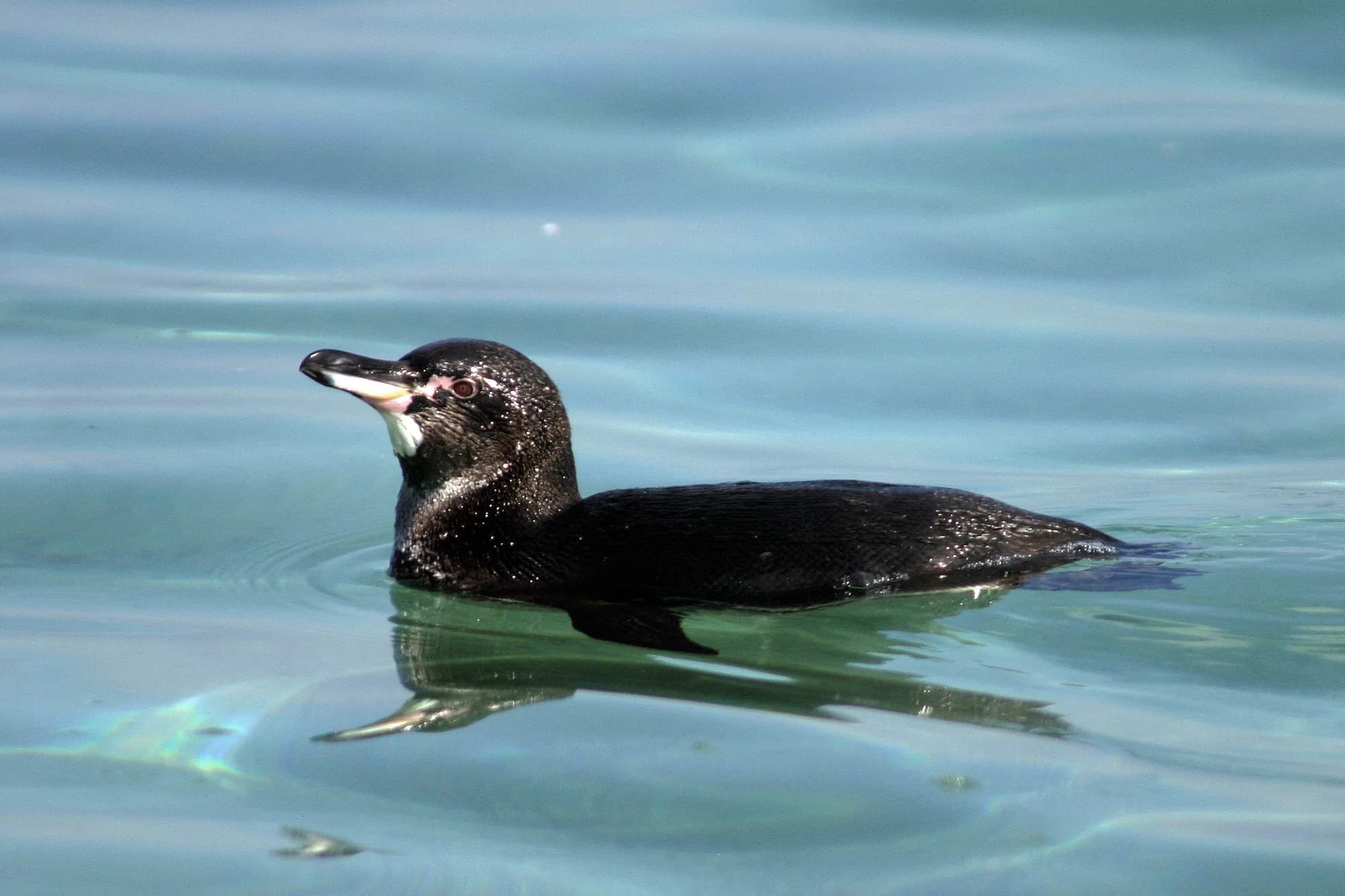
The Galapagos Penguin breeds within a degree of the equator, on islands whose air temperature routinely passes 30 °C. It is not an exception that proves a rule about cold. It is the clearest demonstration of the actual rule. Penguins are not cold-climate birds. They are cold-water birds, and the difference explains the entire map.
What Most People Get Wrong
Most penguins are not Antarctic
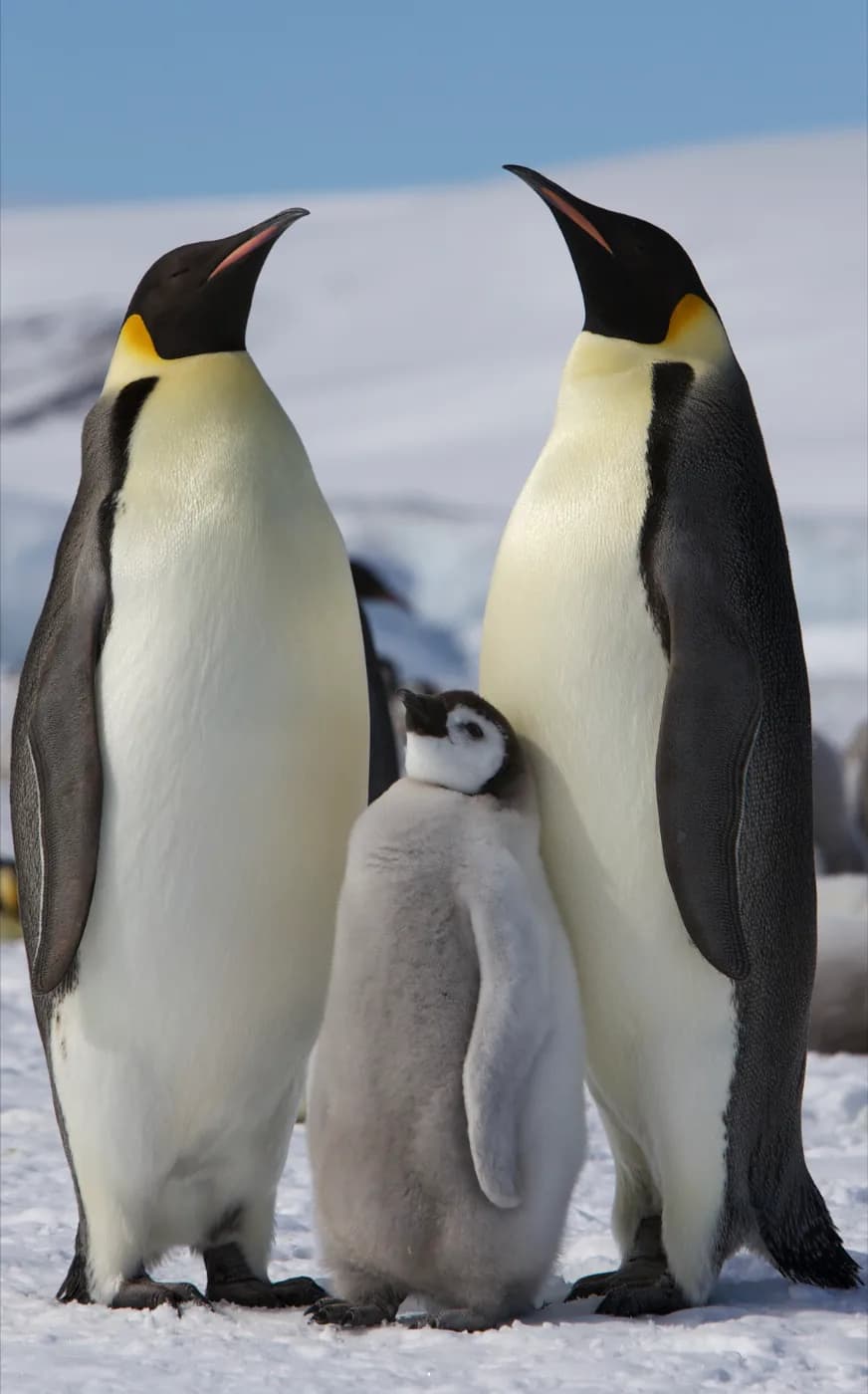
Only two species — the Emperor and the Adélie — breed on the Antarctic continent and its fast ice. Two more, the Chinstrap and the Gentoo, work the Antarctic Peninsula and the Scotia Arc alongside the Adélie. The remaining 15 of the 19 species live north of all of it, on sub-Antarctic islands, temperate coastlines, and in three cases on desert and tropical shores.
The stereotype is not slightly wrong. It covers four species out of 19.
Latitude is the wrong axis
| Region | Species that breed there | Approximate breeding latitude |
|---|---|---|
| Antarctic continent and fast ice | Emperor, Adélie | 66–78° S |
| Antarctic Peninsula and Scotia Arc | Adélie, Chinstrap, Gentoo | 54–65° S |
| South Georgia and sub-Antarctic islands | King, Macaroni, Eastern Rockhopper, Gentoo, Royal | 46–56° S |
| Falkland Islands and southern South America | Magellanic, Western Rockhopper, Gentoo, King | 38–56° S |
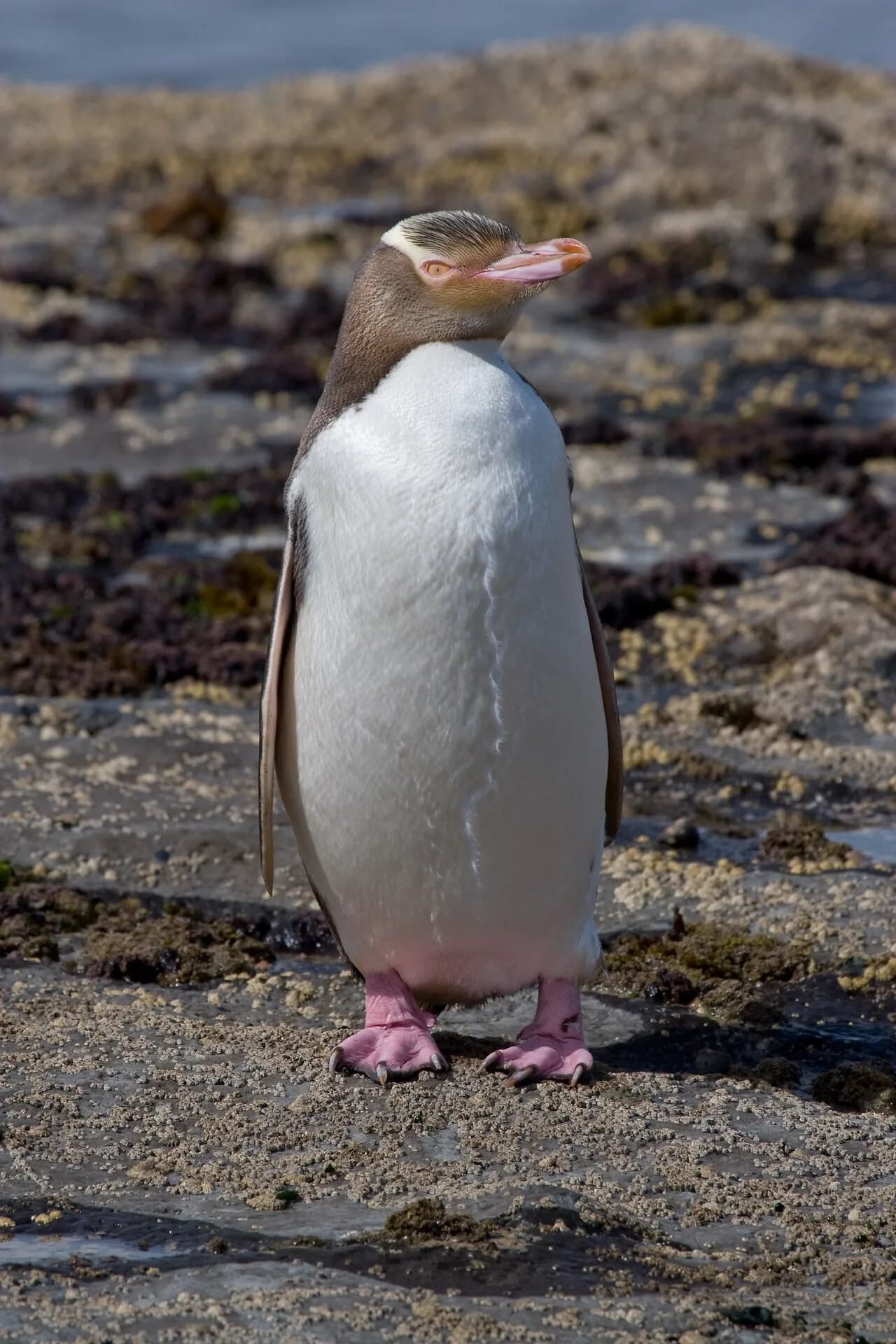
| New Zealand and its southern islands | Yellow-eyed, Fiordland, Snares, Erect-crested, Little Blue | 34–52° S |
| Southern Australia | Little Blue | 32–43° S |
| Tristan da Cunha, Gough, Amsterdam, St Paul | Northern Rockhopper | 37–40° S |
| Peru and northern Chile | Humboldt | 5–42° S |
| Namibia and South Africa | African | 24–35° S |
| Galapagos Islands | Galapagos | 0–1° S |
Read down the latitude column and the pattern breaks immediately. The Humboldt Penguin breeds at 5° S; the African Penguin at 24° S. Both sit at latitudes that on land would be desert. What they share with an Adélie colony at 70° S is not temperature. It is a reliable supply of cold, nutrient-rich water within commuting distance of a nesting site.
The northern hemisphere absence is not simply about heat
The standard explanation — that the tropics are a thermal barrier no penguin can cross — is incomplete. Niche modelling work published in 2025 found that climatically suitable marine conditions for penguins do exist in parts of the northern hemisphere.1 The constraint appears to be a combination of phylogenetic niche conservatism and accessible area: penguins have never had a route across, and nothing has selected for one.
Why This Problem Is Hard
A penguin range must satisfy two independent constraints
Penguins feed at sea and breed on land, and the two requirements are set by different systems. Productive water without safe nesting ground is useless; safe nesting ground without productive water within range is equally useless. Failing either one removes a coastline from the map, and the two rarely fail together.
That is why islands dominate. An island gives direct access to feeding water and, historically, an absence of terrestrial mammalian predators. Introduce a single predator to that island and the marine half of the equation stops mattering.
The land requirement varies far more than the sea requirement
Every penguin needs cold, productive water. Almost nothing else is shared. Emperors breed on floating fast ice with no nest at all. Yellow-eyed Penguins nest solitarily under coastal forest and scrub, out of sight of their neighbours. Humboldts dig into guano and desert soil. Little Blue Penguins use burrows and come ashore only after dark. Crested species pack onto rocky coastlines and climb, sometimes tens of metres, to reach the colony.
Ranges are measured at two different scales
Colony census and at-sea tracking answer different questions. A colony map shows where a species breeds — a few weeks of a coastline. Tracking shows where it feeds, which can be hundreds of kilometres away and may extend across an entire ocean basin outside the breeding season. Most published range statements conflate the two.
What Scientists Know
The Southern Ocean fronts do the sorting
The Antarctic Circumpolar Current is banded by fronts — the Antarctic Polar Front and the Subtropical Front among them — where water masses of different temperature and density meet. These are not lines on a chart. They are where production concentrates, and penguin distribution tracks them closely.
Satellite tracking of King Penguins at the Crozet Archipelago showed breeding birds restricted during the austral summer to the Polar Frontal Zone, bounded to the south by the Polar Front and to the north by the Sub-Antarctic Front, with the most intense prospecting at 50–51° S along the northern limit of the Polar Front.2 Their main prey, myctophid lanternfish, sits in summer some 400–500 km south of the colony at the Polar Front itself.3 The birds are not choosing a latitude. They are commuting to a hydrographic feature.
The same fronts explain species limits. Molecular work on crested penguins has repeatedly recovered the Polar Front and Subtropical Front as the boundaries separating lineages — the reason there are three rockhoppers rather than one is, in part, that these fronts have been reducing gene flow for a million years.4
Upwelling is what makes warm-water penguins possible
Three eastern-boundary upwelling systems account for every penguin living outside the cold latitudes.
- The Humboldt Current off Peru and Chile is one of the most productive marine systems on Earth, sustained by persistent upwelling of cold, nutrient-rich water that supports dense stocks of anchoveta, sardine and squat lobster.56 It supports the Humboldt Penguin and the northern part of the Magellanic range.
- The Benguela system off Namibia and South Africa does the same job for the African Penguin.
- In the Galapagos, the Equatorial Undercurrent — the Cromwell Current — runs east beneath the surface and strikes the submarine flanks of Isabela and Fernandina, forcing cold water upward.7 Almost the entire Galapagos Penguin population, currently around 1,200 individuals, lives along those two western shorelines.8
Upwelling explains warm-water penguins better than heat tolerance does. The birds are not enduring the tropics. They are sitting in a cold anomaly a few kilometres wide, which is the argument set out in why some penguins live in hot places.
Productivity alone does not place a colony
The Western Antarctic Peninsula shelf is productive along its full length, yet Adélie colonies are distributed unevenly along it. The leading explanation — the canyon hypothesis — is that submarine canyons cutting the shelf concentrate and retain krill predictably enough for a colony to be built beside them.9 Penguins do not settle where food is abundant. They settle where food is abundant reliably, in the same place, every year.
The family moved out of the cold, not into it
Phylogenetic reconstruction places the origin of living penguins in the Antarctic, with more derived lineages occurring at progressively lower latitudes as global cooling reshaped the Southern Ocean.10 The tropical species are the recent frontier of that expansion, not relics of a warm past.
What Is Still Unclear
Where the fronts go next
Frontal positions are shifting, and there is no consensus on how far or how fast. Because so much penguin distribution is keyed to those fronts rather than to absolute temperature, a poleward shift of a few degrees does not simply warm a colony. It lengthens every foraging trip made from it, which is a breeding-success problem before it is a survival problem.
Whether warm-edge species can move
The Galapagos case cuts both ways and is worth stating honestly. The cold pool west of Isabela and Fernandina has been intensifying and expanding northward since 1982, with a measured cooling trend of about 0.8 °C over 33 years, driven by an equatorward shift in the Equatorial Undercurrent.7 That is a rare piece of good news, and it is not obviously durable. The same population crashed hard after the 1982–83 El Niño, and with roughly 1,200 individuals confined to two coastlines there is no room to relocate.8
The ice-obligate species have the least flexibility
Almost all emperor colonies depend on stable land-fast ice.11 In 2022, record-low sea ice in the central and eastern Bellingshausen Sea broke up before the fledging period, and of five emperor colonies in the region, four suffered total breeding failure. It was the first widespread emperor breeding failure clearly linked to large-scale sea-ice contraction.12 What is unclear is whether colonies can relocate to more stable ice fast enough to matter, and current evidence on that is thin.
Where To Go Next
Start with the region hubs to see the cast by coastline, or the Antarctica hub for the ice-dependent species. For the nesting-ground half of the equation, browse penguin habitats. For the marine half — what the productive water actually contains and who eats it — read what penguins eat, and for the warm-edge species specifically, why some penguins live in hot places.
References
-
dos Santos, A.M. & Oliveira, U. (2025). Environmental and evolutionary forces shaping penguin geographic limits. Journal of Biogeography 52 (doi:10.1111/jbi.15179) — highest habitat suitability in the southern hemisphere "although suitable locations also exist in the Northern Hemisphere", with strong phylogenetic niche conservation and accessible area modelled explicitly. https://europepmc.org/article/AGR/IND609268420 ↩
-
Bost, C.-A., Georges, J.-Y., Guinet, C., Cherel, Y., Pütz, K., Charrassin, J.-B., Handrich, Y., Zorn, T., Lage, J. & Le Maho, Y. (1997). Foraging habitat and food intake of satellite-tracked king penguins during the austral summer at Crozet Archipelago. Marine Ecology Progress Series 150: 21–33 — intense prospecting at the northern limit of the Polar Front (50–51° S) and the southern limit of the Sub-Antarctic Front (44.5–45° S); myctophids dominated the diet. https://hal.science/hal-03849670 ↩
-
Charrassin, J.-B. & Bost, C.-A. (2001). Utilisation of the oceanic habitat by king penguins over the annual cycle. Marine Ecology Progress Series 221: 285–298 — incubating and brooding birds in summer preferentially exploited the polar front located 340 to 450 km south of the breeding site. https://hal.science/hal-03692410 ↩
-
Frugone, M.J., Lowther, A., Noll, D., Ramos, B., Pistorius, P., Dantas, G.P.M., Petry, M.V., Bonadonna, F., Steinfurth, A., Polanowski, A., Raya Rey, A., Lois, N.A., Pütz, K., Trathan, P., Wienecke, B., Poulin, E. & Vianna, J.A. (2018). Contrasting phylogeographic pattern among Eudyptes penguins around the Southern Ocean. Scientific Reports 8: 17481 — the Antarctic Polar Front and Subtropical Front act as barriers, supporting three rockhopper species. https://doi.org/10.1038/s41598-018-35975-3 ↩
-
Chavez, F.P., Bertrand, A., Guevara-Carrasco, R., Soler, P. & Csirke, J. (2008). The northern Humboldt Current System: brief history, present status and a view towards the future. Progress in Oceanography 79: 95–105 — the system "produces more fish per unit area than any other region in the world oceans", on less than 0.1% of the ocean surface. https://doi.org/10.1016/j.pocean.2008.10.012 ↩
-
Gutiérrez, M., Ramirez, A., Bertrand, S., Móron, O. & Bertrand, A. (2008). Ecological niches and areas of overlap of the squat lobster 'munida' (Pleuroncodes monodon) and anchoveta (Engraulis ringens) off Peru. Progress in Oceanography 79: 256–263. https://doi.org/10.1016/j.pocean.2008.10.019 ↩
-
Karnauskas, K.B., Jenouvrier, S., Brown, C.W. & Murtugudde, R. (2015). Strong sea surface cooling in the eastern equatorial Pacific and implications for Galápagos Penguin conservation. Geophysical Research Letters 42: 6432–6437 — local upwelling from upward deflection of the Equatorial Undercurrent by the islands; cold pool intensifying and expanding northward since 1982 at 0.8 °C/33 yr, consistent with an equatorward shift of the Undercurrent. https://www2.whoi.edu/site/jenouvrier/wp-content/uploads/sites/118/2021/02/Karnauskas_et_al-2015-Geophysical_Research_Letters.pdf ↩ ↩2
-
Boersma, P.D. (1998). Population trends of the Galápagos penguin: impacts of El Niño and La Niña. The Condor 100(2): 245–253 — breeding areas confined largely to where the Cromwell Current upwells around Fernandina and Isabela; the population dropped precipitously after the 1982–83 El Niño. https://digitalcommons.usf.edu/condor/vol100/iss2/4/ ↩ ↩2
-
Schofield, O., Ducklow, H., Bernard, K., Doney, S., Patterson-Fraser, D., Gorman, K., Martinson, D., Meredith, M., Saba, G., Stammerjohn, S., Steinberg, D. & Fraser, W. (2013). Penguin biogeography along the West Antarctic Peninsula: testing the canyon hypothesis with Palmer LTER observations. Oceanography 26(3): 204–206. https://doi.org/10.5670/oceanog.2013.63 ↩
-
Baker, A.J., Pereira, S.L., Haddrath, O.P. & Edge, K.-A. (2006). Multiple gene evidence for expansion of extant penguins out of Antarctica due to global cooling. Proceedings of the Royal Society B 273: 11–17. https://pmc.ncbi.nlm.nih.gov/articles/PMC1560011/ ↩
-
IUCN (2026). Emperor penguin and Antarctic fur seal now Endangered due to climate change – IUCN Red List. Press release, Gland, 9 April 2026 — "Emperor penguins require fast ice … as habitat for their chicks and during their moulting season"; uplisted from Near Threatened to Endangered. https://iucn.org/press-release/202604/emperor-penguin-and-antarctic-fur-seal-now-endangered-due-climate-change-iucn ↩
-
Fretwell, P.T., Boutet, A. & Ratcliffe, N. (2023). Record low 2022 Antarctic sea ice led to catastrophic breeding failure of emperor penguins. Communications Earth & Environment 4: 273 — of the five breeding sites in the central and eastern Bellingshausen Sea, all but one suffered total breeding failure after sea-ice break-up before the fledging period; the first widespread failure clearly linked to large-scale sea-ice contraction. https://doi.org/10.1038/s43247-023-00927-x ↩