
Penguins in Bounty Islands
Bounty Islands are linked here mainly with Erect-crested Penguin. Regional hubs with one species are still useful: they show the place-specific trap that bird is in.
Bounty Islands are part of the penguin world because the surrounding seas, nesting ground, and climate make life possible there. On this page that means one bird first: Erect-crested Penguin. With an extremely restricted breeding range and low reproductive flexibility, this species has very little buffer when conditions turn poor.
Species in lens
1
Singleton hub — depth over breadth
Profile focus
Erect-crested Penguin
Up to 70 cm
Highest risk in view
Erect-crested Penguin
Endangered
Species profile entry
Bounty Islands are part of the penguin world because the surrounding seas, nesting ground, and climate make life possible there.
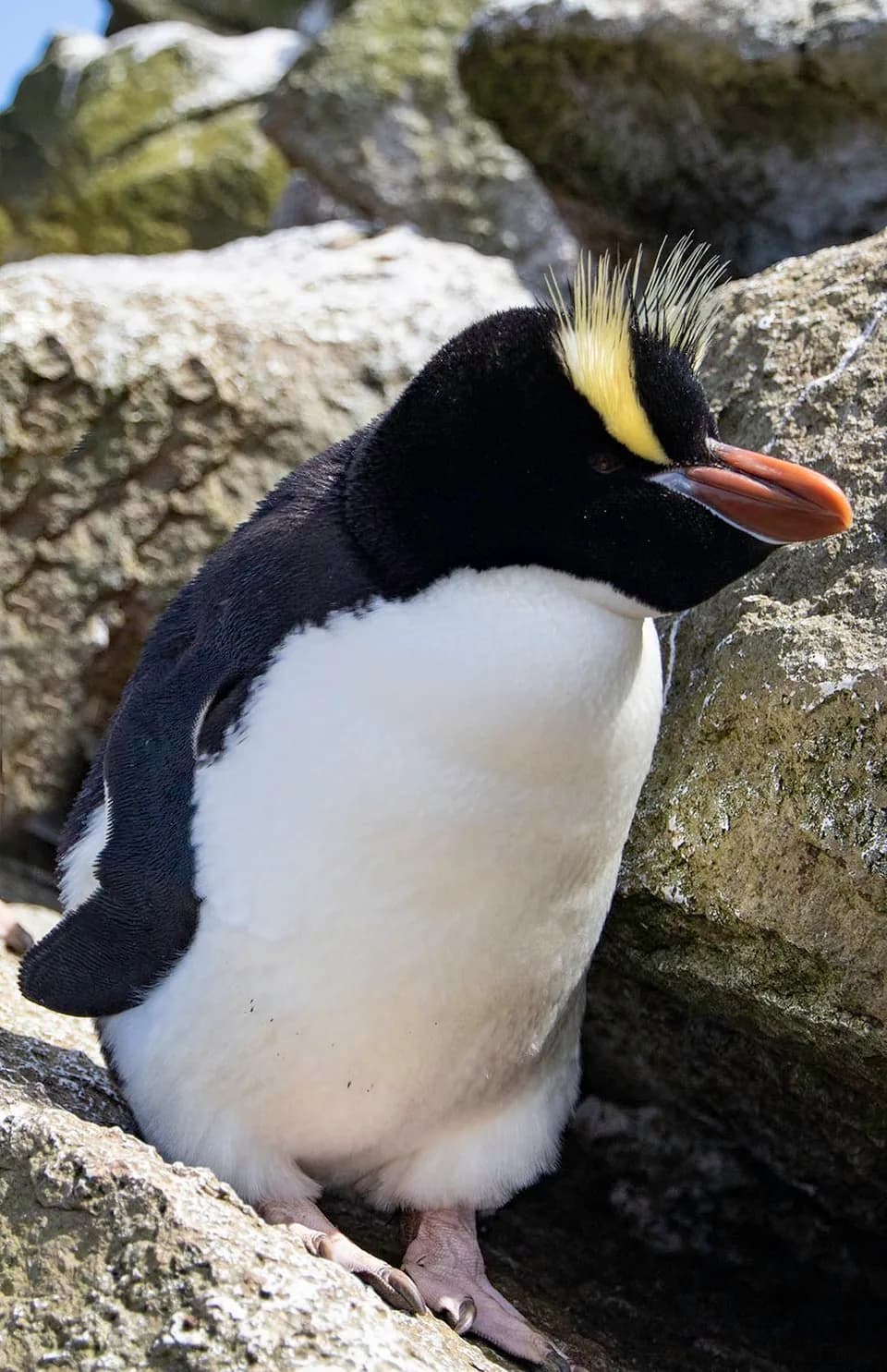
Signature insight
Erect-crested Penguins are the awkward question in penguin reproduction: why lay a first egg you almost never raise?
Open full Erect-crested Penguin profileWhat this view reveals
- Erect-crested Penguin is the only species in this region view right now.
- With an extremely restricted breeding range and low reproductive flexibility, this species has very little buffer when conditions turn poor.
- Conservation: Endangered · ~150,000 breeding pairs.
Understanding Penguins in Bounty Islands
Bounty Islands currently highlights one species in this catalogue: Erect-crested Penguin (Eudyptes sclateri). Erect-crested Penguins are the awkward question in penguin reproduction: why lay a first egg you almost never raise?
Survival brief: With an extremely restricted breeding range and low reproductive flexibility, this species has very little buffer when conditions turn poor. Myth people still carry: Two eggs means two real chances at a chick. What the evidence supports instead: In erect-crested penguins, the first egg is so often lost or ignored that it looks less like a backup and more like an unresolved evolutionary puzzle.
Field numbers: 50–70 cm, 2.5–6 kg, lifespan about 15–20 years. Status Endangered; population ~150,000 breeding pairs; trend decreasing.
Where and what: ranges include Bounty Islands and Antipodes Islands (New Zealand); habitats Rocky coastlines and Sub-Antarctic islands; diet krill, squid, and small fish. Classified as Endangered, with significant population declines over the past several decades. Open the full profile for sources, research gaps, and related species.
Frequently asked questions
Which penguins live in Bounty Islands?
In this catalogue, Erect-crested Penguin is the species tied to this region page. One of the least-known penguin species, named for distinctive upward-pointing yellow crest feathers they can raise and lower at will.
What is the main survival problem for Erect-crested Penguin?
With an extremely restricted breeding range and low reproductive flexibility, this species has very little buffer when conditions turn poor.
What is the conservation status of Erect-crested Penguin?
Erect-crested Penguin is listed as Endangered, with an estimated population of ~150,000 breeding pairs. Trend: decreasing. Classified as Endangered, with significant population declines over the past several decades.