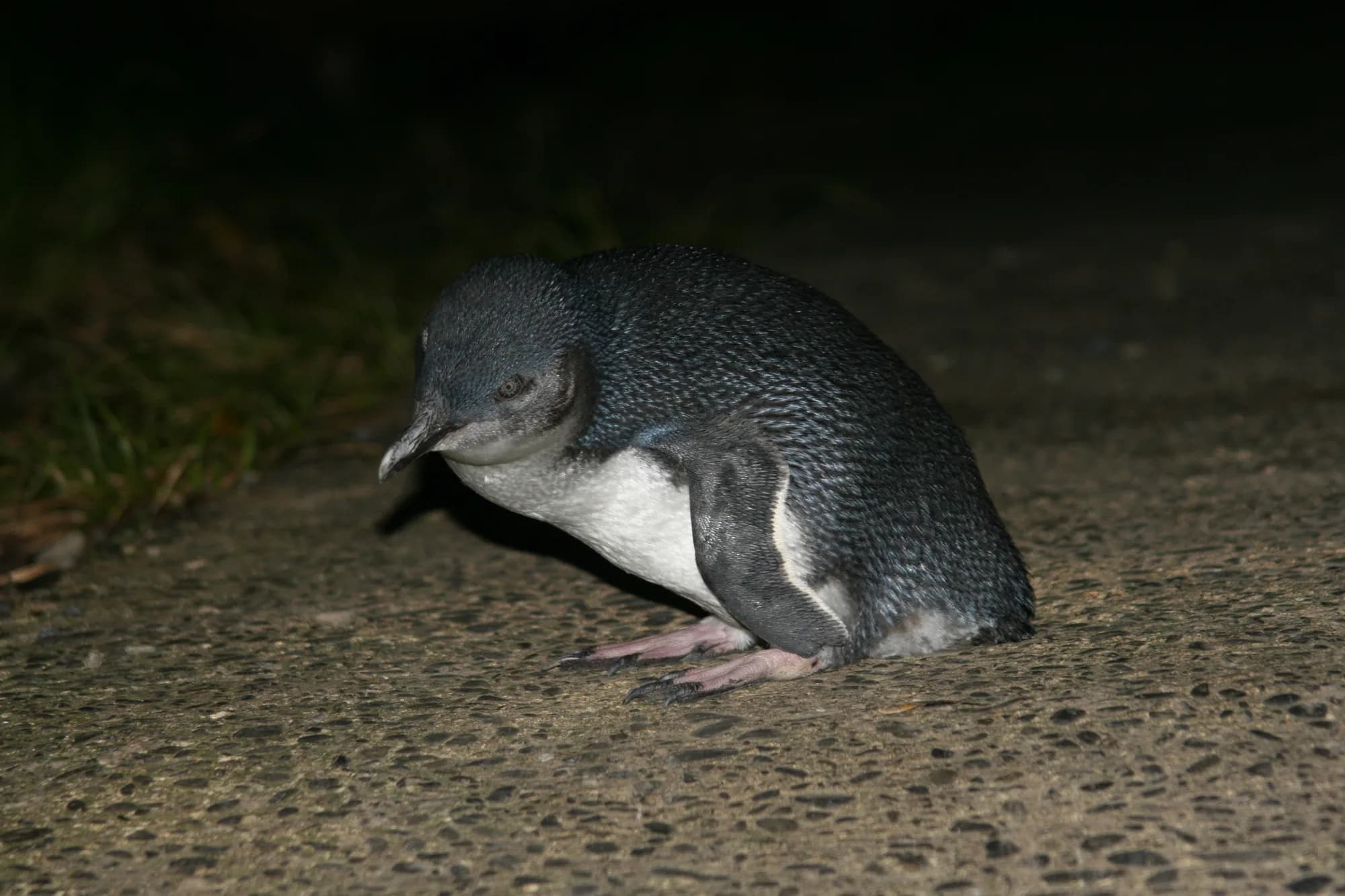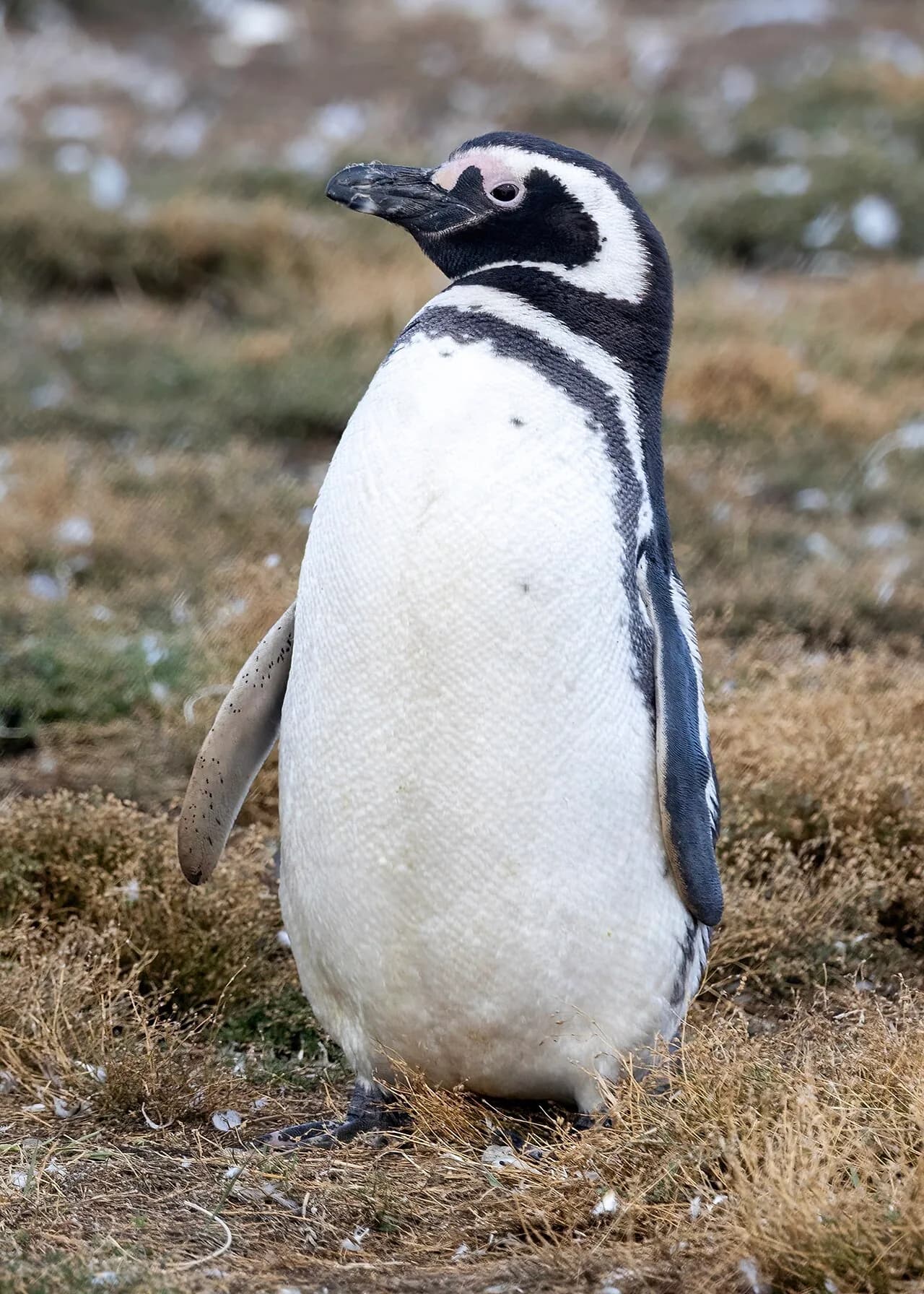
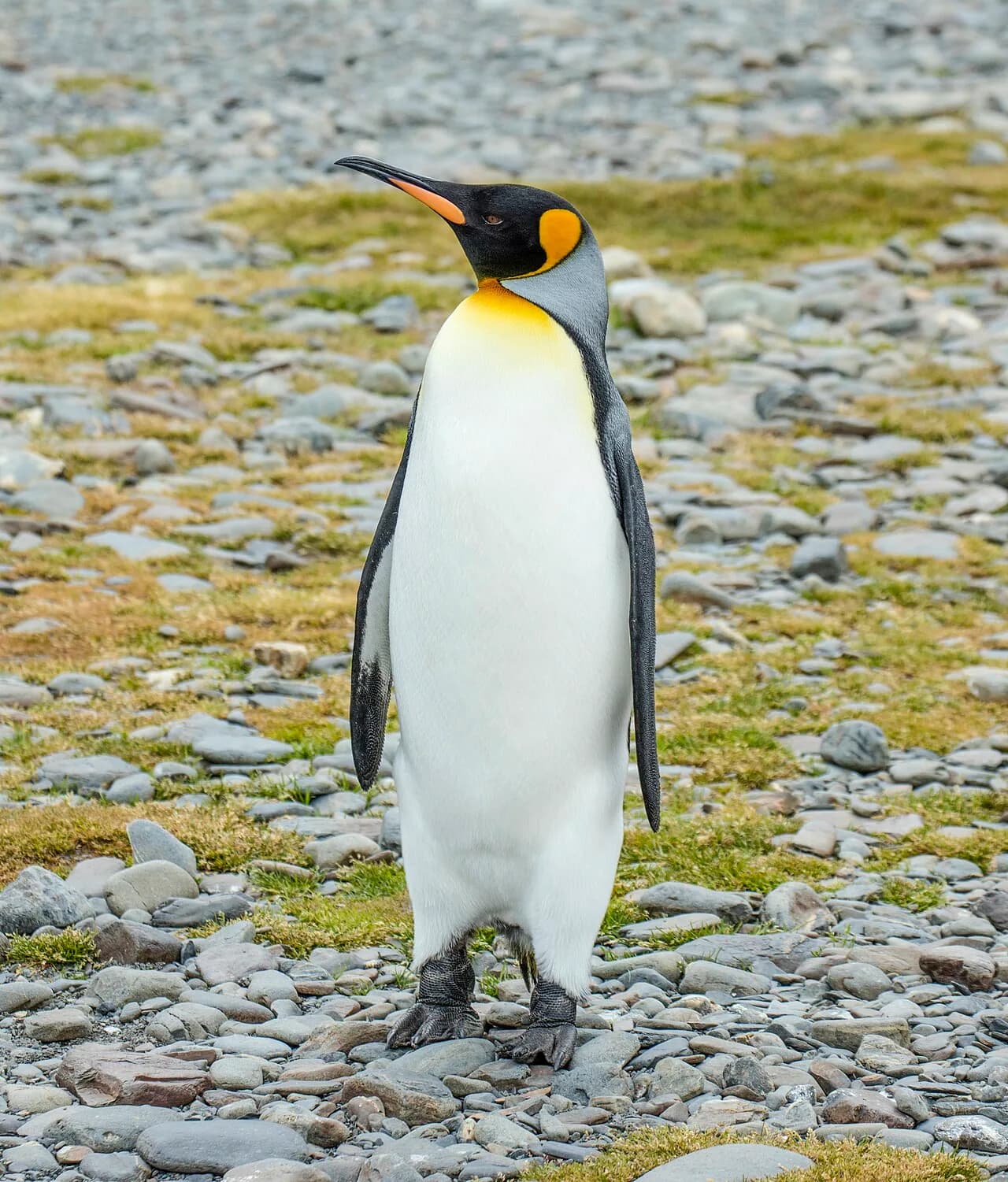
The King Penguin and the Magellanic Penguin both carry a published lifespan of 25–30 years, which puts them at the top of this ranking and hides most of what the ranking is actually made of. A lifespan figure for a wild penguin is not an observation. It is an estimate assembled from marked birds, using a marking method that has been shown to shorten the lives it was measuring.
What Most People Get Wrong
Lifespan is a survival curve, not a countdown
"Lives 25 years" reads like a design specification. It is a summary of a distribution in which the overwhelming majority of individuals die early. At Phillip Island, first-year survival in Little Blue Penguins was estimated at 17%, rising to 71% in the second year and around 80% thereafter, declining gradually after about age nine.1 Average life expectancy for a breeding adult of the species is roughly 6.5 years. The species maximum is 25 years and 8 months.2
Six and a half years and twenty-five years describe the same population.
Size does not rank longevity
The intuitive story — bigger bird, slower life, longer life — does not survive contact with the table below. The Magellanic Penguin weighs 2.7–6.5 kg and is listed at 25–30 years. The King Penguin weighs 11–16 kg and is listed at the same 25–30 years. The Emperor Penguin, heaviest living penguin at 22–45 kg, is listed at 15–20 years, which is a lower ceiling than a 1 kg little blue.
Body mass predicts diving depth and fasting endurance well. It predicts recorded lifespan badly.
The wide ranges are honesty
Lifespans given as 6–25, 8–25, 10–30 and 10–27 years look like sloppy reference work. They are the opposite. They are what happens when a figure has to cover a first-year mortality of over 80% at one end and a rare marked survivor at the other, using data that cannot follow individuals at sea.
Why This Problem Is Hard
The animal spends most of its life where nobody is watching
Little penguins spend around 80% of their time at sea,3 and most mortality appears to occur there.2 Nothing about a death at sea is recorded. What field studies observe is presence at a colony, and absence from a colony has at least three explanations — death, emigration, and failure to be detected — which standard mark-recapture models must separate statistically rather than observe directly. Estimates of this kind are properly called apparent survival for that reason.
The main measuring instrument damages the subject
Penguins cannot be leg-banded because of their leg joint anatomy, so bands go around a flipper. That is the limb used for propulsion, beating several times a second.
A decade-long experiment on king penguins at Possession Island in the Crozet archipelago split 100 birds between steel flipper bands and implanted electronic transponders.4 After ten years, 10 of the 50 banded birds were still alive against 18 of the 50 transponder-only birds — 20% survival against 36%. Banded birds arrived later in the season for courtship, made longer foraging trips, and produced roughly 40% fewer chicks.5 An earlier study from the same programme found that survival of unbanded, electronically tagged king penguin chicks after two to three years was about twice the rate reported in the literature for banded chicks.4
Flipper banding is not a neutral observation. It is an intervention that lowers the number it exists to measure.
The bias runs the wrong way for records
The consequence for longevity records specifically is that they are biased low. Banding has been shown to affect survival in five of six penguin species studied. In the Phillip Island longevity work, five of the seven birds that survived more than 20 years had needed their bands replaced for excessive wear, on average 12.5 years after initial banding — meaning the marks were degrading on precisely the individuals whose ages matter most.2
Even watching carefully has a price
A 23-year analysis of Yellow-eyed Penguin breeding on the Otago Peninsula examined investigator disturbance alongside life-history variables, on a species known to be sensitive to human intrusion, and found that only 18.8% of chicks survived to breed and 10.3% went on to produce banded offspring of their own. Handling birds, eggs and chicks is how the data exist. It is also a variable in the data.
What Scientists Know
The ranking
| Species | Lifespan (yr) | Weight (kg) | Clutch | IUCN status |
|---|---|---|---|---|
| King Penguin | 25–30 | 11–16 | 1 | Least Concern |
| Magellanic Penguin | 25–30 | 2.7–6.5 | 2 | Least Concern |
| Western Rockhopper Penguin | 10–30 | 2–3.4 | 2 | Vulnerable |
| Eastern Rockhopper Penguin | 10–30 | 2.1–3.5 | 2 | Vulnerable |
| African Penguin | 10–27 | 2.2–3.5 | 2 | Critically Endangered |
| Little Blue Penguin | 6–25 | 1–1.5 | 2 | Least Concern |
| Yellow-eyed Penguin | 8–25 | 4.5–8.5 | 2 | Endangered |
| Northern Rockhopper Penguin | 10–25 | 2.5–4.3 | 2 | Endangered |
| Adélie Penguin | 10–20 | 3.6–6 | 2 | Least Concern |
| Emperor Penguin | 15–20 | 22–45 | 1 | Endangered |
| Macaroni Penguin | 8–15 | 3.3–6.6 | 2 | Vulnerable |
Read the two columns on the left together. There is no consistent relationship between them, and the Macaroni Penguin — a mid-sized crested penguin with a population in the millions — carries the lowest ceiling in the table.
Mortality is front-loaded, then flat, then rising
The age structure of penguin survival has a consistent shape. Juvenile mortality is severe, adult survival then plateaus at a high value for years, and a slow decline appears in old age. The Phillip Island little penguin analysis, drawn from 23,686 flipper-banded birds followed from 1968 to 2003, put that plateau near 80% annual survival and located the decline after age nine.6
What sits underneath the juvenile figure is conditions at fledging rather than genetics. First-year survival in that dataset rose with mean fledging weight and with the number of chicks fledged per pair, fell with later mean laying date, and increased after warmer sea surface temperatures in the preceding summer and autumn. Chicks hatched early in a season survived their first year far better than late chicks in the same cohort.6
Deferred maturity is the other half of the strategy
Long-lived seabirds do not breed at their first opportunity. Female little penguins reach sexual maturity at around two years,7 and many penguins take longer to recruit into the breeding population. Work on Adélie Penguins at three Ross Island colonies, using known-age and known-history birds tracked from 1996 to 2019, found that pre-breeders had higher survival rates than breeders.8 Waiting is not idleness. It is a cheaper state than breeding.
The corresponding trade appears in king penguins studied without flipper bands: birds that skipped breeding in a given year had the same survival as breeders, but breeders were less likely to breed again the following year.9 The cost of reproduction in this species is paid in future breeding opportunities rather than in immediate mortality. That logic is developed further in penguin breeding and chicks.
One species can hold two different survival curves
Thirty-three years of resightings at Punta Tombo, from roughly 44,000 Magellanic chicks banded between 1983 and 2010, found that non-breeding-season survival was lower for females than for males, that the gap was largest in juveniles, and that it widened in the worst years. The bias accumulated as cohorts aged, progressively skewing the colony's sex ratio.10
A single lifespan figure for a species averages over that. The average conceals the mechanism driving the decline.
What Is Still Unclear
The upper bound is genuinely unresolved
The peer-reviewed longevity record for a little penguin is a male banded as a chick on 2 January 1976 at Phillip Island, recorded incubating eggs on 18 November 2000 at 24 years and 10 months, and recaptured alive on 22 September 2001 at 25 years and 8 months.2 The AnAge database lists a maximum longevity of 42.2 years for the same species, sourced to a banding-scheme record and rated "acceptable" quality rather than high.7
Those two numbers cannot both describe a typical maximum. One is a documented life history with a full breeding record attached; the other is a banding recovery whose provenance has not been examined in the same detail. Until it is, the true ceiling for the species is open.
Whether senescence is real or an artefact
The gradual decline in survival after age nine is consistent with senescence, and it is also consistent with old birds becoming harder to detect, moving between colonies, or losing worn bands. Distinguishing genuine actuarial senescence from declining resight probability requires transponder-based monitoring over decades, and very few colonies have it.
What rising adult mortality does
This is the question with consequences. A life history that invests in adult survival is highly sensitive to losing adults. Population viability analysis for the yellow-eyed penguin concluded that even a small increase in adult mortality raises extinction probability dramatically, and the mainland population is genetically isolated enough that losses are not replaced by immigration — inferred immigration rate 0.003 per generation.11
Long life is not a buffer against that. It is the reason the species has almost no buffer, because a long-lived, slow-breeding bird cannot replace lost adults quickly. That relationship between life history and threat category is unpacked in penguin conservation status explained.
Where To Go Next
For the breeding rhythm that long life is designed to spread risk across, read penguin breeding and chicks. For how these life histories translate into critically endangered listings, read penguin conservation status explained and the conservation overview. To put lifespan next to size and depth for individual species, use compare.
References
-
Sidhu, L.A., Catchpole, E.A. & Dann, P. (2007). Mark-recapture-recovery modeling and age-related survival in little penguins (Eudyptula minor). The Auk 124(3): 815–827. https://doi.org/10.1093/auk/124.3.815 ↩
-
Dann, P., Carron, M., Chambers, B., Chambers, L., Dornom, T., McLaughlin, A., Sharp, B., Talmage, M.E., Thoday, R. & Unthank, S. (2005). Longevity in little penguins Eudyptula minor. Marine Ornithology 33: 71–72. https://doi.org/10.5038/2074-1235.33.1.645 ↩ ↩2 ↩3 ↩4
-
Tasmanian Department of Natural Resources and Environment. Little Penguin Toolkit, Section 2: Little Penguin Ecology. https://nre.tas.gov.au/Documents/1b%20Penguin%20Toolkit%20Section%202%20Little%20Penguin%20Ecology.pdf ↩
-
Gauthier-Clerc, M., Gendner, J.-P., Ribic, C.A., Fraser, W.R., Woehler, E.J., Descamps, S., Gilly, C., Le Bohec, C. & Le Maho, Y. (2004). Long-term effects of flipper bands on penguins. Proceedings of the Royal Society B 271(Suppl. 6): S423–S426. https://doi.org/10.1098/rsbl.2004.0201 ↩ ↩2
-
Saraux, C., Le Bohec, C., Durant, J.M., Viblanc, V.A., Gauthier-Clerc, M., Beaune, D., Park, Y.-H., Yoccoz, N.G., Stenseth, N.C. & Le Maho, Y. (2011). Reliability of flipper-banded penguins as indicators of climate change. Nature 469: 203–206. https://doi.org/10.1038/nature09630 ↩
-
Sidhu, L.A. (2007). Analysis of recovery-recapture data for little penguins. PhD thesis, University of New South Wales. https://doi.org/10.26190/unsworks/18083 ↩ ↩2
-
AnAge: The Animal Ageing and Longevity Database. Eudyptula minor entry (maximum longevity 42.2 years, data quality "acceptable", from the Australian Bird and Bat Banding Scheme; female sexual maturity 727 days). Human Ageing Genomic Resources. https://genomics.senescence.info/species/entry.php?species=Eudyptula_minor ↩ ↩2
-
Morandini, V., Dugger, K.M., Schmidt, A.E., Varsani, A., Lescroël, A., Ballard, G., Lyver, P.O'B., Barton, K. & Ainley, D.G. (2024). Sex-specific recruitment rates contribute to male-biased sex ratio in Adélie penguins. Ecology and Evolution 14(2): e10859. https://doi.org/10.1002/ece3.10859 ↩
-
Le Bohec, C., Gauthier-Clerc, M., Grémillet, D., Pradel, R., Béchet, A., Gendner, J.-P. & Le Maho, Y. (2007). Population dynamics in a long-lived seabird: I. Impact of breeding activity on survival and breeding probability in unbanded king penguins. Journal of Animal Ecology 76(6): 1149–1160. https://doi.org/10.1111/j.1365-2656.2007.01268.x ↩
-
Gownaris, N.J. & Boersma, P.D. (2019). Sex-biased survival contributes to population decline in a long-lived seabird, the Magellanic Penguin. Ecological Applications 29(1): e01826. https://doi.org/10.1002/eap.1826 ↩
-
Ellenberg, U. & Mattern, T. (2012). Yellow-eyed penguin — review of population information. Report POP2011-08 for the New Zealand Department of Conservation. https://www.doc.govt.nz/globalassets/documents/conservation/marine-and-coastal/marine-conservation-services/reports/pre-2019-annual-plans/pop-2011-08-yellow-eyed-penguin-population-information-review.pdf ↩