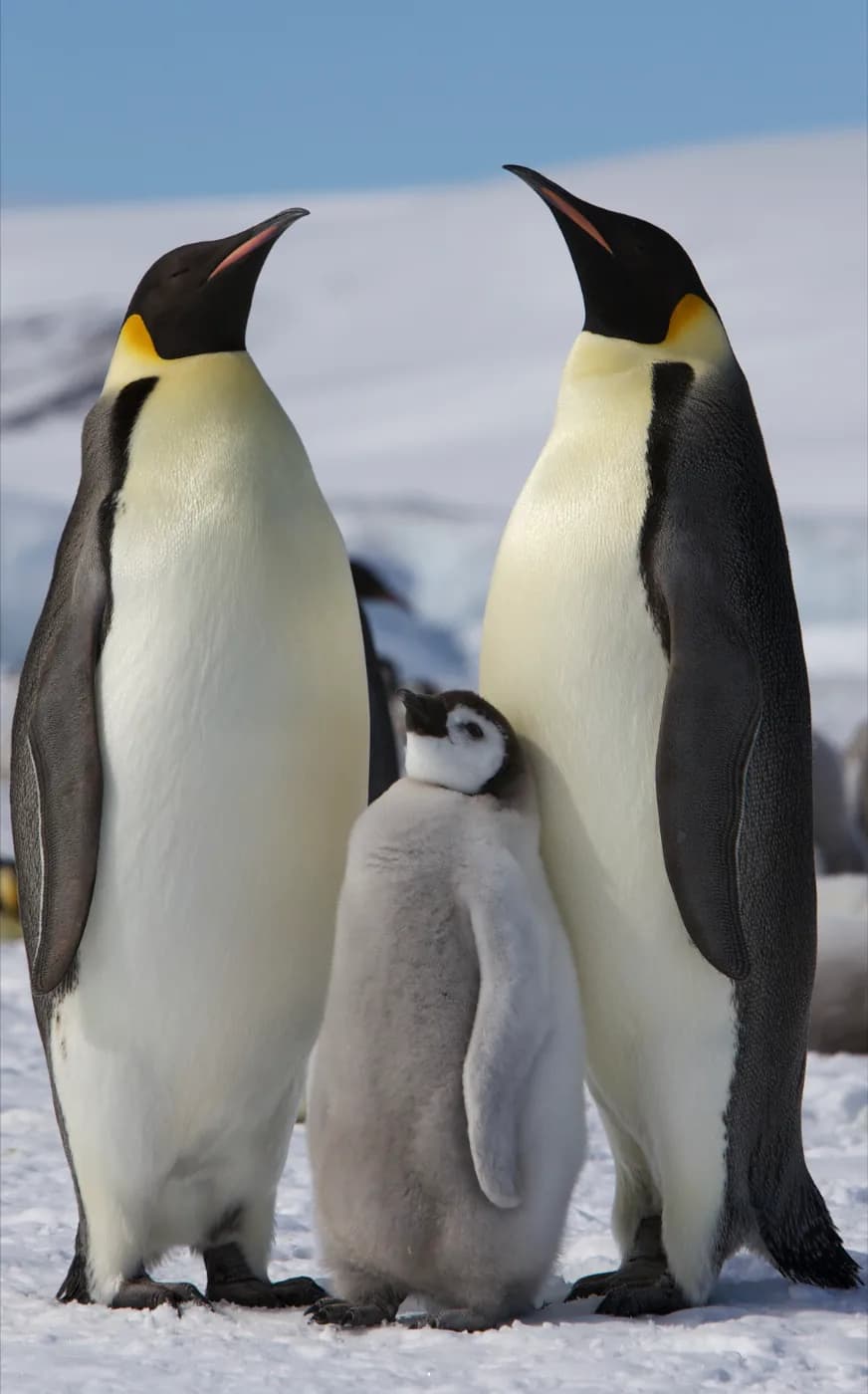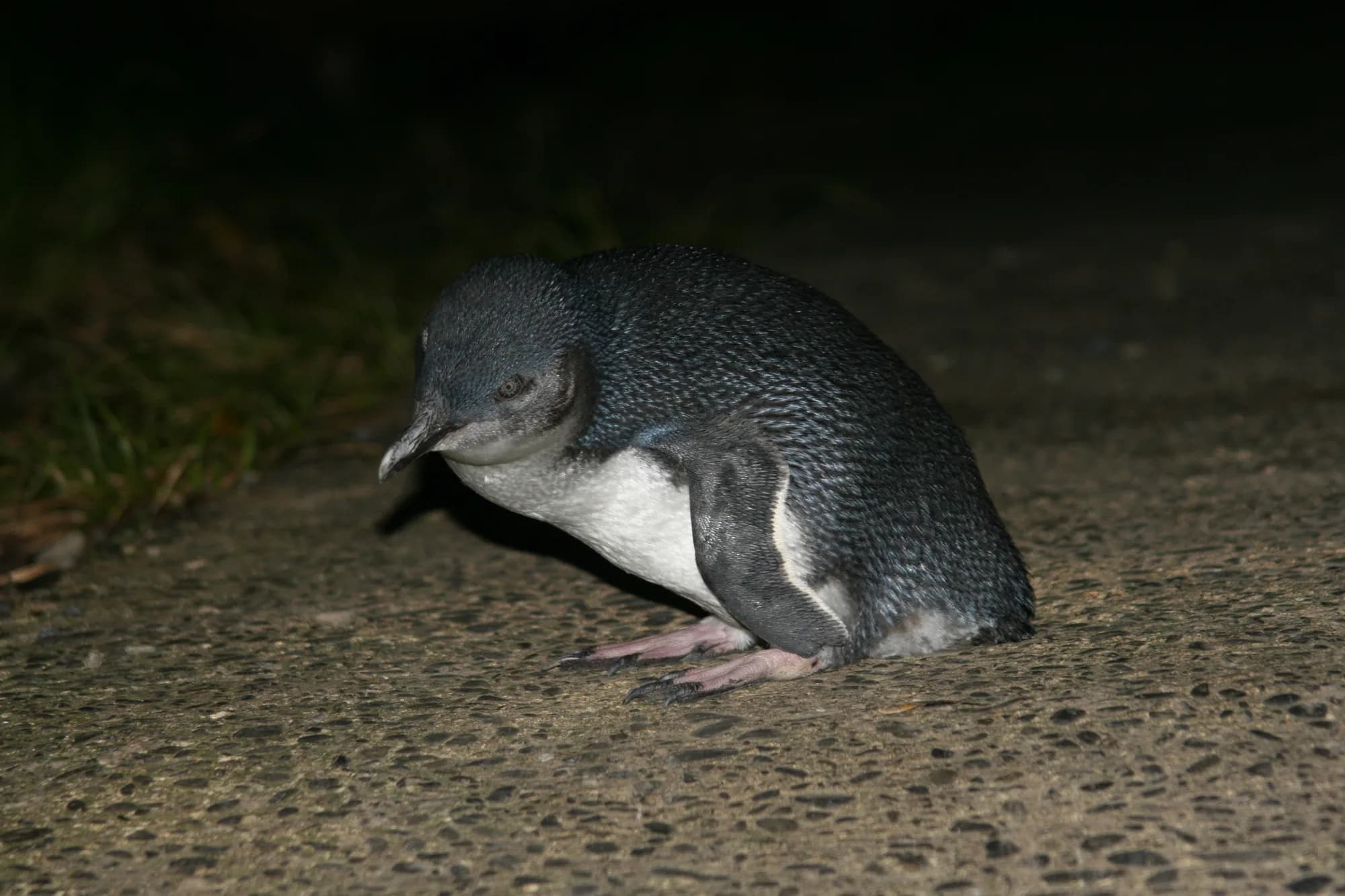
An Emperor Penguin male holds a single egg on his feet for 64 to 67 days and eats nothing the whole time. On the other side of the Southern Ocean, a Little Blue Penguin pair swaps places in a burrow most nights and is never more than a few hours from the sea. Both are raising a chick in the same ocean. Breeding style is not a family trait handed down the penguin tree. It is a schedule, and the schedule is set by how far away the food is.
What Most People Get Wrong
Penguins do not mate for life
Across the species with enough marked birds to measure it, mate fidelity varies enormously — most sit somewhere between 59 and 89 per cent, and the two Aptenodytes are far below that. The pattern inside that range is not the one the popular story predicts. Galápagos, gentoo, Magellanic and yellow-eyed penguins divorce at under 20 per cent a year. Emperor and king penguins — the two largest, longest-lived, highest-survival species in the family — divorce at over 80 per cent.1
Fidelity is not devotion. It is an address. Both Aptenodytes species build no nest at all, so a returning bird has no fixed place to wait and no way to be found except by voice in a crowd of thousands. Bried, Jiguet and Jouventin found that most emperor pairs formed within 24 hours of the males arriving, that king penguins were more likely to divorce the further apart their arrival dates fell, and — the awkward result — that neither retaining a mate nor changing one made any measurable difference to chick production the following year.2
Two eggs is not two chicks
Seventeen of the 19 species lay two eggs. Only the two Aptenodytes lay one. But clutch size is a poor guide to output, because in the crested penguins the reduction from two to one is built into the calendar rather than decided by conditions. That system is covered in why penguin chicks die in bad years; the short version is that under 1 per cent of first-laid Eudyptes eggs ever produce a fledged chick.3
The full spread of clutch, incubation and nest type
| Species | Clutch | Incubation (days) | Nest |
|---|---|---|---|
| Emperor Penguin | 1 | 64–67 | None; egg carried on the feet under a brood fold |
| King Penguin | 1 | 52–56 | None; egg carried on the feet |
| Adélie Penguin | 2 | 32–34 | Stone scrape on ice-free ground |
| Chinstrap Penguin | 2 | 33–35 | Stone scrape, often on steep slopes |
| Gentoo Penguin | 2 | 34–36 | Built mound of stones and vegetation |
| Little Blue Penguin | 2 | 33–39 | Burrow, cave, crevice or nest box |
| Magellanic Penguin | 2 | 38–42 | Burrow or scrape under shrubs |
| Humboldt Penguin | 2 | 40–42 | Burrow dug in guano, or rock crevice |
| Galápagos Penguin | 2 | 38–40 | Lava crevice or cave |
| African Penguin | 2 | 38–41 | Guano burrow, bush scrape or artificial box |
| Yellow-eyed Penguin | 2 | 39–51 | Solitary nest in coastal forest or scrub |
| Fiordland Penguin | 2 | 30–36 | Rainforest floor, cave or root hollow |
| Snares Penguin | 2 | 31–37 | Scrape under tree daisy forest |
| Erect-crested Penguin | 2 | 33–37 | Bare rock, usually with no nest material |
| Macaroni Penguin | 2 | 33–37 | Shallow scrape on open slope |
| Royal Penguin | 2 | 33–37 | Shallow scrape on open slope |
| Western Rockhopper Penguin | 2 | 32–34 | Rock scrape among boulders |
| Eastern Rockhopper Penguin | 2 | 32–34 | Rock scrape among boulders |
| Northern Rockhopper Penguin | 2 | 32–34 | Rock scrape, often in tussac |
Incubation runs from 30 days to 67, with no relationship to clutch size and only a loose one to body mass. The yellow-eyed penguin is the clearest outlier: it takes 38 to 50 per cent longer to incubate and rear a chick to fledging than the similarly sized Fiordland, Snares and Magellanic penguins breeding at comparable latitudes, and nobody has explained why.1
Why This Problem Is Hard
The nest is really a commute
Croxall and Davis argued that most penguin life-history variation collapses onto one axis: whether a species feeds inshore or offshore. Resident inshore feeders take short fasts ashore, start breeding at three years old, and rarely divorce. Migrant offshore feeders take long fasts, start breeding at seven or more, and divorce often.1
The fasting figures show the split plainly. Pre-laying and incubation fasts run 25 to 40 days in Adélie, Magellanic, king and all crested penguins, and roughly 100 days in male emperors. Gentoo and yellow-eyed penguins of similar body size fast for under three days in the same period — not because they cannot do more, but because they do not have to.1 The physiology behind the long fasts is set out in how penguins survive long fasts.
The awkward cases break their own genus. Gentoos sit with the residents while the rest of Pygoscelis migrates; Magellanics sit with the migrants while the rest of Spheniscus stays put.
Timing is the constraint, not effort
Age at first breeding runs from three years in gentoo, little blue and yellow-eyed penguins, through five to six in Adélie, emperor, king and Magellanic, to more than seven in macaroni, royal and Snares penguins — variation that does not track body size or survival rate the way life-history theory expects.1
What Scientists Know
Four solutions to the same nest problem
Penguins have arrived at four structural answers. No nest: the Aptenodytes carry the egg on the feet under a fold of skin, holding it near 38 °C while the air outside a winter emperor colony falls below −35 °C.4 Built nests: Pygoscelis species pile stones, gentoos most elaborately, which lifts the egg above meltwater. Enclosed nests: Spheniscus and Eudyptula use burrows, crevices and caves, which buy shade as much as shelter. Nothing at all: Eudyptes lay onto bare rock, and at the Antipodes 91.2 per cent of erect-crested nests held no material whatsoever.5
The yellow-eyed penguin is a fifth case on its own: it nests solitarily, out of sight of other pairs, which is why it is the only penguin whose breeding habitat is best described as forest.
Incubation shifts run on trust, and the trust fails often
The commonest way an Adélie egg dies is that nobody comes back. At Lützow-Holm Bay, coordinated pairs ran a female first foraging trip of 18.3 days after clutch completion followed by a male trip of 10.6 days; 20 per cent of all eggs were deserted by parents whose partner did not return, and only 4 per cent were lost to skua predation from attended nests.6 At Cape Bird, failure to relieve a mate accounted for 48 deserted eggs — 47.5 per cent of all egg losses — and starvation of 29 chicks, 35.4 per cent of chick losses.7 Desertion risk only became appreciable after eggs were 16 days old, peaking at 22 to 24 days.8 Chick starvation clustered at six to eight days old.
Coordination is not a nicety layered on top of the pair bond. It appears to be the pair bond. Davis found that Adélie pairs which successfully coordinated their first three foraging trips were together again the next season, and pairs that did not, separated.9
Guard, crèche, fledge
Once a chick can regulate its own temperature, both parents forage at once and the chick joins a crèche. In Falklands rockhoppers the guard stage runs 20 to 28 days with the male fasting on the nest, crèching begins in late December, juvenile plumage arrives at 35 to 40 days old and fledging at about ten weeks. The crèche is the exposed window: the chick has left adult cover but has not yet grown a waterproof coat.
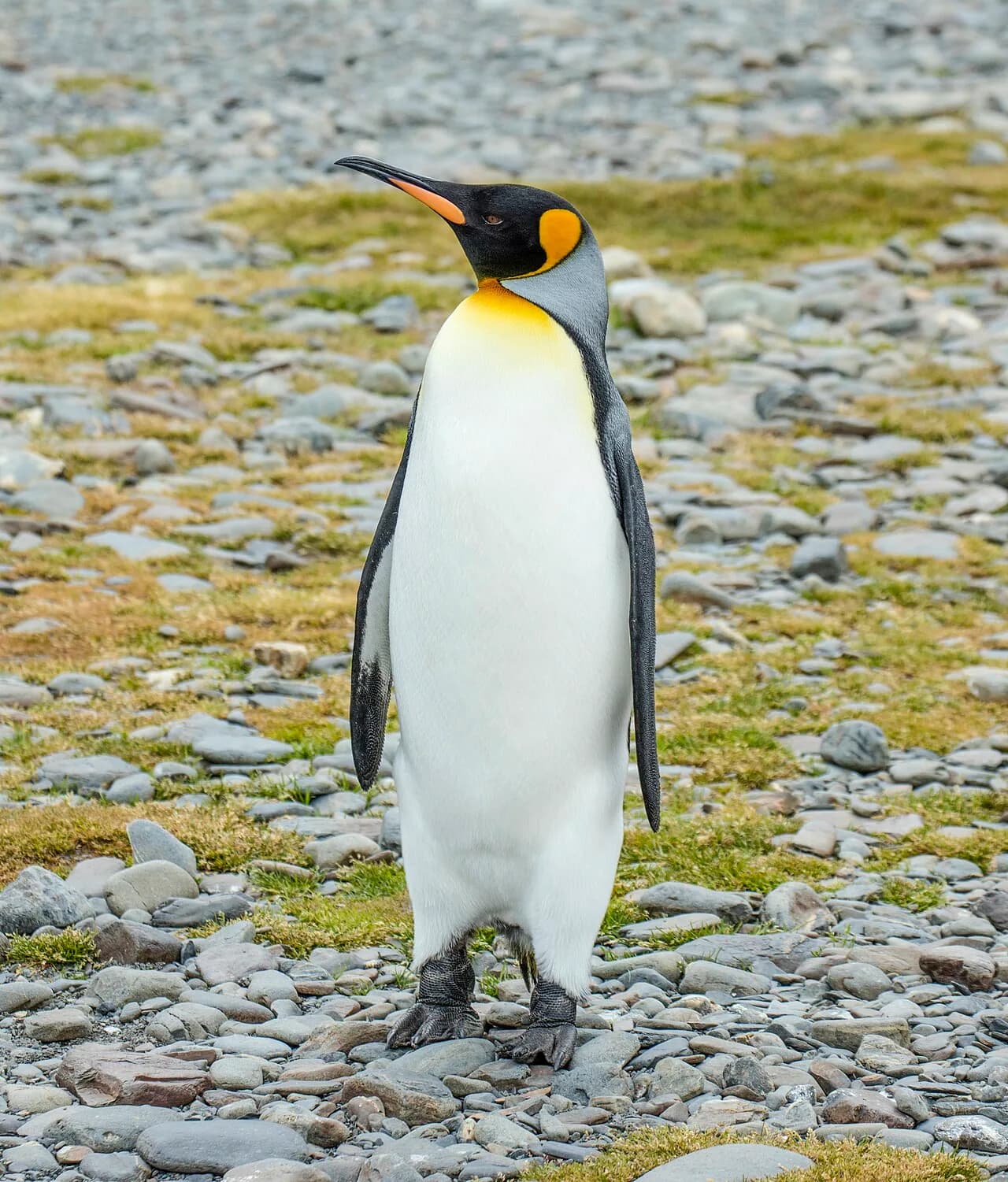
King Penguins run the same sequence stretched to breaking point. The cycle takes about 14 months, laying spreads across four, and the chick's growth period of roughly 11 months is interrupted by the sub-Antarctic winter. At best a pair rears one chick every two years. The cycle also flexes with food: at South Georgia it ran 437 days in a good year and 455 in a poor one, and the share of birds attempting a late second brood fell from 88 to 38 per cent between them.10
Moult is a second breeding-scale fast
Every penguin replaces its entire plumage at once and cannot enter the water until it is finished. The fast lasts 13 to 40 days depending on species, and it arrives immediately after a breeding season that has already drawn reserves down.1
Royal penguins at Macquarie Island take a 36-day pre-moult foraging trip, gaining 3 kg at 83.3 g per day, then moult ashore for 28 days and lose 46 to 47 per cent of their pre-moult mass; 99 per cent do it at their breeding site.11 King penguins fast about a month and finish 44 per cent lighter, with fat oxidation supplying 85 per cent of the energy and protein 15 per cent — twice the protein fraction of a breeding fast, drawn mainly from the pectoral muscles.12 Little Blue Penguins at Phillip Island moult in a median of 18.0 and 17.5 days across two seasons, starting in mid to late February.13
Moult is not the tidy end of a season. It is the second of two fasts, and a bird that has not gained enough beforehand cannot shorten it.
What Is Still Unclear
Whether divorce is a strategy or a side effect
The adaptive reading is that in species with no nest site and a hard laying deadline, waiting for last year's partner costs more than it returns. The evidence is consistent with that but not decisive: mate retention showed no measurable fitness benefit in either Aptenodytes species, which is equally consistent with divorce being a by-product of asynchronous arrival rather than a choice.2
How much the timing can stretch
The 18-day difference in king penguin cycle length between good and poor years shows the schedule is elastic.10 Nobody knows the limit, or what happens to a 14-month cycle when the good years stop arriving often enough to reset it.
What a good breeding site actually looks like
In the Catlins, the yellow-eyed colonies with the highest breeding success sat in small gullies with limited shrub cover, not the mature forest long assumed to be optimal habitat.14 For a species down to around 3,400 individuals, that is an uncomfortable finding: habitat management was aimed at the wrong target.
The outcome nobody can watch
Fledging is not the endpoint that matters. Recruitment is, and it is measured years later when a bird either returns to breed or does not. Every judgement about whether a breeding system is working carries that lag.
Where To Go Next
For the failure modes of the system described here, read why penguin chicks die in bad years. For the physiology behind a 100-day incubation fast, read how penguins survive long fasts. For what arrives at the nest uninvited, read penguin predators and threats. To see how nest type maps onto geography, start at the regions index.
References
-
Croxall, J.P. & Davis, L.S. (1999). Penguins: paradoxes and patterns. Marine Ornithology 27: 1–12. https://doi.org/10.5038/2074-1235.27.1.417 ↩ ↩2 ↩3 ↩4 ↩5 ↩6
-
Bried, J., Jiguet, F. & Jouventin, P. (1999). Why do Aptenodytes penguins have high divorce rates? The Auk 116(2): 504–512. https://digitalcommons.usf.edu/auk/vol116/iss2/20/ ↩ ↩2
-
Stein, R.W. & Williams, T.D. (2013). Extreme intraclutch egg-size dimorphism in Eudyptes penguins, an evolutionary response to clutch-size maladaptation. The American Naturalist 182(2): 260–270. https://www.sfu.ca/biology/wildberg/NewCWEPage/papers/SteinWilliamsAmNat2013.pdf ↩
-
Australian Antarctic Program. Emperor penguin breeding cycle. Australian Antarctic Division. https://www.antarctica.gov.au/about-antarctica/animals/penguins/emperor-penguin/breeding-cycle/ ↩
-
Davis, L.S., Renner, M., Houston, D., Zhu, L., Finkler, W. & Mattern, T. (2022). The breeding biology of erect-crested penguins, Eudyptes sclateri: hormones, behavior, obligate brood reduction and conservation. PLOS ONE 17(10): e0275106. https://doi.org/10.1371/journal.pone.0275106 ↩
-
Watanuki, Y. (1993). Mortality of eggs and nest attendance pattern in Adélie Penguins in Lützow-Holm Bay. Japanese Journal of Ornithology 42(1): 1–8. https://doi.org/10.3838/jjo.42.1 ↩
-
Davis, L.S. (1982). Timing of nest relief and its effect on breeding success in Adelie Penguins (Pygoscelis adeliae). The Condor 84(2): 178–183. https://digitalcommons.usf.edu/condor/vol84/iss2/7/ ↩
-
Davis, L.S. & McCaffrey, F.T. (1986). Survival analysis of eggs and chicks of Adélie Penguins (Pygoscelis adeliae). The Auk 103(2): 379–388. https://digitalcommons.usf.edu/auk/vol103/iss2/15/ ↩
-
Davis, L.S. (1988). Coordination of incubation routines and mate choice in Adélie Penguins (Pygoscelis adeliae). The Auk 105(3): 428–432. https://digitalcommons.usf.edu/auk/vol105/iss3/4 ↩
-
Olsson, O. & Brodin, A. (1997). Changes in king penguin breeding cycle in response to food availability. The Condor 99: 994–997. https://www.bas.ac.uk/data/our-data/publication/changes-in-king-penguin-breeding-cycle-in-response-to-food/ ↩ ↩2
-
Hull, C.L., Wilson, J. & le Mar, K. (2001). Moult in adult Royal Penguins, Eudyptes schlegeli. Emu – Austral Ornithology 101(2): 163–169. https://doi.org/10.1071/MU00023 ↩
-
Cherel, Y., Charrassin, J.-B. & Challet, E. (1994). Energy and protein requirements for molt in the king penguin Aptenodytes patagonicus. American Journal of Physiology 266(4): R1182–R1188. https://pubmed.ncbi.nlm.nih.gov/8184961/ ↩
-
Wells, N.C.A., Ledwidge, M.J., Dann, P., Walker, M.J. & Arnould, J.P.Y. (2025). Mass loss, timing and duration of catastrophic moult in little penguins. Biology Open 14(8): bio061989. https://pmc.ncbi.nlm.nih.gov/articles/PMC12444856/ ↩
-
Ratz, H. & Murphy, B. (1999). Effects of habitat and introduced mammalian predators on the breeding success of Yellow-eyed Penguins Megadyptes antipodes, South Island, New Zealand. Pacific Conservation Biology 5(1): 16–27. https://doi.org/10.1071/PC990016 ↩