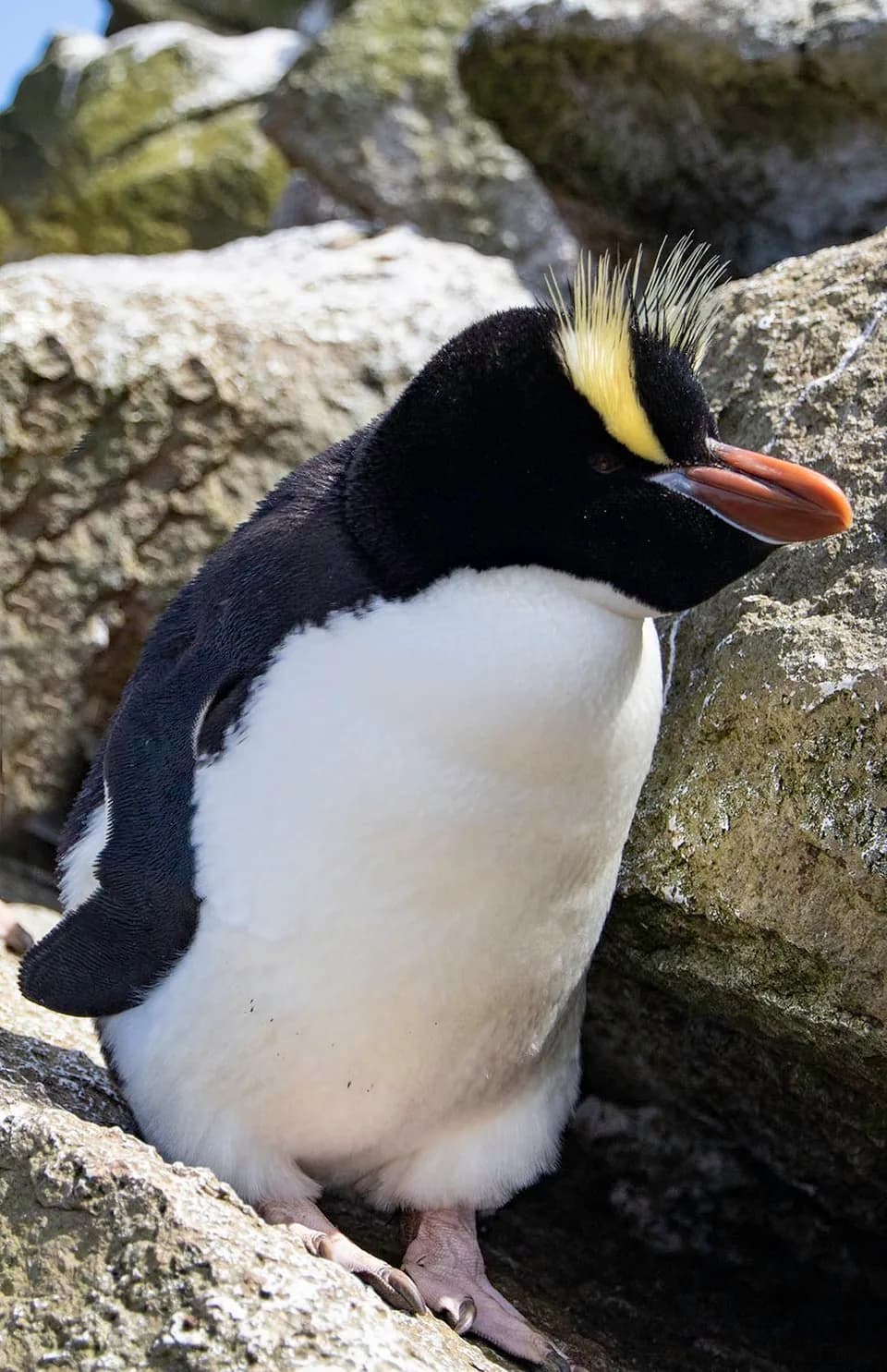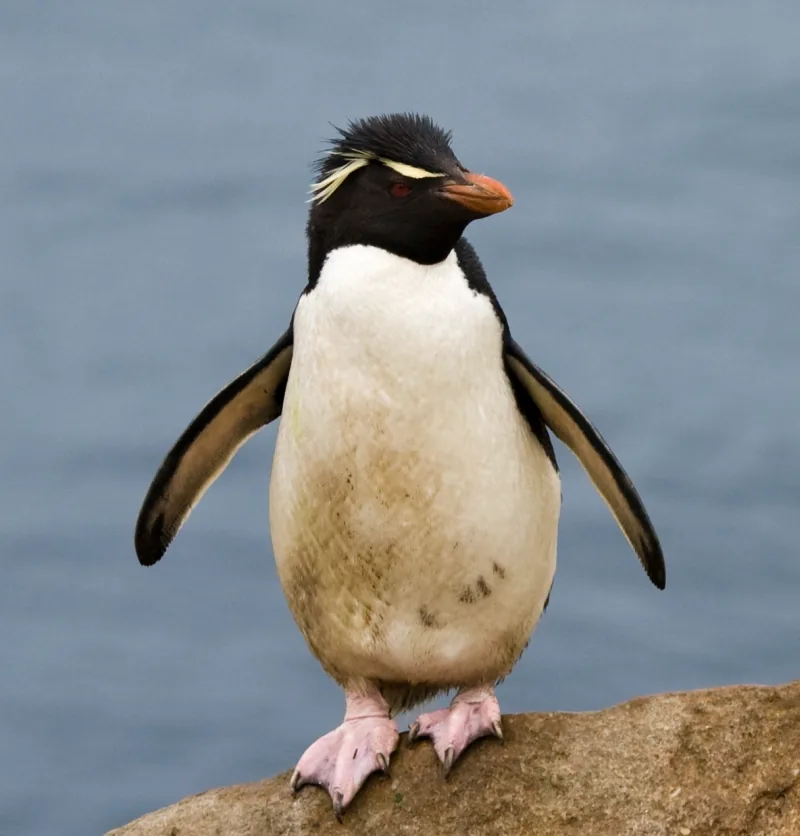
A Western Rockhopper pair lays two eggs. The first is markedly smaller than the second, the second hatches first, and the chick from the first egg almost never survives. That is not what a bad year looks like. That is what every year looks like. Working out why a colony failed means starting from a baseline in which half the clutch was written off before the season began.
What Most People Get Wrong
Predation is rarely where it starts
A skua carrying off a chick is a legible event, so it collects the blame. In most colonies the bulk of the loss happens earlier and less visibly, during incubation and the first days after hatching, much of it in nests no predator ever reached. Predation matters most where introduced mammals are involved, and even then it usually arrives at an attempt already failing.
Most of the loss is scheduled
The crested penguins — Eudyptes, which takes in the three rockhoppers, Macaroni, Royal, Erect-crested, Fiordland and Snares — run a reproductive system with no close parallel among birds.
Every pair lays two eggs. The first-laid A-egg is smaller than the second-laid B-egg by somewhere between 17.5 and 56.9 per cent depending on the species, which Stein and Williams identified as the most extreme intraclutch egg-size dimorphism known in birds.1 Then the sequence reverses. The B-egg, laid second, hatches first — sometimes up to three days earlier.2 The A-egg chick, if it hatches at all, arrives smaller and later into a nest where its sibling holds a head start it cannot close.
Across the genus, under 1 per cent of A-eggs produce a fledged chick.1
The Marion Island figures show what that means. Williams tracked macaroni and rockhopper nests through a full season, and the gap between the two eggs is stark in every measure he took.3
| Measure | Rockhopper | Macaroni |
|---|---|---|
| Nests where both eggs hatched | 6 per cent | None |
| A-egg mortality | 88 per cent | 99.7 per cent |
| B-egg mortality | 32 per cent | 44 per cent |
| Pairs rearing two chicks | None | None |
Where both eggs did hatch, one chick starved within twelve days.3
That is not a bad year. That is the design.
Why This Problem Is Hard
The chain from ocean to chick is long, and it has slack in it
A bad year does not begin at the nest. It begins with water temperature and primary production, which set the prey field, which sets how far adults must travel and how much they carry back, which sets chick growth rate, which sets fledging mass, which sets the odds the bird ever breeds at all.
Parents spend the slack in that chain first. Dehnhard and colleagues tracked chick-rearing rockhoppers at New Island across two seasons that differed in sea surface temperature, chlorophyll a, foraging distance, dive depth and diet — crustacean-dominated in one year, a squid-and-fish mixture in the next. Chick growth rates and chick survival showed no matching difference. The authors could not identify a better year.4
Environmental variation is not the same thing as chick mortality. Adults absorb it until they cannot, and the point where absorption fails is not the point where the environmental graphs cross.
The cause of death is often not what caused the bad year
On 10 January 2008, 120 mm of rain fell on New Island in 24 hours; the whole of 2007 had delivered 634 mm. It came with low temperatures and a hard southerly wind, and it hit when chicks were about a month old and newly in crèche — out from under an adult, still in down. In the sub-colony on open rock, 68.2 per cent of the chicks alive on 1 January died in that single event.5
Post-mortems on twenty of them found stomachs full of fresh food. Nothing about those deaths was a foraging failure. Breeding success for the season came in at 0.49 chicks per nest against an expected 0.66; the previous season had run at 0.69.5
Habitat mattered as much as the weather. Deaths ran roughly three times higher in the bare rocky sub-colony than in the neighbouring one fringed with tussac grass.5 Tussac has been stripped across much of the Falklands since the nineteenth century by grazing and burning, which is what converts a weather event into a mortality event.
The rain did not find a weak colony. It found an unsheltered one.
What Scientists Know
The reduction happens at the egg, not the chick
At Marion Island, egg mortality exceeded chick mortality in both species.3 The clutch is usually reduced before anything hatches, which is why counting dead chicks tells you little about a crested penguin colony.
In Royal Penguins, St Clair and colleagues found the overwhelming cause of A-egg loss is deliberate ejection by the female.6 Erect-crested Penguins are the extreme case. At the Antipodes in 1998, Davis and colleagues recorded 42.3 per cent of A-eggs lost before the B-egg was even laid, another 37.8 per cent on the day it was laid, and none surviving beyond seven days after. The laying interval — 5.4 days — is the longest recorded for any penguin. Some 91.2 per cent of nests held no nesting material, eggs going straight onto rock, and A-eggs were lost mainly by rolling out.7
Then the decisive test: when researchers prevented A-eggs from rolling out, they survived no longer than the controls.7
Brood reduction in this species is obligate. It is not a response to a lean season, and no amount of food, shelter or good weather switches it off.
The calendar, and where in it chicks actually die
The Falklands rockhopper season runs on a tight schedule:
- Laying: highly synchronised, 27 October to 10 November at New Island.
- Hatching: 2 to 15 December.
- Guard: the male holds the nest and fasts 20–28 days; the female returns with food most afternoons.
- Crèche: from late December, both parents provisioning.
- Moult into juvenile plumage: 35–40 days old.
- Fledging: around ten weeks.5
Laid out, the dangerous window is obvious: the crèche period, when a chick has left adult cover but has not yet grown a waterproof coat.
What an ordinary season looks like
Gough Island gives the shape of a normal year for Northern Rockhoppers. Brood loss was heaviest during incubation and the early chick stage, at 33–61 per cent. Of chicks that hatched, 71 per cent survived to crèche, and 73 per cent of those present at early crèche moulted into juvenile plumage.8
The same study found breeding success rose with two things: how vigorously breeding adults responded to threats, and how many other breeding birds sat within 1.5 metres.8 Density is protection — a quietly alarming result for a declining species, because a thinning colony gets worse at defending itself as it thins.
Other lineages fail on different clocks
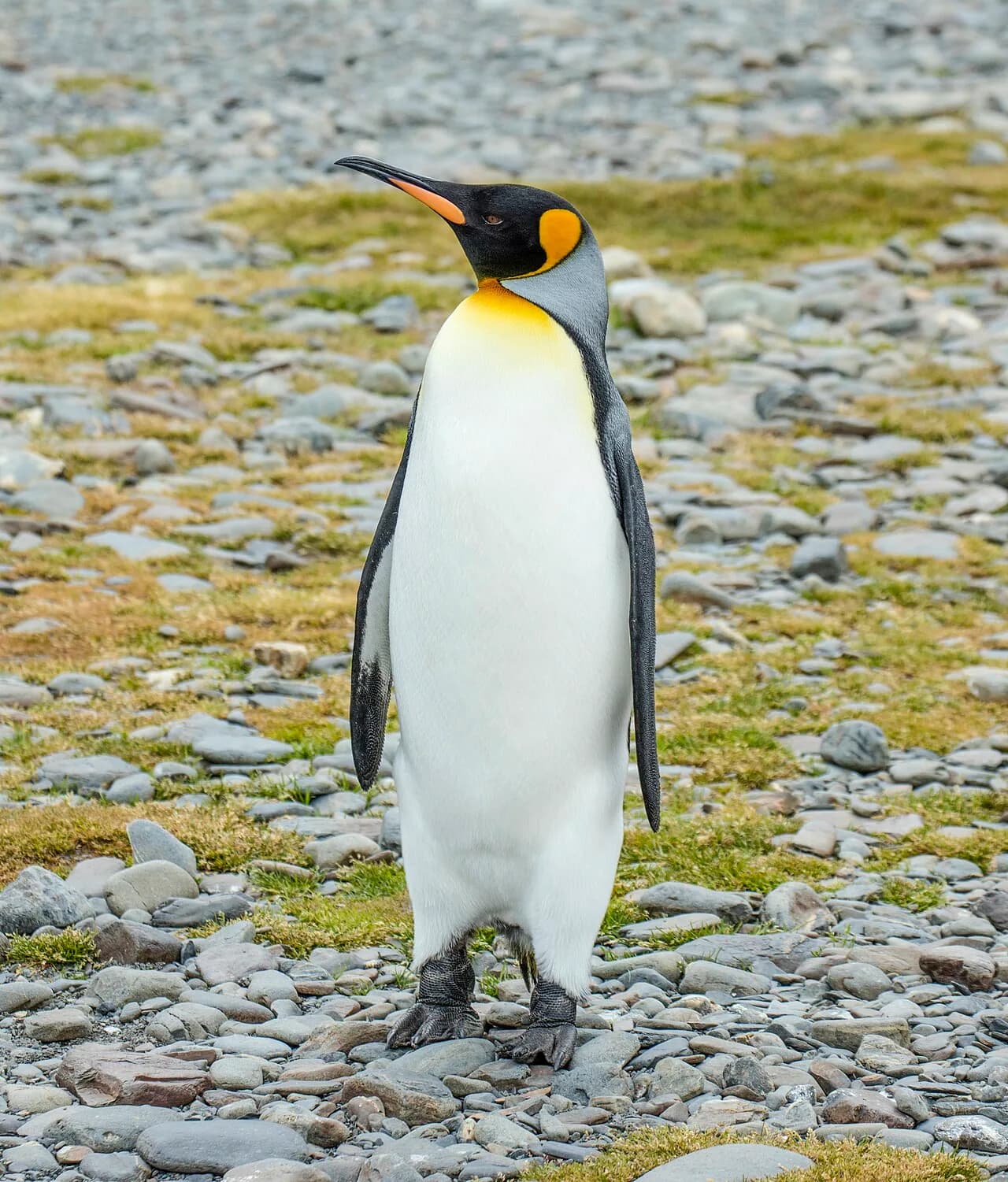
King Penguin chicks overwinter in the colony and are fed irregularly. Cherel and Le Maho followed captive chicks that started near 12.5 kg and fasted an average of five months, ending at 4.0 kg — a 68 per cent loss. Chicks whose parents return too late die at around 3.0 kg.9 A king chick's bad year is a slow clock, not an event.
For Emperor Penguins the failure mode is the platform itself. In the Bellingshausen Sea in 2022, fast ice broke up before chicks could fledge; of five breeding sites in the region, four suffered total breeding failure.10 It was the first widespread emperor breeding failure clearly attributable to large-scale sea ice contraction, and it feeds directly into the species' uplisting to Endangered on 9 April 2026.11
Adélie Penguins in Terre Adélie produced a zero year in 2013/14 — not a poor season, a season in which no chick survived. Unusually heavy precipitation killed chicks outright while weak katabatic winds kept sea ice pinned around the colony, stretching every foraging trip.12 Across 23 seasons near Palmer Station, Adélie fledging mass tracked climate and local weather more strongly than parental diet.13
Three lineages, three failure modes. Only one of them is a food shortage in the ordinary sense.
What Is Still Unclear
Why the A-egg exists at all
Nobody knows what the smaller egg is for, and the candidates have largely not been tested. St Clair set them out in 1998.14 The A-egg may:
- signal to neighbours that a nest site is occupied, reducing fights over space;
- act as a visual stimulus that tightens laying synchrony across the colony;
- advertise a female's readiness to a young or first-time mate;
- supply the tactile stimulation that triggers brood-patch formation, improving the thermal environment for the B-egg.
Since most A-eggs disappear inside the four-to-five-day laying interval, whatever they do has to be discharged fast. It is also possible the honest answer is that they do nothing at all.
Whether the system is adaptive in the first place
Stein and Williams argued in 2013 that the two-egg clutch in Eudyptes is a genus-wide evolutionary maladaptation rather than a strategy. Compared with other two-egg-clutch penguins, Eudyptes first breed 52 per cent later, have 48 per cent lower annual fecundity, and fledge 43 per cent fewer chicks per clutch — and have kept the two-egg clutch anyway.1 On that reading the extreme egg-size dimorphism is not a clever insurance policy but a correlated response to a life history slowed down by extreme pelagic overwintering.
Crossin and colleagues supply the proximate half. Females return from long migrations in a low state of reproductive readiness, and follicle development is constrained by what they arrive carrying.15 The A-egg is small because there was neither the time nor the reserve to make it bigger.
These readings are not mutually exclusive, and the field has not resolved between them.
Which colony tips
Forecasting remains the hard part, for two reasons the biology alone does not predict. The strongest drivers of chick mortality are local — nest substrate, colony density, one storm on one afternoon — so a regional average says very little about any particular headland. And colonies leak: southern rockhoppers have been described as highly vagile and modelled as a metapopulation, so a site that empties has not necessarily lost its birds.16
The outcome that matters most is the one nobody can watch. Fledging mass predicts recruitment, but a rockhopper does not return to breed for about four years.2 Every verdict on whether a season was survivable stays provisional that long.
Where To Go Next
For the full breeding cycle rather than its failure modes, read Penguin Breeding and Chicks. For what predation does to an already-weakened nest, Penguin Predators and Threats is the companion piece. For where each species here currently stands, the conservation tracker is the live record.
References
-
Stein, R.W. & Williams, T.D. (2013). Extreme intraclutch egg-size dimorphism in Eudyptes penguins, an evolutionary response to clutch-size maladaptation. The American Naturalist 182: 260–270. https://www.sfu.ca/biology/wildberg/NewCWEPage/papers/SteinWilliamsAmNat2013.pdf ↩ ↩2 ↩3
-
Katz, C. (2026). Rockhopper penguins' athleticism makes them the daredevils of the animal world. Will a warming climate slow them down?. Smithsonian Magazine, January–February 2026; republished by bioGraphic. https://www.biographic.com/can-rockhoppers-survive-the-next-leap/ ↩ ↩2
-
Williams, A.J. (1980). Offspring reduction in macaroni and rockhopper penguins. The Auk 97: 754–759. https://digitalcommons.usf.edu/auk/vol97/iss4/11 ↩ ↩2 ↩3
-
Dehnhard, N., Ludynia, K., Masello, J.F., Voigt, C.C., McGill, R.A.R. & Quillfeldt, P. (2016). Plasticity in foraging behaviour and diet buffers effects of inter-annual environmental differences on chick growth and survival in southern rockhopper penguins Eudyptes chrysocome chrysocome. Polar Biology 39: 1627–1641. https://doi.org/10.1007/s00300-015-1887-5 ↩
-
Demongin, L., Poisbleau, M., Strange, I.J. & Quillfeldt, P. (2010). Effects of severe rains on the mortality of Southern Rockhopper Penguin (Eudyptes chrysocome) chicks and its impact on breeding success. Ornitología Neotropical 21: 439–443. https://digitalcommons.usf.edu/ornitologia_neotropical/vol21/iss3/11 ↩ ↩2 ↩3 ↩4
-
St Clair, C.C., Waas, J.R., St Clair, R.C. & Boag, P.T. (1995). Unfit mothers? Maternal infanticide in royal penguins. Animal Behaviour 50: 1177–1185. https://doi.org/10.1016/0003-3472(95)80034-4 ↩
-
Davis, L.S., Renner, M., Houston, D., Zhu, L., Finkler, W. & Mattern, T. (2022). The breeding biology of erect-crested penguins, Eudyptes sclateri: hormones, behavior, obligate brood reduction and conservation. PLoS ONE 17(10): e0275106. https://doi.org/10.1371/journal.pone.0275106 ↩ ↩2
-
Wilson, J.W., Burle, M.-H., Cuthbert, R., Stirnemann, R.L. & Ryan, P.G. (2010). Breeding success of Northern Rockhopper Penguins (Eudyptes moseleyi) at Gough Island, South Atlantic Ocean. Emu 110: 137–141. https://doi.org/10.1071/MU09095 ↩ ↩2
-
Cherel, Y. & Le Maho, Y. (1985). Five months of fasting in king penguin chicks: body mass loss and fuel metabolism. American Journal of Physiology 249: R387–R392. https://doi.org/10.1152/ajpregu.1985.249.4.R387 ↩
-
Fretwell, P.T., Boutet, A. & Ratcliffe, N. (2023). Record low 2022 Antarctic sea ice led to catastrophic breeding failure of emperor penguins. Communications Earth & Environment 4: 273. https://doi.org/10.1038/s43247-023-00927-x ↩
-
IUCN (9 April 2026). Emperor penguin and Antarctic fur seal now Endangered due to climate change – IUCN Red List. Press release. https://iucn.org/press-release/202604/emperor-penguin-and-antarctic-fur-seal-now-endangered-due-climate-change-iucn ↩
-
Ropert-Coudert, Y. et al. (2015). A complete breeding failure in an Adélie penguin colony correlates with unusual and extreme environmental events. Ecography 38: 111–113. https://doi.org/10.1111/ecog.01182 ↩
-
Cimino, M.A., Fraser, W.R., Patterson-Fraser, D.L., Saba, V.S. & Oliver, M.J. (2014). Large-scale climate and local weather drive interannual variability in Adélie penguin chick fledging mass. Marine Ecology Progress Series 513: 253–268. https://lternet.edu/biblio/large-scale-climate-and-local-weather-drive-interannual-variability-in-adalie-penguin-chick-fledging-mass/ ↩
-
St Clair, C.C. (1998). What is the function of first eggs in crested penguins?. The Auk 115: 478–482. https://digitalcommons.usf.edu/auk/vol115/iss2/25 ↩
-
Crossin, G.T., Trathan, P.N., Phillips, R.A., Dawson, A., Le Bouard, F. & Williams, T.D. (2010). A carryover effect of migration underlies individual variation in reproductive readiness and extreme egg size dimorphism in macaroni penguins. The American Naturalist 176: 357–366. https://www.sfu.ca/biology/wildberg/NewCWEPage/papers/CrossinetalAmNat2010.pdf ↩
-
Lois, N.A. et al. (2020). Metapopulation dynamics and foraging plasticity in a highly vagile seabird, the southern rockhopper penguin. Ecology and Evolution 10: 3346–3355. https://pmc.ncbi.nlm.nih.gov/articles/PMC7141044/ ↩