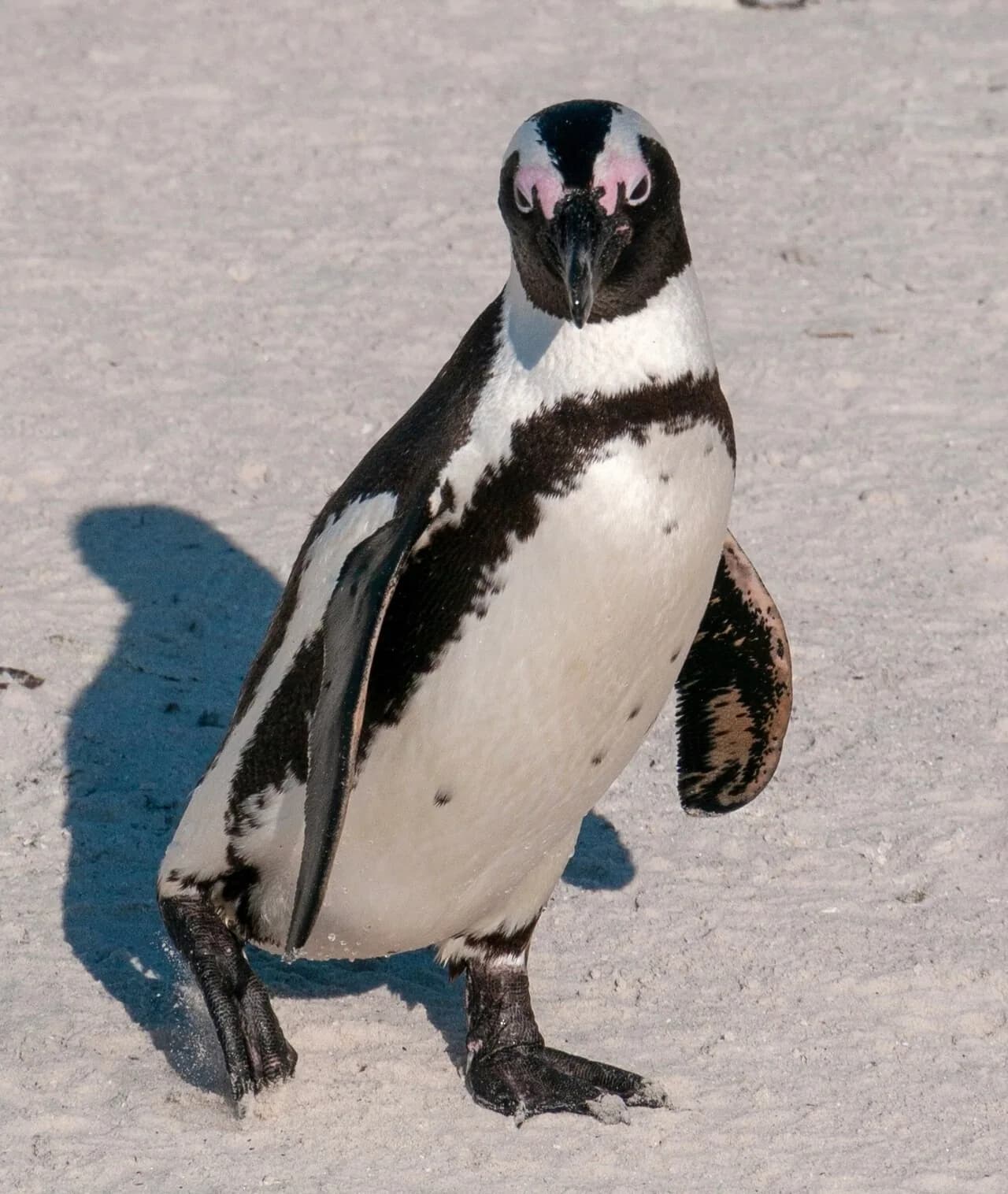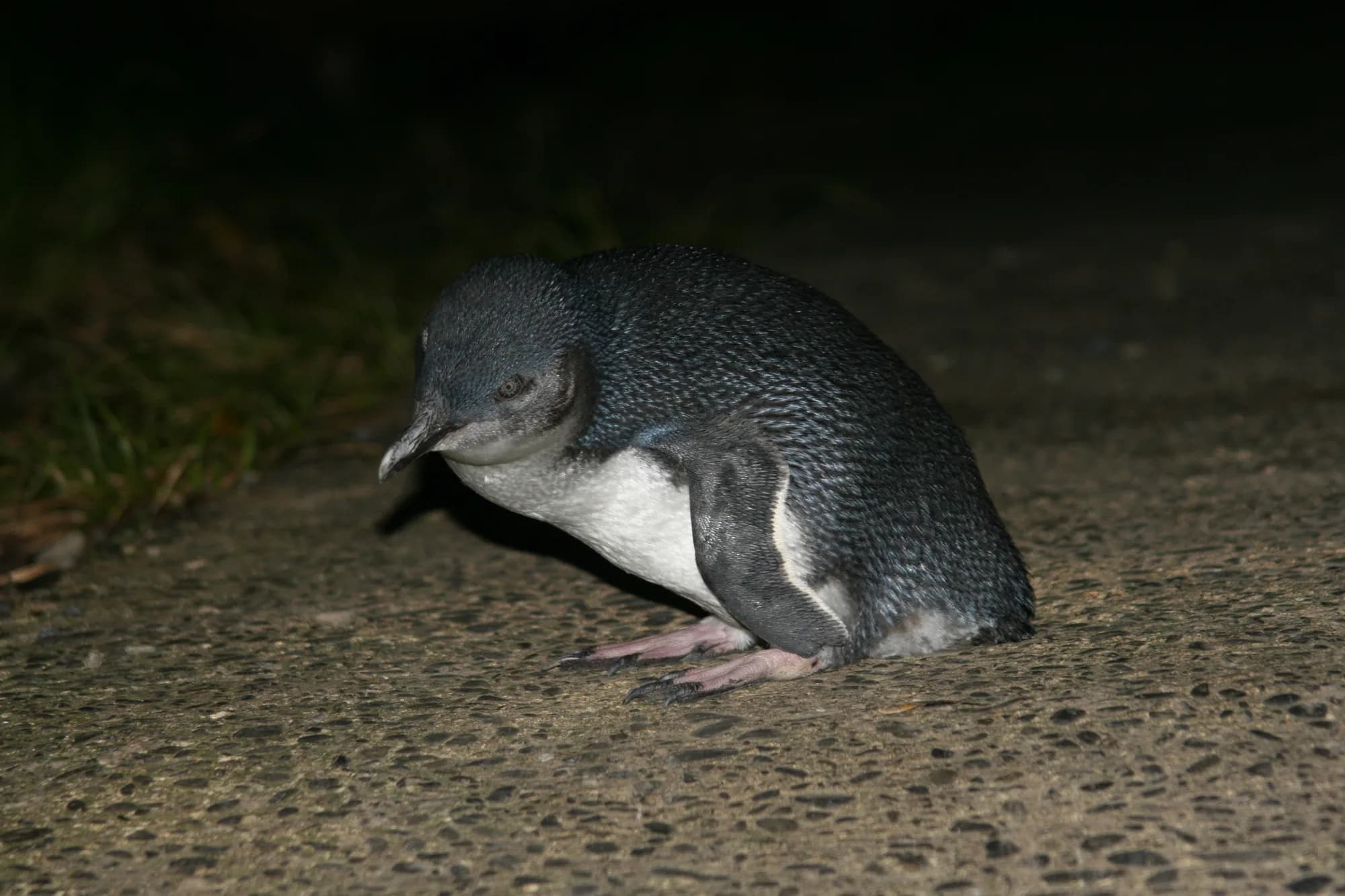
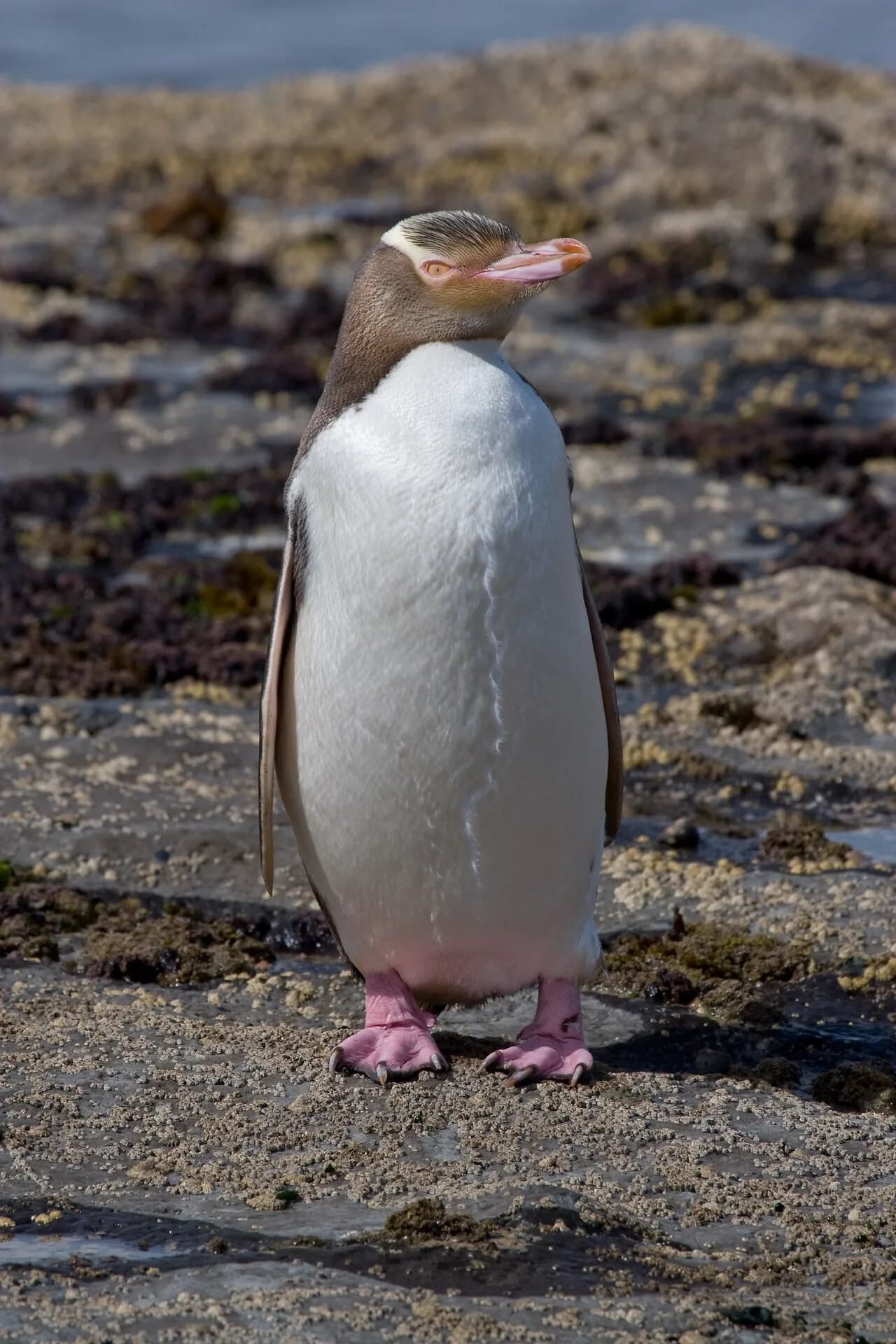
On 19 January 2019 the shade temperature at Punta Tombo in Argentina reached 44 °C, the highest since records at the colony began in December 1982. By the end of the day at least 354 Magellanic Penguins were dead — 264 adults and 90 chicks — and 27 per cent of the dead adults were found on the ground between the nests and the water.1 Nothing ate them. The predator list is the easy part of this subject, and it is not where most penguins are being lost.
What Most People Get Wrong
Predation is measurable, and the numbers are smaller than expected
Leopard seals are the archetype, and they have been counted. At Cape Crozier, seasonal predation was estimated at about 5 per cent of the breeding Adélie population, with active hunting observed during 56 per cent of watch time and an average kill rate of 0.61 birds an hour.2 In Prydz Bay, six leopard seals working the fast-ice edge over 120 days were calculated to take about 2.7 per cent of the adult penguin population.3
Those are real losses and they are survivable. Over the same span in which predator communities barely changed, African Penguins fell from 15,187 breeding pairs in 2018 to roughly 8,750 at the end of 2023 in South Africa alone.4 The leopard seal is not the reason penguins are disappearing. It is the reason breeding is expensive.
Predation risk is a function of traffic, not ferocity
Leopard seals only bothered to stay at Ross Sea colonies where penguin traffic exceeded about 250 birds an hour, and predation rates flattened out above about 1,200 birds an hour.5 That produces a strange result: with respect to seals it is safest to nest in a very small colony, which is not worth a seal's time, or a very large one, where the sheer volume of birds swamps the hunters.
The cost falls on the birds doing the work. A penguin that fails to breed crosses the seal line only two to four times a summer. A penguin provisioning chicks crosses it 20 to 30 times.5
The threat list changes with life stage
| Life stage | Where it is spent | Natural predators | Added human pressures |
|---|---|---|---|
| Egg | Nest | South polar and brown skuas, kelp gulls, sheathbills | Guano and vegetation stripping, disturbance |
| Guard-stage chick | Nest, under an adult | Skuas, kelp gulls, giant petrels | Storms, heat, starvation when foraging fails |
| Crèche chick | Colony, unattended | Giant petrels, skuas | Stoats, ferrets, feral cats, dogs, rats, pigs |
| Fledgling | First weeks at sea | Leopard seals, fur seals, sea lions, sharks | Gillnet bycatch, oil |
| Breeding adult | Commute to feeding grounds | Leopard seals, sea lions, sharks, killer whales | Fisheries competition, oil, bycatch, plastic |
| Moulting adult | Ashore, 2–4 weeks, not waterproof | Land predators only | Heat, disturbance, avian influenza |
Skua pressure is not evenly spread either. At King George Island, attempted and successful skua predation on chicks ran 4.1 to 7.9 times higher at colony edges than in the centre, and total predator activity was higher at large colonies than small ones — the mirror image of the leopard seal pattern.6
Why This Problem Is Hard
Most penguin deaths happen where nobody is counting
Eggs and chicks die in front of researchers. Adults mostly die at sea, out of sight, and a colony registers the loss only as a shortfall in returning birds — often a season or more later, and never with a cause attached. Every published mortality budget is therefore weighted towards the part of the life cycle that happens on land.
Attribution is genuinely contested
Two long-running Adélie studies reached opposite conclusions about the same species. At Cape Bird, South Polar Skua predation was the leading cause of both egg and chick loss, against overall reproductive success of 35.6 per cent.7 At Lützow-Holm Bay, 20 per cent of eggs were deserted by parents whose partner failed to return and were then scavenged by skuas, while only 4 per cent were taken from attended nests.8 Both used careful nest-level observation. The difference is site, season and food, and it means a single colony's cause-of-death tally does not generalise.
The same predator is not the same threat twice
New Zealand's penguin colonies evolved with no terrestrial mammal predators at all. A stoat is not a skua with fur; it hunts by scent, at night, inside cover, and the Yellow-eyed Penguin has no behaviour aimed at it. Modelling in the Catlins put a workable threshold on the problem: the population grows provided total chick loss stays under 43 per cent a season — at least 0.85 chicks fledged per nest — which requires predation losses under about 34 per cent.9
Interventions can create the threat
In New Zealand, areas of rank grass were left ungrazed around yellow-eyed penguin colonies in the hope of physically excluding predators. Tracking showed stoats recorded twice as often and ferrets ten times as often in rank grass as in grazed pasture, mice five to seventeen times more often, and ferrets approaching penguin nests more than twelve times as often as random sites.10 The barrier became a corridor.
What Scientists Know
At sea: a short list
The marine predator set is small and regionally sorted. Leopard seals dominate near Antarctic colonies, where Adélie Penguins are their primary prey.5 Antarctic and sub-Antarctic fur seals take crested penguins. South American and New Zealand sea lions take Magellanic, Humboldt and yellow-eyed penguins. Sharks take African and Little Blue Penguins. Killer whales take penguins occasionally, and unlike the seals their contribution to penguin mortality has never been quantified anywhere.
On land: the native set and the introduced set
Skuas, kelp gulls, giant petrels and sheathbills are the native egg and chick predators across the Southern Ocean, and colonies are structured around them — dense nesting, synchronised laying, aggressive nest defence. None of that works against mammals.
Macquarie Island shows how indirect the introduced-species problem can get. Rabbits stripped the vegetation, hillsides eroded, and one resulting landslide killed hundreds of King Penguins at Lusitania Bay. No rabbit touched a penguin. The eradication that followed cost about 25 million Australian dollars, ran from 2007 to 2014, combined aerial baiting with calicivirus and detection dogs covering more than 90,000 km, and left the island pest-free.11
Food is the largest single lever
The clearest case is the African Penguin, now the only Critically Endangered penguin and roughly 97 per cent below its historical numbers.12 After six years of disagreement over how much closure was biologically meaningful, a March 2025 Pretoria High Court order established no-take zones for the commercial sardine and anchovy purse-seine fishery around six breeding colonies — Dassen, Robben, Stony Point, Dyer, St Croix and Bird islands — for ten years.4 That takes the protection to 2035, the year current projections put the species extinct in the wild.
Oil is both an event and a background
The bulk carrier Treasure sank between Robben and Dassen islands on 23 June 2000. About 19,000 African Penguins were oiled and a further 19,500 unoiled birds were caught and moved 800 km east to keep them out of the slick — together about 20 per cent of the entire species.13 Fewer than 2,000 died in the first month, and by the end of 2004, 70 per cent of rehabilitated adults, 40 per cent of relocated birds and 34 per cent of captive-reared chicks had been seen back at Robben Island.14 A fifth of a species passed through human hands in a month, and the intervention worked.
An oil spill is not a one-day event, and the chronic version does not make the news at all: Magellanic Penguins along the Chubut coast of Argentina have been documented arriving oiled year after year from routine discharges rather than any single wreck.15
Disease arrived in 2023
High pathogenicity avian influenza H5N1 clade 2.3.4.4b was detected in the Antarctic region for the first time on 8 October 2023, in brown skuas at Bird Island, South Georgia.16 Over that season 77 brown skuas, 38 Gentoo Penguins and 58 snowy albatrosses at Bird Island were suspected to have died of it, with infection confirmed in five Antarctic fur seals; the virus was simultaneously confirmed in southern fulmars and black-browed albatrosses in the Falklands, and later in king penguins.1718 Genetic analysis points to arrival from South America with migratory birds.16
The recorded penguin mortality is small. The relevant fact is that the outbreak reached South Georgia at the end of a breeding season, when the birds were dispersing rather than packed at densities of thousands per hectare.
What Is Still Unclear
What H5N1 does to a colony at full density
Nobody knows, because it has not yet happened. Estimates from Bird Island are explicitly floors — carcasses were scavenged or lost at sea before anyone counted them — and there is no baseline for how a penguin colony behaves during an epizootic.17
Whether the food protections are large enough
The African Penguin closures are the best-tested fisheries intervention in the family, and they are still an experiment with one run. The counterfactual cannot be observed, the closures took effect after the species reached Critically Endangered, and the modelled extinction date they are meant to avert falls inside the ten-year term of the court order.
How the pressures combine
A colony that absorbs 5 per cent leopard seal predation in an ordinary year may not absorb it in a year when adults return light and chicks fledge underweight. Heat, storms, prey shortage and predation are usually reported separately because they are usually studied separately. The interaction terms are where the forecasting error lives, and they are largely unmeasured.
Where To Go Next
For the conservation categories that summarise all of this, read penguin conservation status explained. For what happens inside a failing nest, read why penguin chicks die in bad years. For the heat side of the problem, read why some penguins live in hot places. Current standings for every species are on the conservation tracker.
References
-
Holt, K. & Boersma, P.D. (2022). Unprecedented heat mortality of Magellanic Penguins. Ornithological Applications 124(1): duab052. https://doi.org/10.1093/ornithapp/duab052 ↩
-
Penney, R.L. & Lowry, G. (1967). Leopard seal predation of Adelie penguins. Ecology 48(5): 878–882. https://doi.org/10.2307/1933751 ↩
-
Rogers, T.L. & Bryden, M.M. (1995). Predation of Adélie penguins (Pygoscelis adeliae) by leopard seals (Hydrurga leptonyx) in Prydz Bay, Antarctica. Canadian Journal of Zoology 73(5): 1001–1004. https://doi.org/10.1139/z95-119 ↩
-
BirdLife South Africa & SANCCOB (18 March 2025). High Court victory for the Critically Endangered African Penguin (media release). https://www.birdlife.org.za/wp-content/uploads/2025/03/Order-of-Court-media-release_18-March-2025-FINAL.pdf ↩ ↩2
-
Ainley, D.G., Ballard, G., Karl, B.J. & Dugger, K.M. (2005). Leopard seal predation rates at penguin colonies of different size. Antarctic Science. https://doi.org/10.1017/S0954102005002750 ↩ ↩2 ↩3
-
Emslie, S.D., Karnovsky, N. & Trivelpiece, W. (1995). Avian predation at penguin colonies on King George Island, Antarctica. Wilson Bulletin 107(2): 317–327. https://digitalcommons.usf.edu/wilson_bulletin/vol107/iss2/11/ ↩
-
Davis, L.S. & McCaffrey, F.T. (1986). Survival analysis of eggs and chicks of Adélie Penguins (Pygoscelis adeliae). The Auk 103(2): 379–388. https://digitalcommons.usf.edu/auk/vol103/iss2/15/ ↩
-
Watanuki, Y. (1993). Mortality of eggs and nest attendance pattern in Adélie Penguins in Lützow-Holm Bay. Japanese Journal of Ornithology 42(1): 1–8. https://doi.org/10.3838/jjo.42.1 ↩
-
Ratz, H. & Murphy, B. (1999). Effects of habitat and introduced mammalian predators on the breeding success of Yellow-eyed Penguins Megadyptes antipodes, South Island, New Zealand. Pacific Conservation Biology 5(1): 16–27. https://doi.org/10.1071/PC990016 ↩
-
Ratz, H. (2000). Movements by stoats (Mustela erminea) and ferrets (M. furo) through rank grass of yellow-eyed penguin (Megadyptes antipodes) breeding areas. New Zealand Journal of Zoology 27(1): 9–15. https://doi.org/10.1080/03014223.2000.9518210 ↩
-
Australian Antarctic Program (29 May 2024). Macquarie Island's astounding recovery, ten years on from rats, mice and rabbits. Australian Antarctic Division. https://www.antarctica.gov.au/news/2024/macquarie-islands-astounding-recovery-ten-years-on-from-rats-mice-and-rabbits/ ↩
-
SANCCOB & BirdLife South Africa (20 March 2024). Ground-breaking litigation launched to protect the African Penguin from extinction. https://sanccob.co.za/news/ground-breaking-litigation-launched-to-protect-the-african-penguin-from-extinction/ ↩
-
Crawford, R.J.M., Davis, S.A., Harding, R.T., Jackson, L.F., Leshoro, T.M., Meÿer, M.A., Randall, R.M., Underhill, L.G., Upfold, L., van Dalsen, A.P., van der Merwe, E., Whittington, P.A., Williams, A.J. & Wolfaardt, A.C. (2000). Initial impact of the Treasure oil spill on seabirds off western South Africa. South African Journal of Marine Science 22: 157–176. https://www.ajol.info/index.php/ajms/article/view/67621/55726 ↩
-
Barham, P.J., Crawford, R.J.M., Underhill, L.G., Wolfaardt, A.C., Barham, B.J., Dyer, B.M., Leshoro, T.M., Meÿer, M.A., Navarro, R.A., Oschadleus, D., Upfold, L., Whittington, P.A. & Williams, A.J. (2006). Return to Robben Island of African Penguins that were rehabilitated, relocated or reared in captivity following the Treasure oil spill of 2000. Ostrich 77(3–4): 202–209. https://doi.org/10.2989/00306520609485534 ↩
-
Gandini, P., Boersma, P.D., Frere, E., Gandini, M., Holik, T. & Lichtschein, V. (1994). Magellanic Penguins (Spheniscus magellanicus) affected by chronic petroleum pollution along coast of Chubut, Argentina. The Auk 111(1): 20–27. https://digitalcommons.usf.edu/auk/vol111/iss1/3/ ↩
-
Banyard, A.C., Bennison, A., Byrne, A.M.P. et al. (2024). Detection and spread of high pathogenicity avian influenza virus H5N1 in the Antarctic Region. Nature Communications 15: 7433. https://doi.org/10.1038/s41467-024-51490-8 ↩ ↩2
-
Bennison, A., Adlard, S., Banyard, A.C. et al. (2024). A case study of highly pathogenic avian influenza H5N1 at Bird Island, South Georgia: the first documented outbreak in the subantarctic region. Bird Study. https://nora.nerc.ac.uk/id/eprint/537439/ ↩ ↩2
-
Government of South Georgia & the South Sandwich Islands (11 March 2024). HPAI confirmed in penguin populations on South Georgia. https://gov.gs/hpai-confirmed-in-penguin-populations-on-south-georgia/ ↩