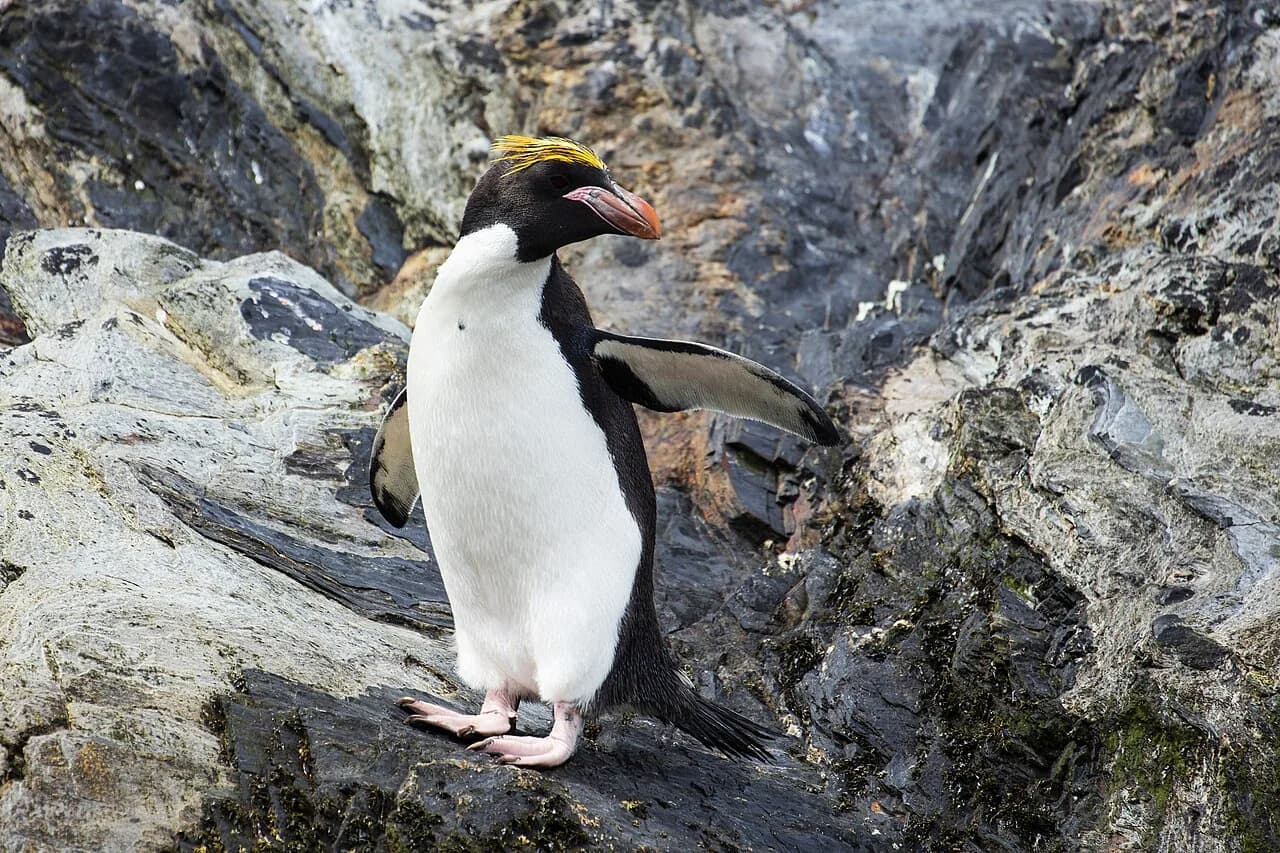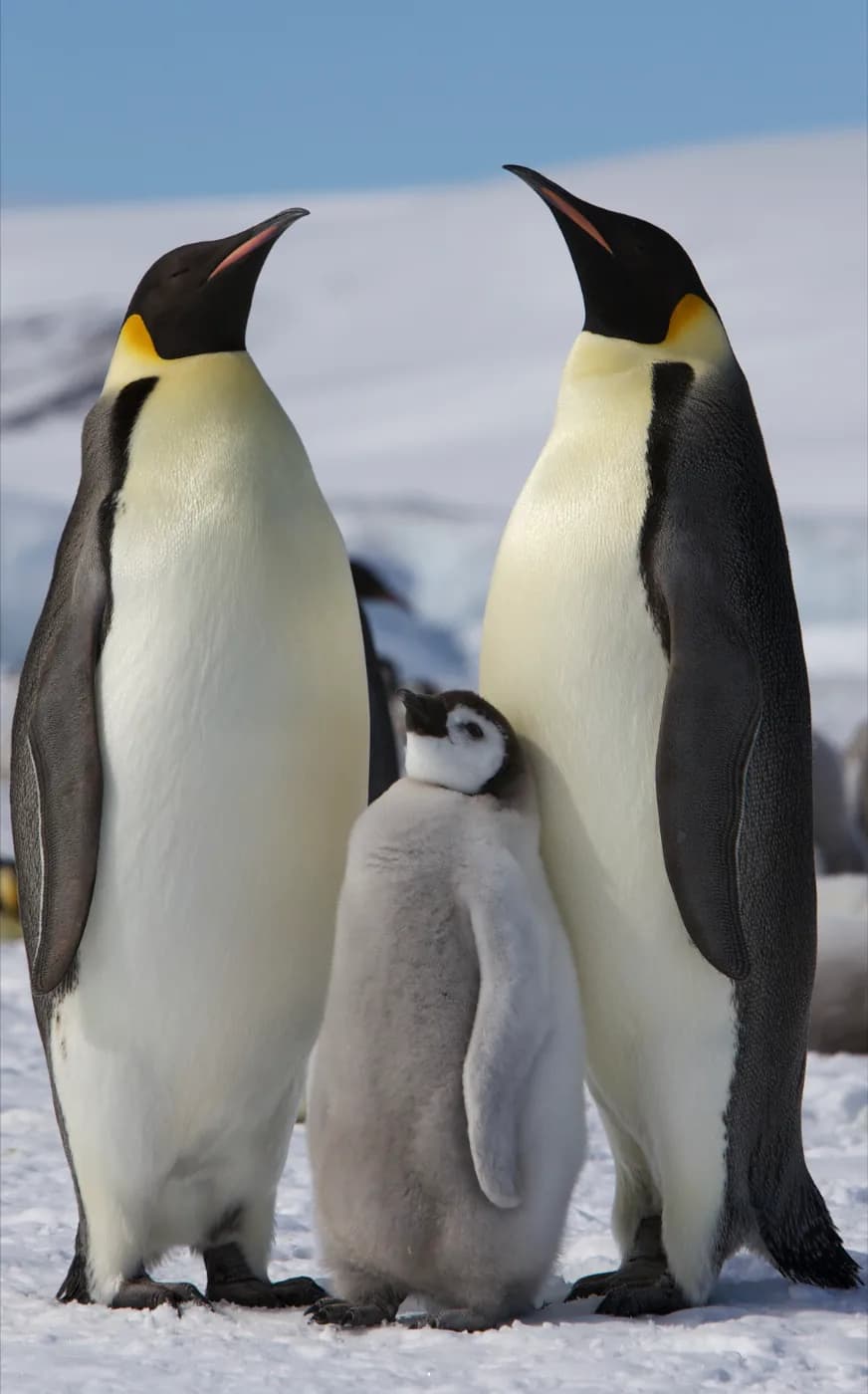
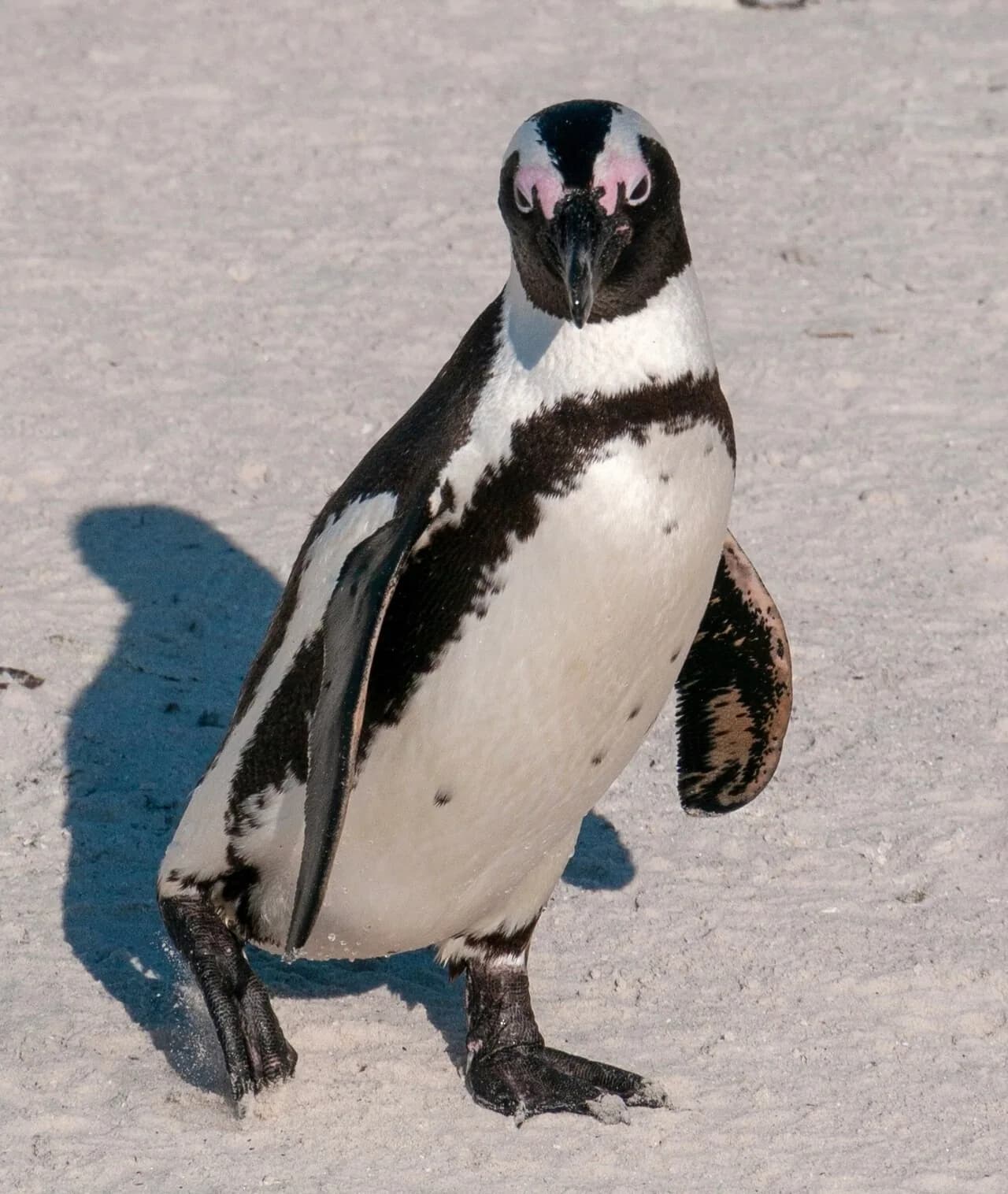
The Macaroni Penguin has about 6.3 million breeding pairs and is listed as Vulnerable. The Gentoo Penguin has about 774,000 pairs and is listed as Least Concern. Neither figure is wrong and the categories are not inconsistent. A Red List category is not a headcount. It is a slope, and the macaroni is on one.
What Most People Get Wrong
The categories measure extinction risk, not rarity
This is the single most useful thing to fix about how status labels are read. The IUCN Red List asks how likely a species is to run out, not how many individuals it currently has. A species with millions of birds that is losing them steadily qualifies as threatened; a species with far fewer birds that is holding its numbers does not.
Macaroni Penguins are listed under criterion A, population reduction, with the assessment citing observed past decline, projected future decline, and a window spanning both. Marion Island is the illustration: 433,723 breeding pairs there in 1994/95 fell to 266,971 by 2012/13.1 Six million is not a safety margin. It is a starting position. The same logic puts seven of the eight Eudyptes crested penguins in a threatened category.
A category is a verdict, not a diagnosis
Two penguins in the same box can have nothing in common. The Emperor Penguin is Endangered with 595,000 individuals, driven there by projected loss of the fast ice it breeds on. The Galápagos Penguin is Endangered with about 1,200 individuals, confined to one archipelago and exposed to El Niño. Same label, opposite arithmetic.
Where the 19 species actually sit
| Species | Category | Population | Unit |
|---|---|---|---|
| African Penguin | Critically Endangered | 9,900 | breeding pairs |
| Emperor Penguin | Endangered | 595,000 | individuals |
| Northern Rockhopper Penguin | Endangered | 240,300 | pairs |
| Erect-crested Penguin | Endangered | 150,000 | pairs |
| Yellow-eyed Penguin | Endangered | 3,400 | individuals |
| Galápagos Penguin | Endangered | 1,200 | individuals |
| Macaroni Penguin | Vulnerable | 6,300,000 | pairs |
| Eastern Rockhopper Penguin | Vulnerable | 1,600,000 | pairs |
| Western Rockhopper Penguin | Vulnerable | 1,500,000 | pairs |
| Snares Penguin | Vulnerable | 25,000 | pairs |
| Humboldt Penguin | Vulnerable | 23,800 | individuals |
| Fiordland Penguin | Vulnerable | 6,250 | mature individuals |
| Royal Penguin | Near Threatened | 850,000 | pairs |
| Chinstrap Penguin | Least Concern | 8,000,000 | pairs |
| Adélie Penguin | Least Concern | 7,580,000 | pairs |
| King Penguin | Least Concern | 2,230,000 | pairs |
| Magellanic Penguin | Least Concern | 1,800,000 | pairs |
| Gentoo Penguin | Least Concern | 774,000 | pairs |
| Little Blue Penguin | Least Concern | 469,760 | individuals |
Read down the population column and the ordering breaks repeatedly. Macaroni Penguins outnumber Gentoos by roughly eight to one and sit two categories higher in risk. Royal Penguins are Near Threatened at 850,000 pairs while Magellanics are Least Concern at 1.8 million. Twelve of the 19 species — 63 per cent — are in a threatened category.
Why This Problem Is Hard
Five criteria, and meeting any one is enough
A species is listed at the highest category it qualifies for under any single criterion. There are five. A is population reduction. B is a small geographic range that is also fragmented, declining or fluctuating: extent of occurrence under 20,000 km² for Vulnerable and under 100 km² for Critically Endangered, or area of occupancy under 2,000 km² and 10 km² respectively. C is a small population that is also declining. D is a population that is simply very small or very restricted. E is a quantitative model of extinction probability.2
Criterion A carries most of the penguin listings, and its thresholds explain a lot:
| Form of criterion A | Critically Endangered | Endangered | Vulnerable |
|---|---|---|---|
| A1 — past reduction, causes understood, ceased and reversible | ≥90% | ≥70% | ≥50% |
| A2, A3, A4 — past, projected, or spanning both, with causes unresolved | ≥80% | ≥50% | ≥30% |
A 30 per cent decline is enough for Vulnerable when nobody can show the cause has stopped.2 That is why abundant species keep appearing in threatened categories.
The measurement window stretches with the bird
Criterion A measures reduction over the longer of ten years or three generations.2 Macaroni Penguin generation length is put at 12.33 years, so its window runs back roughly 37 years.3 A long-lived species can be well into a serious decline and still be inside its first assessment window, which is one reason penguin listings often lag the trend visible at individual colonies.
The counting unit is not consistent
Some penguins are reported in breeding pairs, some in individuals, because that is what the survey method yields. The Red List works in mature individuals and converts. Emperor Penguins are counted from satellite imagery by the guano staining of the sea ice. African Penguins are counted nest by nest. The uncertainty attached to those two numbers is not remotely the same, and neither is the frequency of update.
The African Penguin shows how easily a population figure gets misread. The table above gives roughly 9,900 breeding pairs — a global 2023 count. The 8,750 figure below is South Africa alone, at the end of the same year. Older sources still circulate a figure near 41,700, which counted all age classes rather than breeders and dates from around a decade earlier. Three numbers, all defensible, describing different things: a unit, a geography, and a date. Any population figure without those three attached is close to meaningless.
What Scientists Know
Two moves define the current picture
The Emperor Penguin was Least Concern in 1988, Near Threatened in 2012, and moved to Endangered on 9 April 2026.45 Satellite counts indicated a roughly 10 per cent population loss between 2009 and 2018 — more than 20,000 adults — and the assessment projects the population halving by the 2080s as fast ice is lost.5 Antarctic sea ice extent hit record lows between 2022 and 2024.6 Emperors need fast ice both to breed and to moult, and an early break-up puts chicks in the water before they are waterproof.
The African Penguin went Vulnerable, then Endangered in 2010, then Critically Endangered in 2024 — the first penguin ever placed in the highest category.7 It stands roughly 97 per cent below its historical numbers, having dropped, in South Africa alone, from 15,187 breeding pairs in 2018 to about 8,750 by the end of 2023.89
Taxonomy changes status without changing birds
Rockhopper penguins were long treated as one species, then two, and this site treats them as three. Northern Rockhoppers diverged from the southern lineage roughly 970,000 years ago and are now assessed separately as Endangered with 240,300 pairs.10 Had they remained lumped with 3.1 million southern pairs, that decline would have been averaged into a much larger denominator and largely disappeared.
Splitting does not create risk. It stops the arithmetic from hiding it.
An assessment is a dated snapshot
Red List updates are published twice a year, and species are meant to be reassessed at least every ten years. Occasionally an assessment is released between updates: the 2026 emperor assessment was made available as a pre-publication ahead of the Antarctic Treaty Consultative Meeting in May.11 The practical consequence for anyone reading a status is that the assessment year matters as much as the category.
None of the 19 species here is listed Data Deficient — the category used when there is not enough information to judge risk at all. Data Deficient is not a low-risk finding; it is an absence of a finding, and it quietly removes a species from every count of threatened taxa.
Categories move in both directions
The listings are meant to respond to management, and the interventions exist. Macquarie Island's rabbits, rats and mice were eradicated between 2007 and 2014 in a campaign costing about 25 million Australian dollars, and threatened seabirds there have since recovered enough to be considered for delisting.1213 In March 2025 a Pretoria High Court order created no-take zones for the sardine and anchovy purse-seine fishery around six African Penguin colonies for ten years.9
What Is Still Unclear
A listing built substantially on projection
The emperor's Endangered status rests heavily on modelled sea-ice loss decades ahead. That is legitimate under the criteria — projected reduction is explicitly allowed — but it means the listing is a forecast, and the record lows of 2022 to 2024 show how fast the underlying variable can move in either direction.6 The birds counted today are still numerous.
Data quality is wildly uneven
Some populations are re-counted annually from space. Others rest on estimates from islands almost nobody visits. The Fiordland Penguin figure carries an explicit band of 5,500 to 7,000 mature individuals because its nests are scattered through temperate rainforest and cannot be counted the way an open colony can. The 150,000-pair estimate for the Erect-crested Penguin comes from two remote island groups. Comparing those numbers to a satellite census is comparing different kinds of knowledge.
The rockhopper boundary is not settled
Genome-scale work supports three rockhopper species and warns that relying on limited markers underestimates diversity.14 Earlier multilocus analyses found significant gene flow between eastern and western birds and could not delimit them as separate species.10 If they were merged again, two Vulnerable species of 1.5 and 1.6 million pairs would become one of 3.1 million. Nothing about the birds would change.
Least Concern is not the same as safe
Six penguins hold Least Concern, and the category means only that the species does not currently meet a threatened threshold globally. It says nothing about individual regions. A species can be increasing in one sector of its range and collapsing in another and still sit in the same box, which is why status is a starting question rather than a conclusion.
Where To Go Next
For the pressures behind these categories, read penguin predators and threats, and for how breeding failure translates into decline, why penguin chicks die in bad years. The mechanics of the categories themselves are covered in how IUCN Red List categories work, and the emperor case in is the Emperor Penguin endangered. Current standings for all 19 species are on the conservation tracker and the status index.
References
-
SANBI. Macaroni Penguin Eudyptes chrysolophus — Red List assessment (population and Marion Island trend, citing Crawford et al. 2003, 2009 and Crossin et al. 2013). South African National Biodiversity Institute. https://speciesstatus.sanbi.org/assessment/last-assessment/3143/ ↩
-
IUCN (2012). IUCN Red List Categories and Criteria: Version 3.1, Second edition. Gland, Switzerland and Cambridge, UK: IUCN. https://portals.iucn.org/library/sites/library/files/documents/RL-2001-001-2nd.pdf ↩ ↩2 ↩3
-
BirdLife South Africa. Macaroni Penguin Eudyptes chrysolophus — Regional Red List account (generation time 12.33 years, after BirdLife International 2020). https://www.birdlife.org.za/red-list/macaroni-penguin/ ↩
-
BirdLife International (2012). Aptenodytes forsteri. The IUCN Red List of Threatened Species 2012.2 — uplisted to Near Threatened (archived assessment page). https://web.archive.org/web/20121114131332/http://www.iucnredlist.org/details/106003849/0 ↩
-
IUCN (9 April 2026). Emperor penguin and Antarctic fur seal now Endangered due to climate change – IUCN Red List (press release). https://iucn.org/press-release/202604/emperor-penguin-and-antarctic-fur-seal-now-endangered-due-climate-change-iucn ↩ ↩2
-
British Antarctic Survey (9 April 2026). Emperor penguin and Antarctic fur seal now Endangered due to climate change – IUCN Red List. https://www.bas.ac.uk/news/emperor-penguin-and-antarctic-fur-seal-now-endangered-due-to-climate-change-iucn-red-list/ ↩ ↩2
-
Sherley, R.B., Makhado, A.B., Crawford, R.J.M., Hagen, C., Kemper, J., Ludynia, K., Masotla, M.J., McInnes, A., Pichegru, L., Tom, D., Upfold, L. & Waller, L.J. (2024). The African Penguin Spheniscus demersus should be considered Critically Endangered. Ostrich 95(3): 181–187. https://www.nisc.co.za/products/abstracts/37744/journals/the-african-penguin-spheniscus-demersus-should-be-considered-critically-endangered ↩
-
SANCCOB & BirdLife South Africa (20 March 2024). Ground-breaking litigation launched to protect the African Penguin from extinction. https://sanccob.co.za/news/ground-breaking-litigation-launched-to-protect-the-african-penguin-from-extinction/ ↩
-
BirdLife South Africa & SANCCOB (18 March 2025). High Court victory for the Critically Endangered African Penguin (media release). https://www.birdlife.org.za/wp-content/uploads/2025/03/Order-of-Court-media-release_18-March-2025-FINAL.pdf ↩ ↩2
-
Mays, H.L. Jr, Oehler, D.A., Morrison, K.W. et al. (2019). Phylogeography, population structure, and species delimitation in rockhopper penguins (Eudyptes chrysocome and Eudyptes moseleyi). Journal of Heredity 110(7): 801–817. https://pmc.ncbi.nlm.nih.gov/articles/PMC7967833/ ↩ ↩2
-
IUCN Red List. Pre-publication assessments — Antarctic assessments, including BirdLife International 2026 [early online], Aptenodytes forsteri, e.T22697752A197622453. https://newredlist.iucnredlist.org/assessment/pre-publication ↩
-
Australian Antarctic Program (29 May 2024). Macquarie Island's astounding recovery, ten years on from rats, mice and rabbits. Australian Antarctic Division. https://www.antarctica.gov.au/news/2024/macquarie-islands-astounding-recovery-ten-years-on-from-rats-mice-and-rabbits/ ↩
-
Bird, J.P., Fuller, R.A. & Shaw, J.D. (2024). Patterns of recovery in extant and extirpated seabirds after the world's largest multipredator eradication. Conservation Biology 38(4): e14239 — authors' summary of the findings. https://theconversation.com/ridding-macquarie-island-of-pests-pays-off-as-seabirds-come-back-from-the-brink-but-recovery-has-just-begun-221992 ↩
-
Frugone, M.J., Cole, T.L., López, M.E. et al. (2021). Taxonomy based on limited genomic markers may underestimate species diversity of rockhopper penguins and threaten their conservation. Diversity and Distributions 27(11): 2277–2296. https://nora.nerc.ac.uk/id/eprint/531105/ ↩