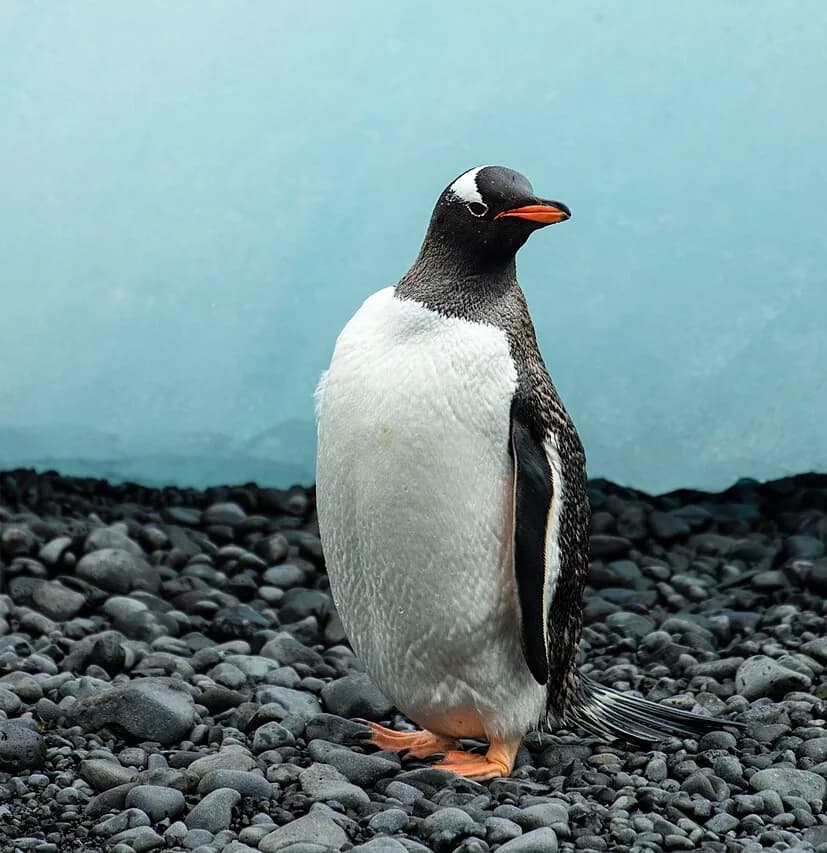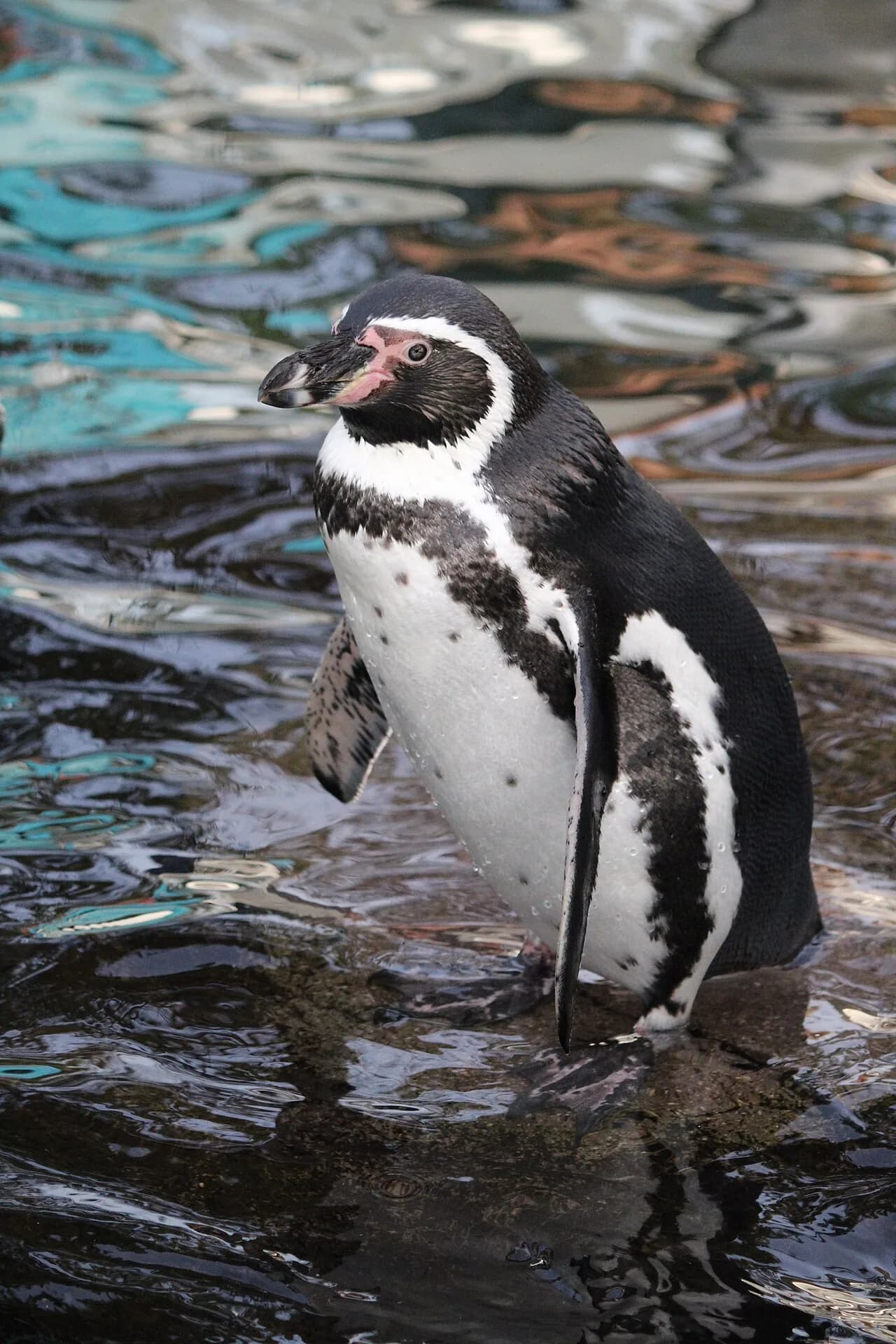
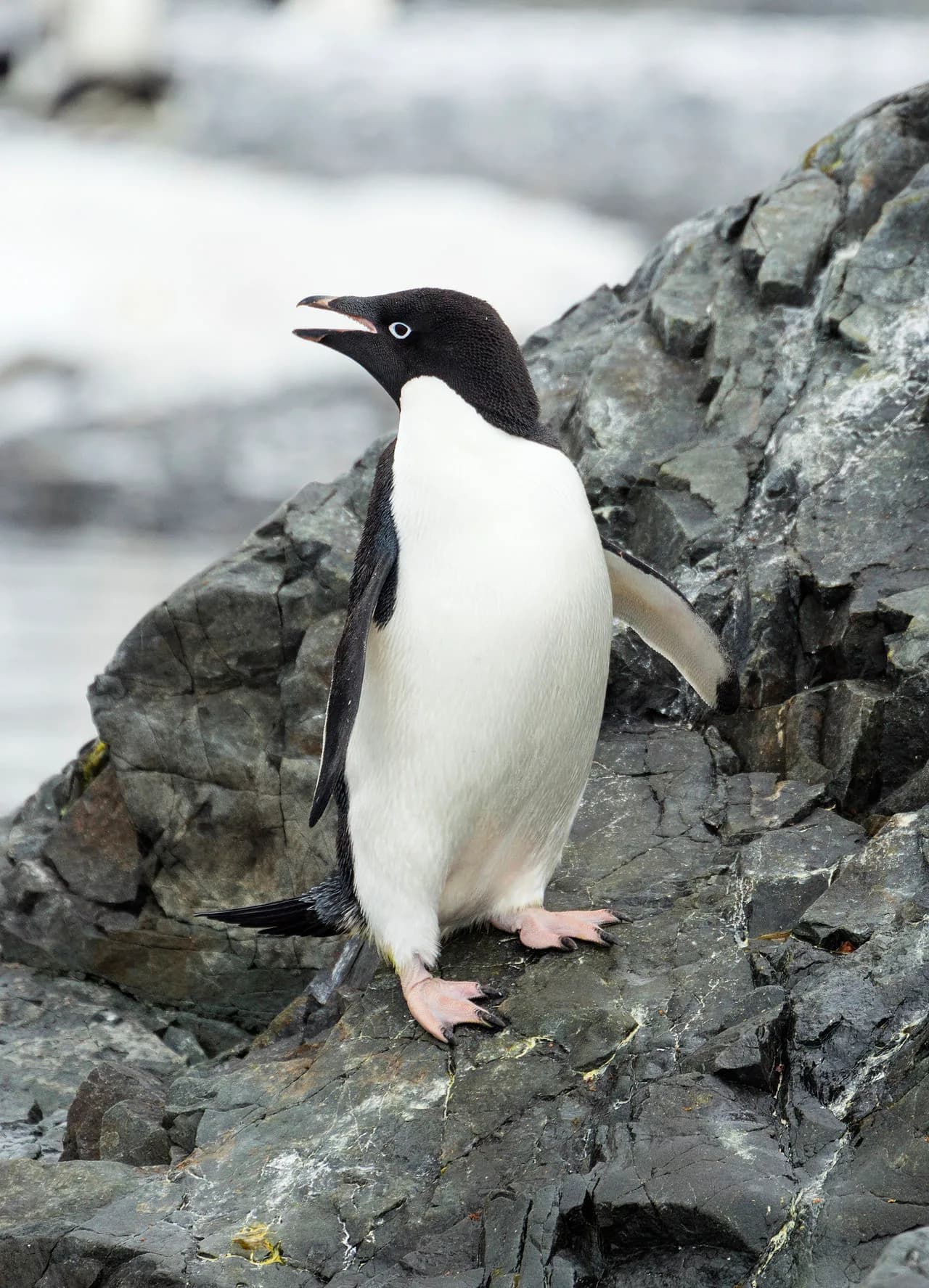
In Adélie Land, Emperor and Adélie Penguins forage in the same water in the same season. Measured by nitrogen isotope ratio, they are separated by 4.1 parts per thousand — more than a full trophic level apart.1 Same ocean, same month, different position in the food web entirely. Diet is not a preference. It is a coordinate, and it predicts dive depth, colony placement, breeding schedule and vulnerability better than body size does.
What Most People Get Wrong
"Fish" is not an answer
Penguin diet gets flattened into one word, and that word is usually wrong. Across the 19 species the principal prey falls into three broad columns — krill and other crustaceans, fish, and squid — and a species' position among them determines almost everything else about how it lives.
| Species | Principal prey | Max recorded dive |
|---|---|---|
| Emperor Penguin | Fish, squid, some krill | 565 m |
| King Penguin | Myctophid lanternfish, squid | 343 m |
| Gentoo Penguin | Mixed krill and fish; generalist | 200 m |
| Adélie Penguin | Antarctic krill, some fish | 180 m |
| Yellow-eyed Penguin | Demersal fish, squid | 160 m |
| Humboldt Penguin | Anchoveta and other small pelagic fish | 150 m |
| African Penguin | Sardine and anchovy | 130 m |
| Chinstrap Penguin | Antarctic krill | 121 m |
| Macaroni Penguin | Krill and other crustaceans, some fish | 115 m |
| Magellanic Penguin | Small pelagic fish, squid | 97 m |
| Little Blue Penguin | Small fish, squid, crustaceans | 72 m |
| Galapagos Penguin | Small schooling fish | 52 m |
The correlation running down that table is not coincidence. Krill sits shallow and in dense swarms; midwater and demersal fish sit deep and dispersed. A species that eats the first does not need the depth economy described in how penguins dive so deep. A species that eats the second cannot survive without it.
A generalist is not automatically safer
The intuitive rule is that a flexible feeder is a resilient feeder. It is not that simple. A bird can technically eat a substitute prey and still fail, because the substitute is smaller, less energy-dense, further from the colony, or available in the wrong month. Flexibility on a diet list is not the same as flexibility in an energy budget.
Why This Problem Is Hard
Every method of measuring diet is biased
There is no clean way to find out what a wild penguin ate.
- Stomach contents and flushing capture the last meal or two, and over-represent prey with hard parts that persist — squid beaks and fish otoliths — while soft-bodied prey digests away.
- Faecal analysis and prey DNA widen the window slightly and still skew towards what survives digestion.
- Stable isotope analysis of blood and feathers integrates diet across weeks to months, which is its advantage, and reports position in the food web rather than species eaten, which is its limitation.
Isotopes are the workhorse method, and their weak point is arithmetic. Converting a δ15N value into a trophic level requires a trophic discrimination factor, and work on free-ranging Pygoscelis penguins has shown these factors vary between species and between tissues within the same bird.2 The measurement is precise. The conversion is not.
Diet is not one number per species
It varies by season, by colony, by year, and by individual bird within a colony. Isotope work in the South Shetlands found that Gentoo Penguins behave as generalists but with strong individual consistency — the same bird eating the same thing across seasons — while Adélies were intermediate generalists with little individual consistency, and Chinstraps were specialists.3 Three species in one archipelago, three different strategies for the same problem.
Prey has to be near the colony, not merely abundant
A breeding penguin is a commuter with a fixed range. Total prey biomass somewhere in the region is close to irrelevant if it is not inside the foraging radius during the weeks a chick needs feeding. This is the single most important idea in penguin feeding ecology, and it is the reason regional stock assessments and colony outcomes so often disagree.
What Scientists Know
The isotope evidence separates species cleanly
The Adélie Land comparison is the sharpest case. Emperor and Adélie blood δ13C values (−24.5‰ and −25.4‰) indicated emperors foraging in more neritic water. The δ15N gap of 4.1‰ placed emperors on fish and squid and Adélies on euphausiids exclusively — a full trophic level of separation between two species standing on the same ice.1
The same technique shows where separation is weakest. At Powell Island in the South Orkneys, the isotopic niches of adult Adélie, Chinstrap and Gentoo Penguins were similar, with moderate to strong overlap in both study seasons.4 At Livingston Island, isotope work on sympatric Gentoos and Chinstraps was framed explicitly as a test for competition over Antarctic krill.5 Where three congeners share a coastline, they are not partitioning prey as neatly as textbook competition theory would predict.
Krill dependence is a concentrated bet
Antarctic krill dominates the energy flow of the Southern Ocean food web, and Adélie, Chinstrap and Macaroni Penguins are built around it. Diet studies across the full annual cycle confirm krill's importance outside the breeding season as well, not just during chick-rearing.6
The exposure is straightforward. Under CCAMLR, the total catch limit for Antarctic krill in Subareas 48.1–48.4 is 5.61 million tonnes per season, but until catch is allocated among smaller management units a trigger level of 620,000 tonnes applies.7 That trigger exists precisely because a fleet is free to take its quota from wherever fishing is easiest — which tends to be the same dense, predictable swarms that penguin colonies were built beside. The problem is not the tonnage. It is where the tonnage comes from.
Fish specialists live on upwelling, and upwelling is unstable
Humboldt Penguins depend on the small pelagic fish of the Humboldt Current — anchoveta, sardine — and squat lobster, as do Magellanic Penguins at the northern end of their range.8 African Penguins depend on Benguela sardine and anchovy. Both systems are exceptionally productive and exceptionally variable, and both collapse in the same way: upwelling weakens, the thermocline deepens, nutrient renewal declines, primary production falls, and the forage fish are simply not there. The African Penguin is now Critically Endangered, down to roughly 9,900 breeding pairs globally in 2023 from about 44,300 in 1993.
The deep fish specialists commute instead
King Penguins solve the same problem in the opposite direction. They depend essentially on myctophid lanternfish, which in summer are concentrated 400–500 km south of the Crozet colonies at the Antarctic Polar Front.9 Incubating males cope with the resulting trip lengths by storing an undigested meal in the stomach for weeks, so a chick can be fed immediately on hatching if the female is late back.10 That is not a feeding adaptation. It is a scheduling adaptation forced by the location of the food.
Chicks are not fed the adult diet
In the same Adélie Land study, δ15N values in Adélie chicks were higher than in the adults feeding them — 10.2‰ against 9.0‰.1 The parents were delivering higher-trophic-level prey to the chick than they were eating themselves. Any account of "what this species eats" that ignores the age class is describing two different diets at once.
What Is Still Unclear
Switching capacity is mostly unmeasured
Scientists know what most penguins eat. How readily a given species can switch when its primary prey fails is a much harder question, and for most species there is no direct answer — only inference from years when prey did fail. Prey change and breeding failure travel together in the record, which tells you the switching is costly without telling you where the ceiling is.
The fisheries-competition question is genuinely contested
South Africa ran a decade-long experiment closing waters around four African Penguin colonies to anchovy and sardine fishing, two in the Benguela and two in the adjacent Agulhas region.11 Analyses of the same dataset have reached materially different conclusions. One reading found closures within the birds' primary foraging range increased breeding productivity and reduced parental foraging effort, indicating real competition.1112 Another found very little evidence of an effect in either direction, projecting annual population growth improvements of −0.25% at Dassen, +0.25% at Robben, 0% at Bird and +0.5% at St Croix.13 An international review panel was convened in 2023 specifically because the statistical dispute could not be resolved internally.14
The honest summary is that the biological mechanism is not in doubt and the effect size is. That distinction matters for policy, and it is regularly flattened in both directions.
The krill baseline is uncertain
Krill biomass estimates carry wide uncertainty and are updated on a multi-year cycle, while the fishery operates continuously.15 Whether the current catch limits are precautionary depends on a stock estimate that is itself under revision.
Where To Go Next
Browse the diet hubs to compare species sharing prey, starting with krill and fish. For how prey depth translates into physiology, read how penguins dive so deep; for how prey location sets the map, read where penguins live. The clearest warm-water food bottlenecks are the African and Galapagos Penguins, and the pressure side of the story continues in penguin conservation status explained and on the conservation overview.
References
-
Cherel, Y. (2008). Isotopic niches of emperor and Adélie penguins in Adélie Land, Antarctica. Marine Biology 154: 813–821 — adult blood δ13C −24.5 ± 0.2‰ (emperor) versus −25.4 ± 0.2‰ (Adélie); a δ15N difference of 4.1‰ (12.0 ± 0.4 versus 7.9 ± 0.1‰) spanning more than one trophic level; Adélie chick δ15N 10.2 ± 0.8‰ against adults at 9.0 ± 0.2‰. https://doi.org/10.1007/s00227-008-0974-3 ↩ ↩2 ↩3
-
Ceia, F.R., Cherel, Y., Seco, J., Barbosa, A., Chipev, N. & Xavier, J.C. (2021). Variability in tissue-specific trophic discrimination factors (Δ13C and Δ15N) between Antarctic krill Euphausia superba and free-ranging Pygoscelis penguins. Polar Biology 44: 1541–1551 — discrimination factors differed between species, tissues and age classes in wild chinstrap and gentoo penguins eating the same prey. https://doi.org/10.1007/s00300-021-02889-2 ↩
-
Herman, R.W., Valls, F.C.L., Hart, T., Petry, M.V., Trivelpiece, W.Z. & Polito, M.J. (2017). Seasonal consistency and individual variation in foraging strategies differ among and within Pygoscelis penguin species in the Antarctic Peninsula region. Marine Biology 164: 115 — in the South Shetland Islands, gentoos were generalists with individual consistency, Adélies intermediate generalists with little individual consistency, and chinstraps specialists with little variation among individuals. https://doi.org/10.1007/s00227-017-3142-9 ↩
-
Tarroux, A., Lydersen, C., Trathan, P.N. & Kovacs, K.M. (2018). Temporal variation in trophic relationships among three congeneric penguin species breeding in sympatry. Ecology and Evolution 8: 3660–3674 — at Powell Island, South Orkney Islands, the isotopic niche regions of adult Adélie, chinstrap and gentoo penguins were similar, with moderate to strong overlap in both breeding seasons. https://pubmed.ncbi.nlm.nih.gov/29686847/ ↩
-
Dimitrijević, D., Paiva, V.H., Ramos, J.A., Seco, J., Ceia, F.R., Chipev, N., Valente, T., Barbosa, A. & Xavier, J.C. (2018). Isotopic niches of sympatric Gentoo and Chinstrap Penguins: evidence of competition for Antarctic krill? Polar Biology 41(9): 1655–1669 — both species breeding in sympatry at Livingston Island, Antarctic krill dominating both diets. https://doi.org/10.1007/s00300-018-2306-5 ↩
-
Juáres, M.A., Santos, M., Mennucci, J.A., Coria, N.R. & Mariano-Jelicich, R. (2016). Diet composition and foraging habitats of Adélie and gentoo penguins in three different stages of their annual cycle. Marine Biology 163: 105 — Antarctic krill dominated the diet of both species in all three stages sampled (pre-breeding, breeding and post-breeding). https://doi.org/10.1007/s00227-016-2886-y ↩
-
CCAMLR (2024). Conservation Measure 51-01 (2024): precautionary catch limitations on Euphausia superba in Statistical Subareas 48.1, 48.2, 48.3 and 48.4 — total combined catch limited to 5.61 million tonnes per fishing season, further limited to a trigger level of 620,000 tonnes until the limit is allocated among smaller management units. https://cm.ccamlr.org/en/measure-51-01-2024 ↩
-
Herling, C., Culik, B.M. & Hennicke, J.C. (2005). Diet of the Humboldt penguin (Spheniscus humboldti) in northern and southern Chile. Marine Biology 147: 13–25 — schooling pelagic fish dominated at both colonies, with anchovy Engraulis ringens, Araucanian herring and silverside the primary prey in the south; the authors note the birds' dependence on commercially exploited schooling prey. https://doi.org/10.1007/s00227-004-1547-8 ↩
-
Charrassin, J.-B. & Bost, C.-A. (2001). Utilisation of the oceanic habitat by king penguins over the annual cycle. Marine Ecology Progress Series 221: 285–298 — incubating and brooding birds in summer preferentially exploited the polar front, located 340 to 450 km south of the Crozet breeding site. https://hal.science/hal-03692410 ↩
-
Gauthier-Clerc, M., Le Maho, Y., Clerquin, Y., Drault, S. & Handrich, Y. (2000). Penguin fathers preserve food for their chicks. Nature 408: 928–929 — male king penguins returning to the egg carry food for the chick in the stomach, preserved for two to three weeks while the male fasts, so the chick can be fed if the female's return is delayed. https://pubmed.ncbi.nlm.nih.gov/11140669/ ↩
-
Sydeman, W.J., Hunt, G.L. Jr, Pikitch, E.K., Parrish, J.K., Piatt, J.F., Boersma, P.D., Kaufman, L., Anderson, D.W., Thompson, S.A. & Sherley, R.B. (2021). South Africa's experimental fisheries closures and recovery of the endangered African penguin. ICES Journal of Marine Science 78(10): 3538–3543 — a decade-long closure of anchovy and sardine take around four colonies, two in the Benguela and two in the adjacent Agulhas region; "fisheries closures within the birds' primary foraging range increased their breeding productivity and perhaps reduced parental foraging efforts, indicating that the fisheries are competing with the birds for food". https://www.faralloninstitute.org/s/Sydeman-et-al-2021-ICES-J-Mar-Sci.pdf ↩ ↩2
-
Sherley, R.B., Barham, B.J., Barham, P.J., Campbell, K.J., Crawford, R.J.M., Grigg, J., Horswill, C., McInnes, A., Morris, T.L., Pichegru, L., Steinfurth, A., Weller, F., Winker, H. & Votier, S.C. (2018). Bayesian inference reveals positive but subtle effects of experimental fishery closures on marine predator demographics. Proceedings of the Royal Society B 285: 20172443 — closures improved chick survival and condition, with modelled population growth gains exceeding 1% at one colony. https://pubmed.ncbi.nlm.nih.gov/29343602/ ↩
-
Butterworth, D.S. & Ross-Gillespie, A. (2021). A revised summary of results for the island closure experiment. FISHERIES/2021/JUN/SWG-PEL/41, University of Cape Town (doi:10.25375/uct.15073419) — "very little evidence for any impact (in either direction)"; coarse predicted improvements in annual population growth rate of Dassen −0.25%, Robben +0.25%, Bird 0% and St Croix +0.5%. https://ndownloader.figshare.com/files/28984611 ↩
-
Punt, A.E. (Chair), Furness, R.W., Parma, A.M., Plagányi-Lloyd, É., Sanchirico, J.N. & Trathan, P. (2023). Report of the International Review Panel regarding fishing closures adjacent to South Africa's African penguin breeding colonies and declines in the penguin population. Department of Forestry, Fisheries and the Environment, July 2023. https://biodiversitylaw.org/wp-content/uploads/2024/03/International-Panel-Report-August-2023.pdf ↩
-
Krafft, B.A., Macaulay, G.J., Skaret, G., Knutsen, T., et al. (2021). Standing stock of Antarctic krill (Euphausia superba Dana, 1850) (Euphausiacea) in the Southwest Atlantic sector of the Southern Ocean, 2018–19. Journal of Crustacean Biology 41(3): ruab046 — only the second large-scale synoptic survey of Area 48, the operative catch limit having rested on a re-analysis of the CCAMLR 2000 survey (60.3 Mt, sampling CV 13%). https://doi.org/10.1093/jcbiol/ruab046 ↩