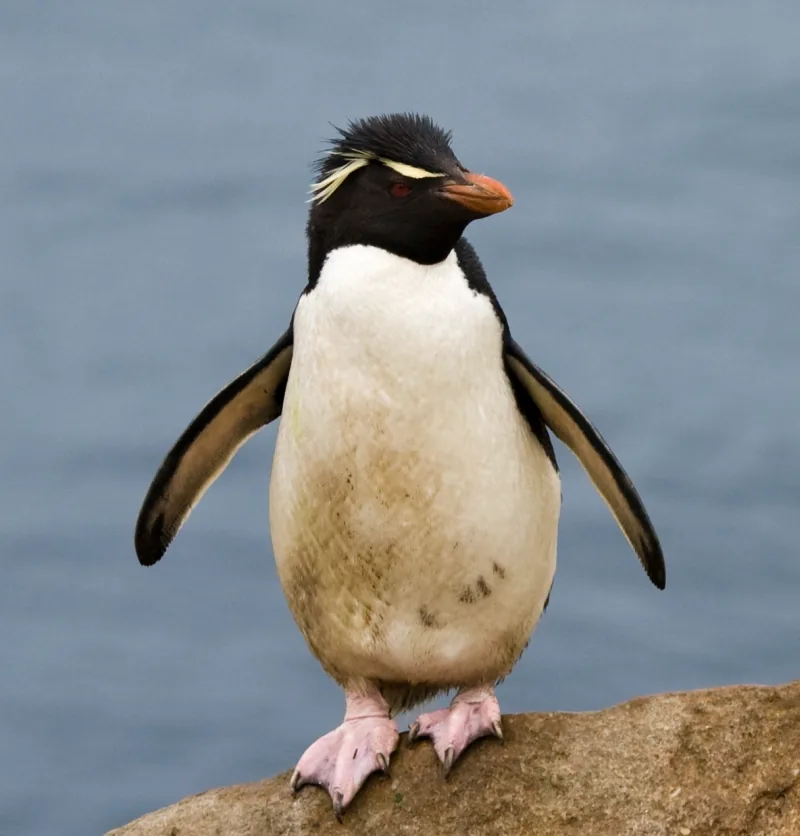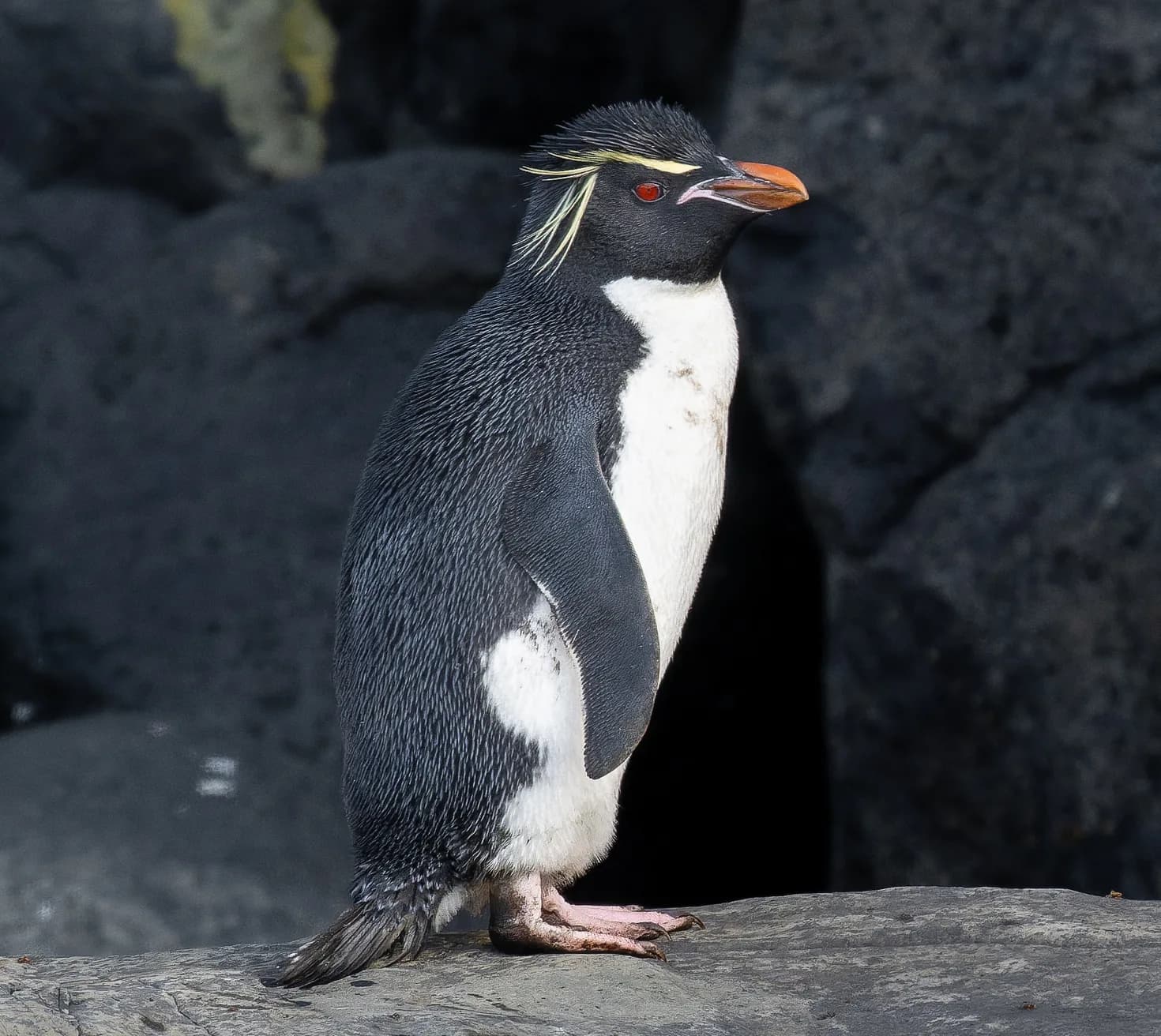
A rockhopper coming ashore on a Falklands cliff coast does not walk out of the water. It rides the swell in, hits weed-slicked rock chest-first, and has a second or two to get upright and clear before the next wave arrives. Many fail the first attempt and get dragged back out to try again. The hop stops looking like a novelty the moment you accept that this is the front door.
What Most People Get Wrong
The waddle was never the problem
Hopping gets treated as comic relief — a small bird with a bad walk making the best of it. The research points somewhere else entirely, and it starts with a more general question: why is walking so expensive for penguins at all?
Pinshow, Fedak and Schmidt-Nielsen put a number on it in 1977, in a Science paper titled Terrestrial Locomotion in Penguins: It Costs More to Waddle. Penguins moving on land burn energy well above the rate a bird of that mass should need.1 The obvious suspect was the side-to-side roll.
Griffin and Kram tested the suspect in 2000 and cleared it. At their preferred walking speed, Emperor Penguins perform the same amount of mechanical work lifting and accelerating their centre of mass as any other walking animal of the same size, and the rocking gait recovers pendulum energy efficiently rather than squandering it. All that swinging — rotational work — accounts for only about 10 per cent of total centre-of-mass work.2
The cost sits in the legs. Set a roughly 20 kg emperor beside a rhea of nearly the same mass and both push against the ground with the same average force. The emperor, with far shorter legs, has to produce that force about twice as fast, which means recruiting faster and less economical muscle fibres.2
Waddling is not the penalty. Short legs are.
Western Rockhoppers run 45–55 cm and 2–3.4 kg. They are working with the shortest legs and smallest bodies in that argument, and they took them to the worst ground in the family.
Why This Problem Is Hard
The landing is the dangerous half
Most penguins pick the easy shoreline. Gentoos, kings, Magellanics and macaronis in the Falklands mostly settle on soft, level ground with a straightforward walk up from the water. Rockhoppers do the opposite. Juan Masello, who has worked on New Island for years, puts it bluntly: they go for the worst.3
At Rockhopper Point on Sea Lion Island the colony sits on an exposed headland roughly 30 metres above breaking sea.3 Birds returning from a foraging trip porpoise in over the surge, launch themselves belly-first onto rock covered in kelp and guano, and either pop up and sprint clear or get swept back out. Plenty get swept back out. That is an ordinary commute on a rocky coastline, repeated day after day for a whole breeding season.
The climb arrives at the worst moment
Above the landing is the actual work: gullies, boulder tiers, and gaps a bird clears with a leap more than twice its own height. During chick-rearing at New Island, the birds making that climb in the evening are almost all females. They have been at sea since dawn — around fourteen hours. Their mates are inside the colony fasting, holding the nest for roughly a month while the chicks are still on it.3
The returning female is also carrying a payload that is not hers. Rockhopper digestion shuts down on the run home and the stomach cools, keeping the day's catch of krill and small fish fresh for the chick.3 So the hardest terrain in the penguin world gets crossed at the bottom of the day's energy budget, by a bird deliberately not digesting its own food.
Shore access is not a detail of rockhopper ecology. It is the tax on every meal.
What Scientists Know
Three species, one movement style
Genetic work published in 2006 argued that rockhoppers are not one species but three, and this site follows that split.4 It matters here because the three birds are not interchangeable.
| Species | Length | Mass | Breeding pairs | Status |
|---|---|---|---|---|
| Western Rockhopper (Eudyptes chrysocome) | 45–55 cm | 2–3.4 kg | ~1.5 million | Vulnerable |
| Eastern Rockhopper (Eudyptes filholi) | 45–55 cm | 2.1–3.5 kg | ~1.6 million | Vulnerable |
| Northern Rockhopper (Eudyptes moseleyi) | 52–62 cm | 2.5–4.3 kg | ~240,300 | Endangered |
Read the table rather than the names. Eastern and western rockhoppers are effectively the same bird by the numbers: same length, overlapping mass, both listed as Vulnerable, both counted in the millions of pairs. What separates them is which ocean they work — western birds around the Falklands and southern South America, eastern birds around the subantarctic islands of the Indian and Pacific — and, increasingly, where their trend lines point.
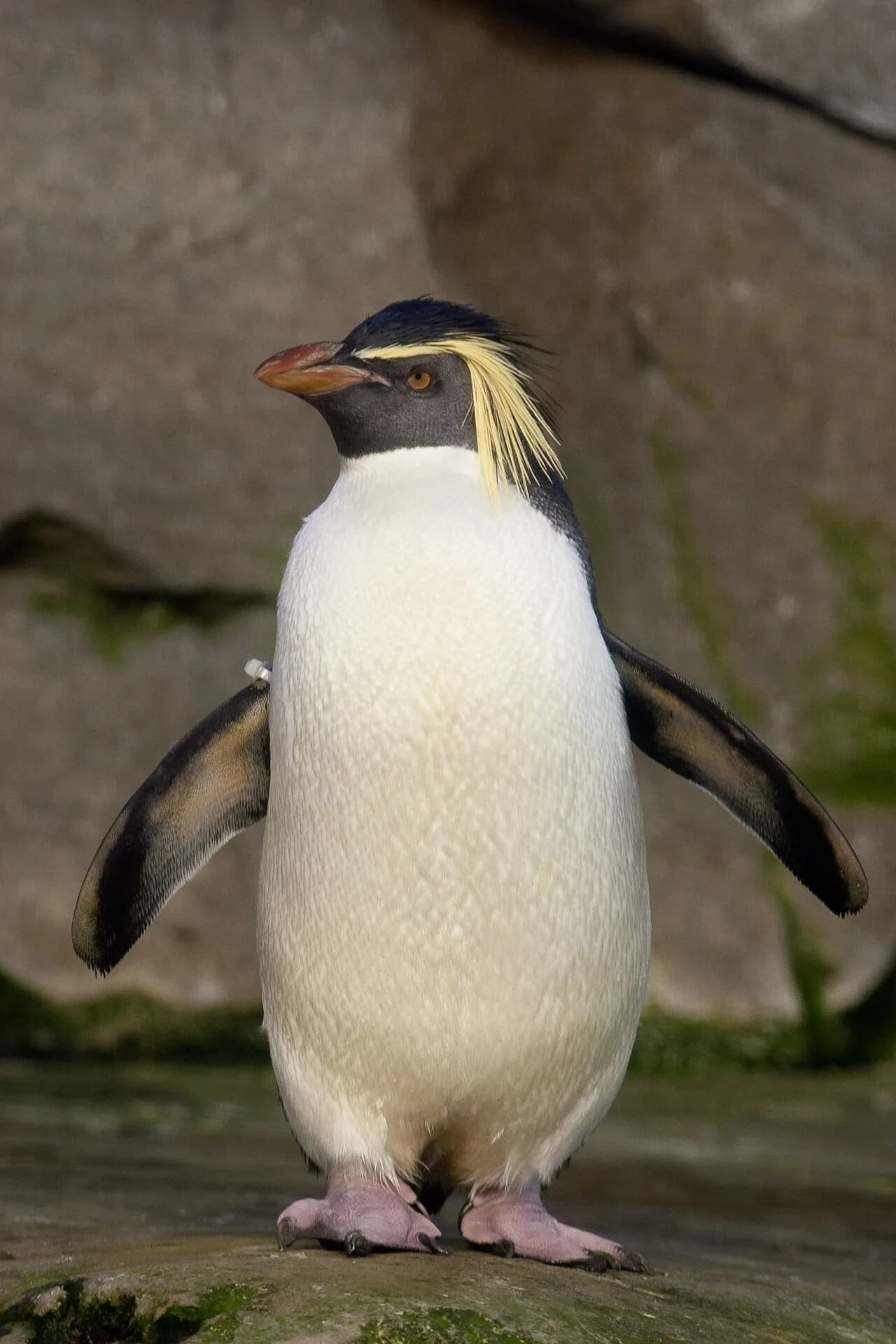
The Northern Rockhopper is the genuine outlier. It is the largest of the three, carries noticeably longer crest plumes, and holds roughly a seventh as many pairs as either southern species. It is the only one listed as Endangered.
What the hop actually buys
Hopping is a two-footed push. Both feet leave together, both land together, and the claws do the gripping. Against a walk, that trades control for commitment.
A walker crossing a boulder field has to find a viable placement for each foot in sequence, and every placement is a chance to slip. A hopper picks one target, commits both feet, and either sticks it or does not. Where the good surfaces are small, discontinuous, wet and often moving, halving the number of decisions is worth something. Hopping also delivers vertical displacement on demand, which a walking gait cannot.
That mechanical logic is coherent. It is also, as far as the published literature goes, unmeasured. Penguin locomotion energetics have been worked out on emperors, kings, Adélies and gentoos, on treadmills and force plates. Nobody has put a rockhopper on the equipment. The claim that hopping beats walking on broken rock is an inference from morphology and behaviour, not a number anyone has recorded.
The crest is probably a signal
The yellow in a crested penguin's plumes is not carotenoid or melanin, the pigments behind most bird ornaments. It is an unusual fluorescent compound currently thought to be a pterin — the class that colours butterflies and amphibians.5
The best data come from Snares Penguins, a close relative in the same Eudyptes genus. McGraw and colleagues sampled crest feathers in 2002 and 2003 and found that birds of both sexes grew yellower, more pigment-rich crests in 2002, the year they were in better body condition. Males with yellower crests tended to be larger, heavier and in better condition regardless of year. Females carried more pigment than males, reversing the usual bird pattern.6
That is a condition-dependent ornament in a crested penguin. Whether rockhoppers read it the same way, and what the northern bird's longer plumes are doing, has not been tested.
What Is Still Unclear
Whether hard access costs anything measurable
The interesting question is not whether the climb is difficult. It is whether the climb changes an outcome when food is already short — whether a colony perched 30 metres up a cliff loses more chicks in a lean year than one sitting ten metres above an easy landing. That comparison has not been made properly, in part because rockhopper colonies are almost all on difficult ground, which leaves very little to compare them against.
Whether the split is settled
A 2019 phylogeographic study using multilocus data from 114 individuals across 12 colonies still framed the southern birds as two subspecies of a single species rather than two species.7 Taxonomic authorities differ. Both readings rest on the same underlying data; this site follows the three-way treatment, and you will meet the two-species version elsewhere without either being wrong.
The declines, which nobody has fully explained
The most-quoted rockhopper statistic is wrong. Falklands counts from 1932/33 were long reported as more than three million breeding pairs, setting up a headline decline above 90 per cent. Pütz and colleagues re-examined those records in 2003 and concluded the original figure was substantially overestimated — probably nearer 1.5 million pairs — and revised the mid-1990s count from 297,000 down to about 263,000. The corrected decline between 1932 and 1995 still exceeded 80 per cent, at roughly 2.75 per cent a year.8 Smaller catastrophe, same catastrophe.
What happened next is less tidy. Archipelago-wide censuses in 2000 and 2005 recorded a further 30 per cent drop. The 2010 census then counted 319,163 pairs, a 51 per cent increase on 2005, which Baylis and colleagues attributed largely to improved vital rates and to fewer adults sitting the season out.9
Elsewhere the trend has not turned. Eastern rockhoppers at Campbell Island fell 94 per cent from the early 1940s, a decline Cunningham and Moors tied to rising sea surface temperature in 1994 and that a 1942–2012 reanalysis supported, noting that the warming hiatus of the 2000s paused the fall rather than reversing it.1011 Northern rockhoppers declined more than 90 per cent at both Gough Island and the main island of Tristan, over at least 45 and 130 years respectively; a three-generation decline above 50 per cent is what produced the Endangered listing. Middle Island held an estimated 100,000 pairs in 1973 and is now losing nesting space to recolonising subantarctic fur seals.12
Past sealing, oiling and introduced predators account for the older Tristan losses. They do not account for the sharp fall at Gough since the 1950s. Sea temperature accounts for much of Campbell. Nothing on the list accounts for the Falklands rebound.
The mechanism at the shoreline is understood. The trend line is not.
Whether colonies are as fixed as they look
A 2020 study described southern rockhoppers as a highly vagile seabird and modelled them as a metapopulation rather than a set of independent colonies.13 If birds move between sites more than the site-fidelity picture implies, some of what a regional census records as loss is redistribution instead. Separating the two is unfinished work, and it changes how every count above should be read.
Where To Go Next
Put the three profiles side by side — Western, Eastern and Northern — and the split stops being a taxonomic footnote. Then widen to the Eudyptes hub, where the same crest, the same steep coastlines and the same strange two-egg clutch keep recurring. For what happens after the climb, read Penguin Breeding and Chicks. For where the numbers stand now, the conservation tracker is the current record.
References
-
Pinshow, B., Fedak, M.A. & Schmidt-Nielsen, K. (1977). Terrestrial locomotion in penguins: it costs more to waddle. Science 195: 592–594. https://pubmed.ncbi.nlm.nih.gov/835018/ ↩
-
Griffin, T.M. & Kram, R. (2000). Penguin waddling is not wasteful. Nature 408: 929. https://doi.org/10.1038/35050167 ↩ ↩2
-
Katz, C. (2026). Rockhopper penguins' athleticism makes them the daredevils of the animal world. Will a warming climate slow them down?. Smithsonian Magazine, January–February 2026; republished by bioGraphic. https://www.biographic.com/can-rockhoppers-survive-the-next-leap/ ↩ ↩2 ↩3 ↩4
-
Banks, J., Van Buren, A., Cherel, Y. & Whitfield, J.B. (2006). Genetic evidence for three species of rockhopper penguins, Eudyptes chrysocome. Polar Biology 30: 61–67. https://doi.org/10.1007/s00300-006-0160-3 ↩
-
McGraw, K.J., Toomey, M.B., Nolan, P.M., Morehouse, N.I., Massaro, M. & Jouventin, P. (2007). A description of unique fluorescent yellow pigments in penguin feathers. Pigment Cell Research 20: 301–304. https://homepages.uc.edu/~morehonn/wp-content/uploads/2018/10/McGraw-KJ-et-al-2007-Pigm-Cell-Res.pdf ↩
-
McGraw, K.J., Massaro, M., Rivers, T.J. & Mattern, T. (2009). Annual, sexual, size- and condition-related variation in the colour and fluorescent pigment content of yellow crest-feathers in Snares Penguins (Eudyptes robustus). Emu 109: 93–99. https://doi.org/10.1071/MU08034 ↩
-
Mays, H.L. Jr et al. (2019). Phylogeography, population structure, and species delimitation in rockhopper penguins (Eudyptes chrysocome and Eudyptes moseleyi). Journal of Heredity 110: 801–817. https://pmc.ncbi.nlm.nih.gov/articles/PMC7967833/ ↩
-
Pütz, K., Clausen, A.P., Huin, N. & Croxall, J.P. (2003). Re-evaluation of historical rockhopper penguin population data in the Falkland Islands. Waterbirds 26: 169–175. https://nora.nerc.ac.uk/id/eprint/12944/ ↩
-
Baylis, A.M.M., Wolfaardt, A.C., Crofts, S., Pistorius, P.A. & Ratcliffe, N. (2013). Increasing trend in the number of Southern Rockhopper Penguins (Eudyptes c. chrysocome) breeding at the Falkland Islands. Polar Biology 36: 1007–1018. https://doi.org/10.1007/s00300-013-1324-6 ↩
-
Cunningham, D.M. & Moors, P.J. (1994). The decline of rockhopper penguins Eudyptes chrysocome at Campbell Island, Southern Ocean, and the influence of rising sea temperatures. Emu 94: 27–36. https://doi.org/10.1071/MU9940027 ↩
-
Morrison, K.W., Battley, P.F., Sagar, P.M. & Thompson, D.R. (2015). Population dynamics of Eastern Rockhopper Penguins on Campbell Island in relation to sea surface temperature 1942–2012: current warming hiatus pauses a long-term decline. Polar Biology 38: 163–177. https://doi.org/10.1007/s00300-014-1575-x ↩
-
Cuthbert, R. et al. (2009). Population trends and conservation status of the Northern Rockhopper Penguin Eudyptes moseleyi at Tristan da Cunha and Gough Island. Bird Conservation International 19: 109–120. https://doi.org/10.1017/S0959270908007545 ↩
-
Lois, N.A. et al. (2020). Metapopulation dynamics and foraging plasticity in a highly vagile seabird, the southern rockhopper penguin. Ecology and Evolution 10: 3346–3355. https://pmc.ncbi.nlm.nih.gov/articles/PMC7141044/ ↩